
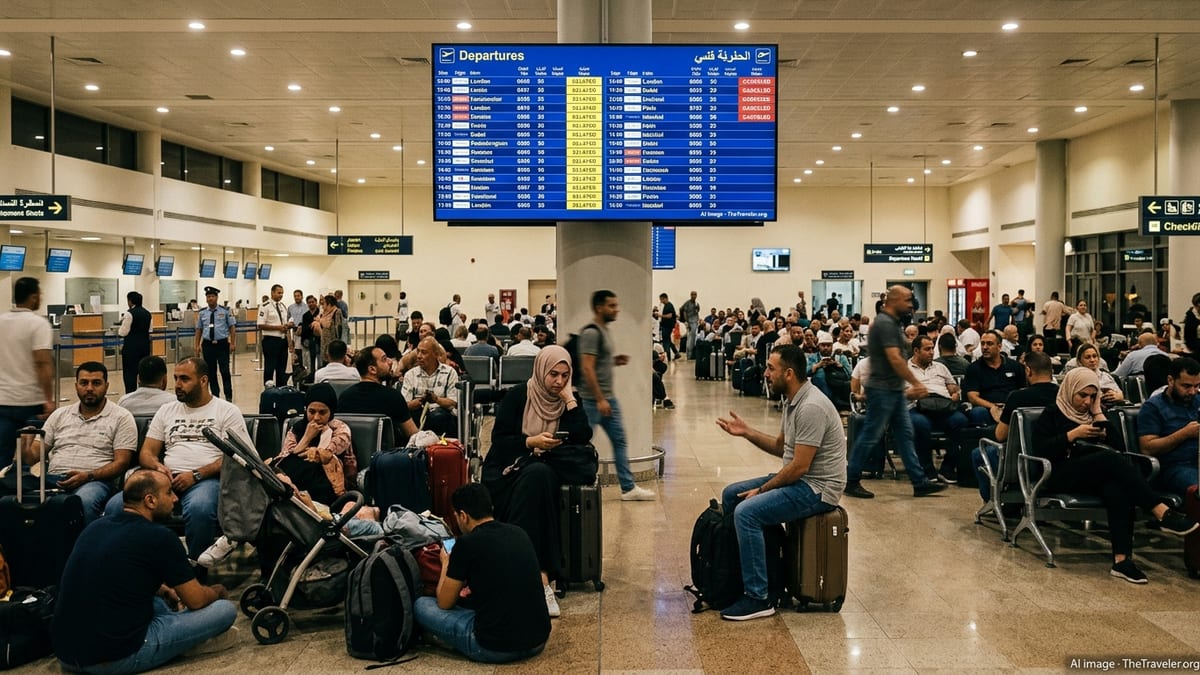
Forty-seven flights delayed and three cancelled in a single day — Queen Alia International Airport in Amman is dealing with one of its most disruptive operational periods in recent memory, leaving passengers from multiple continents stranded, rerouted, or scrambling for answers.
The disruption is hitting a wide range of carriers simultaneously. Royal Jordanian, Turkish Airlines, EgyptAir, Lufthansa, and Emirates are among the airlines affected, meaning the chaos is not isolated to one route or one region. Travelers heading to or arriving from Europe, the Middle East, and Asia are all caught in the fallout.
For a hub airport that serves as one of the primary gateways connecting the Arab world to international destinations, a disruption of this scale carries consequences far beyond a few missed connections.
(function(){var wrp=document.getElementById(“paap_stat_69c84abbe1d5a7.82304426”);if(!wrp)return;var ids=[“paap_stat_69c84abbe1d5a7.82304426_c0″,”paap_stat_69c84abbe1d5a7.82304426_c1”];var dur=1800;function ease(t){return 1-Math.pow(1-t,3);}function anim(){ids.forEach(function(id){var el=document.getElementById(id);if(!el)return;var tgt=parseFloat(el.getAttribute(“data-target”))||0;var pfx=el.getAttribute(“data-prefix”)||””;var sfx=el.getAttribute(“data-suffix”)||””;var dec=parseInt(el.getAttribute(“data-decimals”))||0;var st=null;function step(ts){if(!st)st=ts;var p=Math.min((ts-st)/dur,1);var v=ease(p)*tgt;el.textContent=pfx+v.toFixed(dec)+sfx;if(p<1)requestAnimationFrame(step);}requestAnimationFrame(step);});}if("IntersectionObserver" in window){var obs=new IntersectionObserver(function(e){e.forEach(function(en){if(en.isIntersecting){anim();obs.disconnect();}});},{threshold:0.2});obs.observe(wrp);}else{anim();}})();
What Is Happening at Queen Alia International Airport Right Now
Queen Alia International Airport, known by its IATA code AMM, is Jordan’s largest and busiest airport, located south of Amman. It serves as the primary hub for Royal Jordanian and handles millions of passengers annually traveling between the Middle East, Europe, Africa, and Asia.
The current disruption has resulted in 47 delayed flights and 3 outright cancellations. Both inbound and outbound passengers are affected, meaning the problem is not limited to one direction of travel. People trying to leave Jordan are waiting, and people trying to arrive are facing significant delays before their aircraft even depart from origin airports.
The scale of the disruption — nearly 50 flights impacted in a single operational period — points to a systemic issue rather than an isolated incident involving one airline or one route. When carriers as operationally diverse as Lufthansa, Emirates, and Turkish Airlines are all experiencing delays at the same airport simultaneously, the source of the problem sits with the airport’s operations rather than with any individual carrier.
Which Airlines and Routes Are Caught in the Disruption
The list of affected carriers covers some of the world’s most prominent airlines, each serving distinct passenger markets:
- Royal Jordanian — Jordan’s national carrier, with the heaviest operational presence at AMM
- Turkish Airlines — a major connector between the Middle East and Europe via Istanbul
- EgyptAir — serving routes between Jordan and Egypt, as well as onward connections through Cairo
- Lufthansa — connecting Amman to key German and European hubs
- Emirates — linking Jordan to Dubai and the wider Emirates global network
Routes to Europe, the Middle East, and Asia are all disrupted, which means passengers with connecting flights through Istanbul, Dubai, Cairo, or Frankfurt face a compounding problem: a delay out of Amman can cascade into a missed connection at a hub thousands of miles away.
| Airline | Primary Hub Connection | Regions Affected |
|---|---|---|
| Royal Jordanian | Amman (AMM) | Middle East, Europe, Asia |
| Turkish Airlines | Istanbul | Europe, Middle East, Asia |
| EgyptAir | Cairo | Middle East, Africa |
| Lufthansa | Frankfurt / Munich | Europe |
| Emirates | Dubai | Middle East, Asia, Global |
How This Affects Passengers on the Ground
If you are currently at Queen Alia International Airport or scheduled to fly through Amman today, the practical reality is straightforward and unpleasant: expect longer waiting times, reduced flight options, and limited information about when your flight will depart.
Passengers on cancelled flights — three so far — face the most difficult situation. Airlines are obligated to rebook affected travelers, but when the disruption is airport-wide rather than carrier-specific, available seats on alternative flights are quickly absorbed. That means some passengers could be waiting for hours or even until the following day.
For travelers with tight connections, the math gets worse quickly. A two-hour delay departing Amman can erase a 90-minute layover in Istanbul or Dubai, turning a single disruption into a full travel day lost. Business travelers, families with children, and anyone connecting to long-haul international flights are particularly exposed.
Jordan’s tourism sector is also watching closely. Queen Alia International Airport is the country’s front door for international visitors, and disruptions of this kind — particularly when they affect major European carriers like Lufthansa — can influence traveler confidence in ways that extend well beyond a single bad day at the airport.
What Travelers Should Do While the Situation Unfolds
The disruption is active, which means the situation can shift. Passengers scheduled to fly through Amman in the coming hours should check their airline’s app or website for real-time status updates before heading to the airport. Arriving early will not resolve a ground delay, but it does give you more time to speak with airline staff if your flight status changes.
Those on cancelled flights have clear rights: airlines are required to rebook you on the next available service or, in some cases, offer a refund. Documenting your delay — keeping boarding passes, delay notifications, and any communication from the airline — is always worth doing if you plan to claim compensation or reimbursement for expenses incurred.
Passengers transiting through Amman from a third country should also notify their airline of the situation proactively, as some carriers will protect onward bookings if a delay is flagged in advance rather than after a missed connection.
The broader picture will become clearer as airport operations either stabilize or the disruption extends further into the day. Travelers with flexibility in their schedules may want to consider whether rebooking to a later departure date is a practical option given the current congestion at the airport.
Frequently Asked Questions
How many flights have been affected at Queen Alia International Airport?
A total of 47 flights have been delayed and 3 flights have been cancelled as of the current disruption period.
Which airlines are experiencing delays at Amman airport?
Royal Jordanian, Turkish Airlines, EgyptAir, Lufthansa, and Emirates are among the confirmed affected carriers.
Are both arriving and departing flights affected?
Yes — the disruption is affecting both inbound and outbound passengers at Queen Alia International Airport.
What routes are disrupted by the Amman airport delays?
Flights to and from Europe, the Middle East, and Asia are all affected, given the range of international carriers involved.
What caused the delays and cancellations at Queen Alia Airport?
The specific cause of the disruption has not been confirmed in available reports at this time.
What should passengers on cancelled flights do?
Passengers should contact their airline directly as soon as possible to request rebooking on the next available service, as alternative seats are likely to fill quickly during a widespread disruption.




Leave a Reply