
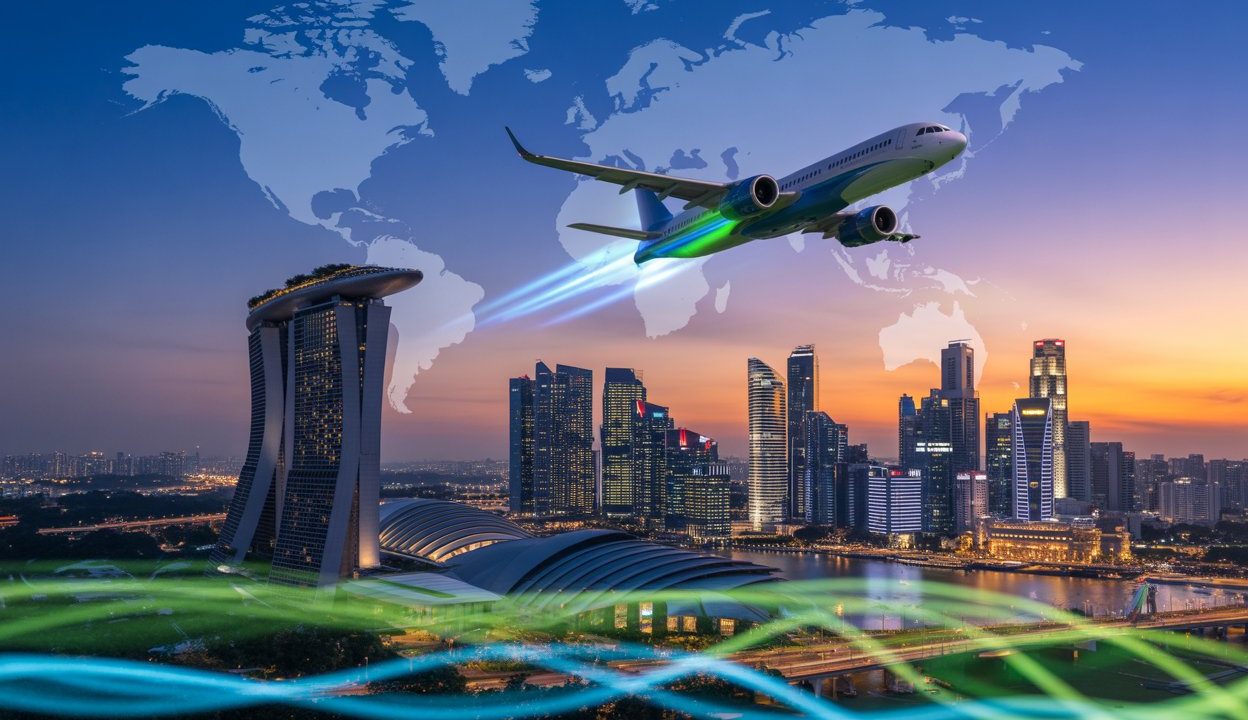
Singapore has made a deliberate choice to put its aviation decarbonisation timeline on hold — and geopolitics is the reason why. The Civil Aviation Authority of Singapore has postponed the rollout of its sustainable aviation fuel (SAF) levy, pushing implementation to 2027, citing the destabilising effect of ongoing Middle East conflict on global aviation economics.
The decision is not a retreat from climate commitments. Officials have framed it as a sequencing adjustment — a recognition that piling additional costs onto airlines already absorbing volatile fuel prices and uneven passenger demand recovery could do more harm than good right now. Sustainability goals remain on the agenda, just not on the original schedule.
For travellers, airlines, and anyone watching how major aviation hubs balance environmental policy with economic reality, this is a story worth following closely.
Why Singapore Pulled Back on the SAF Levy Now
The SAF levy was designed to accelerate the aviation sector’s shift away from conventional jet fuel by making sustainable alternatives more financially viable. Under the original plan, airlines operating through Singapore would face a charge tied to their fuel uplift, with the revenue intended to support SAF adoption across the region.
But the Middle East conflict has introduced a layer of turbulence that policymakers could not ignore. Fuel prices have remained highly volatile, and airlines have been absorbing elevated operational costs for an extended period. Layering a new levy on top of those pressures risked pushing ticket prices higher at a moment when passenger demand is still sensitive to fare increases.
The Civil Aviation Authority of Singapore acted to prevent that from happening. The move reflects a broader principle: that economic resilience and environmental ambition are not always compatible at the same pace, and that forcing both simultaneously can undermine both.
Officials have noted that the decision demonstrates policy flexibility rather than policy failure. The goal is still decarbonisation — the path to it is simply being recalibrated.
What the Delay Actually Means — Key Details
Several factors came together to drive this decision. Here is what is confirmed:
- The SAF levy rollout has been formally postponed to 2027
- Singapore has also revised its fuel uplift target as part of the same policy reset
- The Civil Aviation Authority of Singapore led the decision-making process
- The stated rationale includes protecting airlines from compounding cost pressures
- Passenger fare sensitivity was identified as a key concern in the timing assessment
- Long-term decarbonisation goals have not been abandoned — only the immediate timeline has shifted
| Policy Element | Original Plan | Revised Position |
|---|---|---|
| SAF Levy Rollout | Earlier implementation timeline | Delayed to 2027 |
| Fuel Uplift Target | Original target in place | Revised downward |
| Decarbonisation Goals | Active pursuit | Maintained, re-sequenced |
| Primary Driver of Change | N/A | Middle East geopolitical instability |
Who Feels This — and How
The most immediate beneficiaries of this delay are the airlines themselves. Carriers operating through Singapore’s Changi Airport have been managing elevated costs for an extended stretch, and the postponement removes one more financial variable from an already complicated operating environment.
For passengers, the practical effect is that ticket prices will not face an additional SAF-related surcharge in the near term. That matters in a market where travellers are already navigating higher fares driven by fuel costs and post-pandemic demand patterns.
Longer term, the delay also has implications for Singapore’s positioning as a sustainable aviation hub. The city-state has invested significantly in its reputation as a forward-thinking aviation centre. Postponing the levy is a pragmatic concession — but it does create a window during which competitors could move faster on SAF mandates and claim that positioning instead.
Environmental advocates will likely view the delay with concern. Every year that SAF adoption is not financially incentivised through policy is a year the industry remains more dependent on conventional jet fuel. The argument from Singapore’s side is that a policy introduced at the wrong moment — when airlines are under maximum stress — is a policy that risks being resented, circumvented, or reversed.
What Happens Next for Singapore’s Aviation Strategy
With 2027 now set as the revised target for the SAF levy, the Civil Aviation Authority of Singapore has roughly two years to monitor global aviation conditions and prepare the industry for implementation. That window gives airlines time to plan, and gives policymakers room to refine the levy structure based on how the geopolitical and economic landscape evolves.
The revised fuel uplift target will also need to be worked through in detail. Adjusting that figure is not a trivial change — it affects how much SAF airlines are expected to blend into their fuel supply, which in turn affects the economics of SAF producers and suppliers operating in the region.
What Singapore does between now and 2027 will signal how serious it is about re-engaging with the original ambition. If the delay becomes a rolling deferral, it will be read very differently than if the intervening period is used to build stronger foundations for the policy’s eventual launch.
For now, the message from Singapore is clear: the destination has not changed, but the departure has been pushed back.
Frequently Asked Questions
Why has Singapore delayed its SAF levy?
Singapore postponed the SAF levy rollout to 2027 due to geopolitical instability in the Middle East, which has driven up airline operating costs and made passenger demand more sensitive to additional fare increases.
When will the SAF levy now come into effect?
The Civil Aviation Authority of Singapore has set 2027 as the revised implementation target for the SAF levy.
Has Singapore abandoned its sustainability goals?
No. Officials have stated that long-term decarbonisation goals remain in place — the delay is described as a re-sequencing of the timeline, not a reversal of policy direction.
What else changed alongside the levy delay?
Singapore also revised its fuel uplift target as part of the same broader aviation strategy reset driven by current global conditions.
How does this affect airline ticket prices?
In the short term, passengers will not face a SAF-related surcharge, which removes one potential source of upward pressure on airfares through Singapore.
Which authority made this decision?
The Civil Aviation Authority of Singapore led the decision to postpone the levy and revise the fuel uplift target.


Leave a Reply