
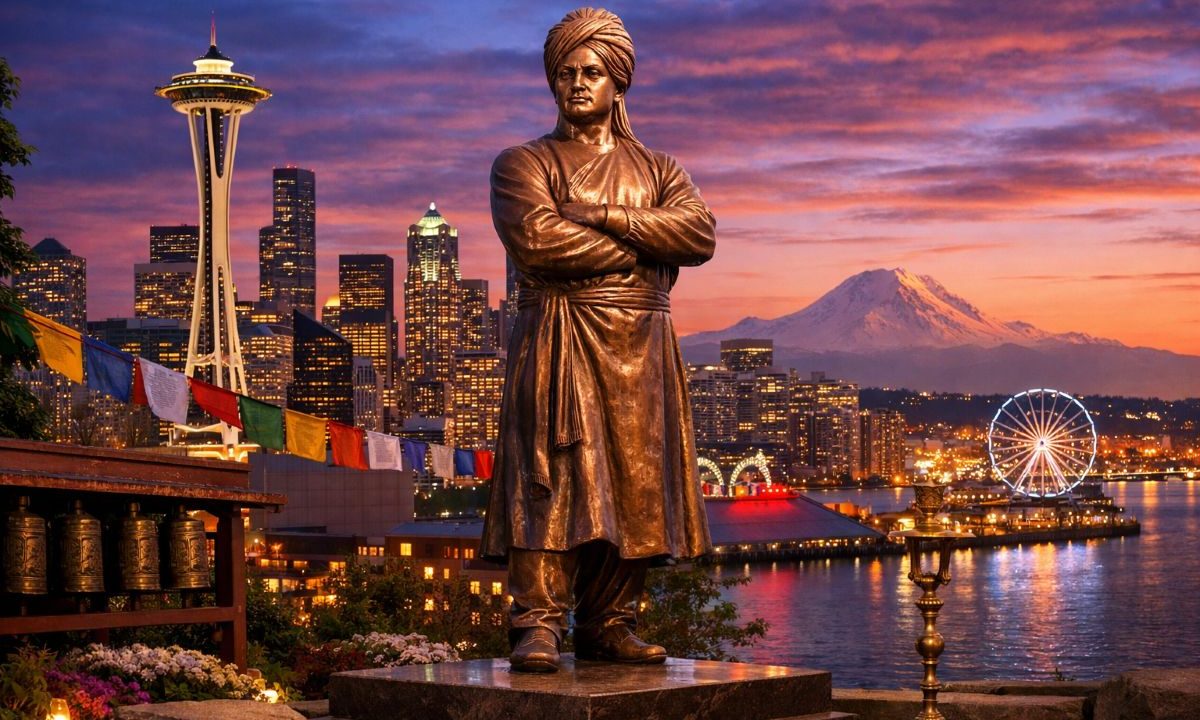
For the first time in United States history, a civic statue of Swami Vivekananda now stands on American soil — and it’s in the heart of downtown Seattle.
The life-size bronze monument was unveiled at Westlake Square, one of Seattle’s busiest and most recognizable public gathering spaces. The installation marks a genuine milestone: no other city in the country has placed a civic statue of the 19th-century Indian spiritual philosopher in a prominent public setting like this. From the moment it went up, the monument began drawing visitors, historians, and international observers curious to see it in person.
This isn’t just a local story. The statue’s arrival at Westlake Square has reframed how people think about Seattle as a destination — not only a tech hub or a gateway to the Pacific Northwest, but a city where global heritage and cultural diplomacy have a visible, physical home.
Why Seattle and Why Now
Swami Vivekananda is one of the most consequential figures in the history of Eastern philosophy reaching Western audiences. His 1893 address at the Parliament of the World’s Religions in Chicago — where he opened with the words “Sisters and Brothers of America” — is widely regarded as a turning point in how the West engaged with Hindu thought and Indian spiritual tradition. He remains a towering figure in India and among diaspora communities worldwide.
Seattle’s decision to place his statue in such a prominent civic location — not tucked inside a temple or cultural center, but out in the open at Westlake Square — signals something deliberate. The city is staking a claim as a place where diverse global heritages are honored in the same spaces where everyday civic life happens.
The timing also reflects the growing size and influence of Seattle’s South Asian community, which has expanded significantly alongside the region’s technology industry. Advocates of the installation have long pointed to the need for public monuments that reflect the full range of cultural contributions shaping American life.
What the Westlake Square Installation Actually Represents
Westlake Square sits at the center of Seattle’s downtown retail and transit corridor. It is not a peripheral or ceremonial location — it is a place where tens of thousands of people pass through on any given day. Placing the statue there, rather than in a park or private institution, was a conscious choice that gives the monument genuine civic weight.
The bronze statue is described as life-size, which means it engages visitors at human scale rather than looming above them. That design choice tends to invite closer interaction — people stop, read the inscription, take photographs, and linger in a way that larger-than-life monuments sometimes don’t encourage.
| Detail | Information |
|---|---|
| Location | Westlake Square, downtown Seattle |
| Type of installation | Life-size bronze statue |
| Subject | Swami Vivekananda, 19th-century Indian spiritual philosopher |
| Historical significance | First civic statue of Swami Vivekananda in the United States |
| Setting | One of Seattle’s busiest public gathering points |
The Cultural Tourism Angle Most People Are Missing
Beyond the symbolism, there’s a practical tourism dimension to this story that deserves attention. Public monuments — especially those tied to global cultural figures — have a documented track record of drawing visitors who make a specific trip to see them. Think of the way certain statues and memorials anchor entire neighborhoods as destinations.
Westlake Square now has a new anchor. International visitors from India, the broader South Asian diaspora, and anyone interested in the history of Eastern philosophy now have a specific reason to visit downtown Seattle that didn’t exist before. That’s not a small thing for a city that competes for tourism dollars with San Francisco, Portland, and Vancouver.
Supporters of the installation argue that cultural landmarks of this kind also create ripple effects — nearby restaurants, cultural events, and guided tours tend to benefit when a new permanent attraction draws foot traffic to a location.
- The statue is the first of its kind in any American city in a civic public setting
- Its placement at Westlake Square gives it maximum visibility in Seattle’s daily life
- The monument adds a new cultural tourism draw to downtown Seattle’s existing attractions
- It reflects the growing role of South Asian heritage in shaping Pacific Northwest identity
- The installation positions Seattle as a city that honors global philosophical and spiritual traditions in shared public space
What This Means for Seattle’s Global Identity Going Forward
Seattle has long positioned itself as an international city — home to major global corporations, a diverse population, and a port that connects the American Pacific coast to Asia. But cultural infrastructure often lags behind economic reality. Public monuments tell a story about who a city thinks matters, whose contributions are worth memorializing in stone and bronze.
This statue makes a statement that goes beyond any single community. It says that Seattle’s public spaces belong to a broad, global heritage — and that a monk who spoke about universal brotherhood at a world parliament in 1893 is someone worth honoring in 2026.
Whether other American cities follow Seattle’s lead remains to be seen. But the fact that it happened here first — in the Pacific Northwest, at a downtown square where anyone walking by can encounter it — feels fitting for a city that has always sat at the crossroads of East and West.
Frequently Asked Questions
Where exactly is the Swami Vivekananda statue located in Seattle?
The life-size bronze statue is installed at Westlake Square in downtown Seattle, described as one of the city’s busiest public gathering points.
Is this the first statue of Swami Vivekananda in the United States?
It is confirmed to be the first civic statue of Swami Vivekananda installed in a public civic setting anywhere in the United States.
Who was Swami Vivekananda?
Swami Vivekananda was a 19th-century Indian spiritual philosopher widely known for introducing Hindu philosophy to Western audiences, most famously through his 1893 speech at the Parliament of the World’s Religions in Chicago.
Why was Westlake Square chosen as the location?
The source confirms Westlake Square is one of Seattle’s busiest public gathering points, suggesting the location was chosen for maximum civic visibility rather than a more secluded setting.
Will the statue draw international tourists to Seattle?
Observers note the monument has already drawn attention from international visitors and cultural historians, and it is described as having instantly transformed Westlake Square into a new cultural tourism landmark.
Are other U.S. cities planning similar installations?
This has not yet been confirmed based on available information — Seattle’s installation is currently noted as a first of its kind in the country.


Leave a Reply