

The world’s flight maps are being redrawn — and if you’re planning international travel in 2026, the routes you relied on even a year ago may look very different today.
A deepening crisis centered on the Persian Gulf is reshaping how airlines connect continents. Escalating fuel costs and restricted airspaces tied to the 2026 Gulf crisis have made the traditional Middle Eastern hub model increasingly difficult to sustain. The result is a fundamental shift in how travelers move between the West and Asia — one that analysts and industry observers are calling a structural change, not a temporary detour.
At the same time, something unexpected is happening: the disruption is fueling a powerful resurgence in Asian tourism, with a new set of regional hubs stepping in to fill the gap left by the Gulf’s diminished role.
How the 2026 Gulf Crisis Is Redrawing Long-Haul Routes
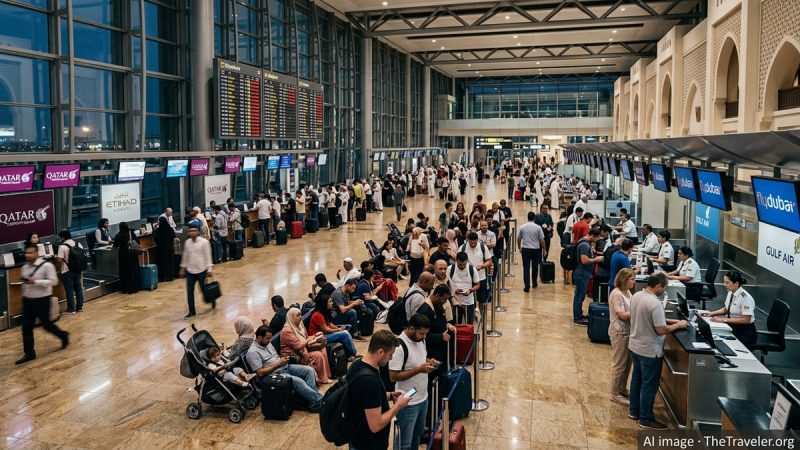
For decades, airports in the Persian Gulf served as the connective tissue of global aviation. Millions of passengers traveling between North America, Europe, Australia, and Asia passed through these mega-hubs every year. That model depended on stable fuel costs, open airspace, and reliable transit conditions — conditions that the 2026 Gulf crisis has significantly disrupted.
With fuel costs rising and certain airspaces becoming restricted or impractical to use, airlines operating long-haul routes out of countries like Canada and Australia are being forced to reconsider their network strategies. The traditional arc through the Gulf is no longer the automatic choice it once was.
What’s emerging in its place is a reorientation toward Asia. Destinations including Indonesia, China, and Japan are increasingly becoming the focus of long-haul routing strategies, while South Korea, Sri Lanka, and Thailand are positioning themselves as primary transit gateways for the modern traveler.
The New Gateway Countries Travelers Need to Know
The shift isn’t happening in a vacuum. Three countries in particular are emerging as the new connective hubs of international travel as the aviation industry’s center of gravity tilts eastward.
- South Korea — Already home to one of Asia’s most efficient hub airports, South Korea is well-positioned to absorb increased transit traffic as Gulf routes become less viable.
- Sri Lanka — Geographically situated between major East-West travel corridors, Sri Lanka is being recognized as a strategic stopover point for routes connecting Australia and Canada to Southeast and East Asia.
- Thailand — A long-established tourism powerhouse, Thailand is now also gaining recognition as a regional aviation gateway, not just a destination.
Meanwhile, the destinations drawing the most traveler interest in this new landscape are Indonesia, China, and Japan — markets that are seeing renewed attention as both endpoints and waypoints in restructured itineraries.
What This Means for Travelers From Canada and Australia
Passengers departing from Canada and Australia are arguably the most directly affected by this transition. Both countries have historically relied on Persian Gulf hubs as the most efficient way to connect to Asia and beyond. That calculus is now changing.
| Traveler Origin | Traditional Route Hub | Emerging Alternative Hubs | Key Destinations Gaining Focus |
|---|---|---|---|
| Canada | Persian Gulf (e.g., Dubai, Doha) | South Korea, Thailand, Sri Lanka | Japan, Indonesia, China |
| Australia | Persian Gulf (e.g., Dubai, Abu Dhabi) | South Korea, Thailand, Sri Lanka | Japan, Indonesia, China |
For travelers, this transition carries both challenges and opportunities. Flight times and layover locations may change significantly. Ticket pricing structures could shift as airlines renegotiate partnerships and codeshare agreements through new hub cities. And the overall travel experience — including lounge access, connection times, and baggage policies — may look different depending on which new gateway a passenger transits through.
Practically speaking, travelers are advised to check current routing options more carefully than they might have in previous years. Assuming that the cheapest or fastest route still runs through the Gulf could mean missing better alternatives that have emerged through Asian carriers and their growing hub networks.
Why Regional Travel Is Becoming the New Standard
The broader trend underlying this specific crisis is one that aviation analysts have been tracking for some time: the rise of regional connectivity within Asia as a complement — and increasingly, an alternative — to long-haul hub-and-spoke models.
As more travelers prioritize safety, efficiency, and cost-effectiveness, shorter regional hops through well-connected Asian airports are becoming more attractive. The Gulf crisis has accelerated a shift that was already underway, pushing airlines to invest in routes and partnerships that reduce dependence on any single geographic corridor.
This is not simply a story about crisis management. It’s a story about where global aviation is headed — toward a more distributed, regionally anchored network where Asia plays a central role rather than a secondary one.
For tourists, the practical upside is real: more direct or near-direct routing options through vibrant Asian cities, greater exposure to regional carriers known for strong service standards, and the chance to discover transit hubs that are destinations in their own right.
What Comes Next for International Aviation
The 2026 Gulf crisis shows no immediate signs of resolution, which means the pressure on traditional long-haul routes is likely to persist throughout the year and potentially beyond. Airlines are already making network decisions based on the assumption that Gulf airspace restrictions and fuel cost pressures will remain factors for the foreseeable future.
For South Korea, Sri Lanka, and Thailand, this moment represents a significant opportunity to cement their roles as indispensable nodes in the global aviation network. Airports and tourism boards in these countries are watching closely — and in many cases, actively preparing to handle increased passenger volumes.
For travelers, the single most important takeaway is flexibility. The long-haul routes you’ve booked before, the hubs you’ve transited through, and the airlines you’ve defaulted to may all be worth reconsidering. The map is changing, and the travelers who adapt earliest will likely find the best options.
Frequently Asked Questions
What is causing the shift away from Gulf aviation hubs in 2026?
The 2026 Gulf crisis has led to escalating fuel costs and restricted airspaces, making traditional Persian Gulf transit routes less practical and more expensive for airlines and travelers.
Which countries are emerging as the new transit hubs?
South Korea, Sri Lanka, and Thailand are identified as the primary emerging gateways replacing Gulf hubs for international travelers.
Which destinations are seeing increased travel interest as a result of this shift?
Indonesia, China, and Japan are among the key destinations gaining greater focus as long-haul routes are restructured away from Gulf corridors.
Are travelers from Canada and Australia the most affected?
Yes, travelers from Canada and Australia are among the most directly impacted, as both countries have historically depended heavily on Persian Gulf hubs to connect to Asian destinations.
Is this change temporary or permanent?
Observers describe this as a strategic pivot rather than a temporary detour, suggesting the shift toward Asian hubs and regional connectivity reflects a longer-term structural change in global aviation.
What should travelers do differently when booking flights right now?
Travelers are advised to actively compare routing options through emerging Asian hubs rather than defaulting to Gulf connections, as new alternatives through South Korea, Sri Lanka, and Thailand may offer better efficiency and value.



Leave a Reply