
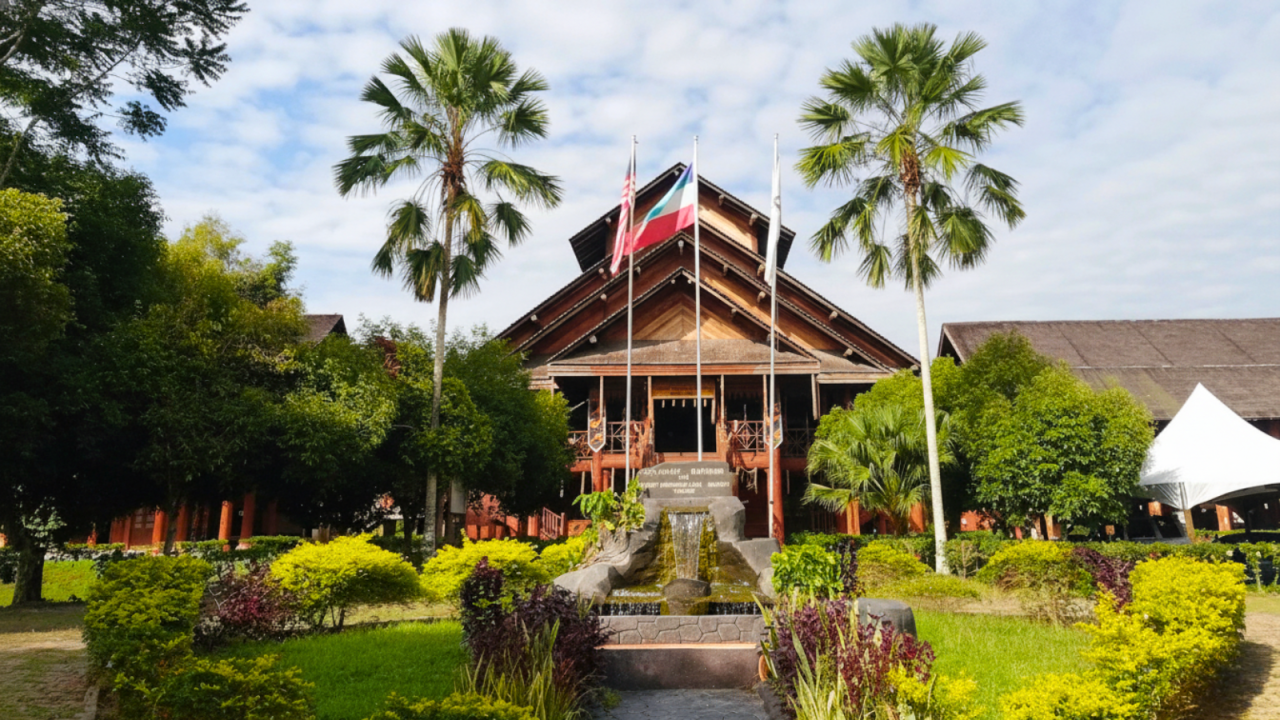
What would you do if the last living proof of your ancestors’ existence sat inside a building built for strangers to photograph?
That question hangs over Tenom, a quiet district tucked into the interior of Sabah, Malaysian Borneo. A new Murut Cultural Centre has opened there, drawing visitors with promises of immersive indigenous heritage. Its anchor attraction is a Skull House, a structure that once served as a sacred repository of enemy skulls collected during headhunting raids. Alongside it stand traditional grave huts, ceremonial artifacts, and displays of Murut craft traditions that stretch back centuries.
The centre is impressive. It is also deeply controversial. And the debate it has sparked cuts to the heart of how the modern world treats indigenous culture.
The Cultural Centre Debate: Authentic Preservation or Packaged Identity?
The Murut are one of Sabah’s largest indigenous groups, known historically as skilled forest hunters and farmers of hill rice and tapioca. Their name, in some dialects, simply means “people of the hills.” For generations, their identity was inseparable from the land, from ritual, and from a cosmology that included ancestor veneration and, yes, headhunting as a rite of warfare and spiritual power.
The practice of headhunting ended long ago under colonial and missionary pressure. But the Skull House remained, a physical relic of a belief system that viewed the skulls of vanquished enemies as sources of protective spiritual energy for the community.
Now that relic is a tourist attraction. Whether that is a triumph of cultural survival or a subtle erasure of what made it sacred is the debate Tenom cannot escape.
The Case for Tenom’s Murut Centre as a Heritage Lifeline
Supporters of the Murut Cultural Centre argue that without institutional preservation, Murut traditions would vanish quietly, not with protest but with the death of elders and the migration of youth to cities.
That argument is not abstract. Across Sabah, minority indigenous languages are disappearing. Young Murut men and women are leaving hill communities for Kota Kinabalu, Tawau, and beyond. The crafts, the oral histories, the ritual knowledge — all of it travels with the old and rarely returns with the young.
A dedicated cultural centre changes that calculus. It creates a physical anchor for identity. It gives younger community members a reason to learn traditional weaving, music, and oral storytelling because those skills now have an audience and an economic context. It also generates income for Murut artisans and performers who might otherwise have no local livelihood tied to their heritage.
“The village helps preserve fading traditions and showcases the soul of Borneo.”
— CLL Adventure Borneo, on cultural heritage sites in Sabah
Cultural centres also create documentation. When elders perform rituals for visitors, those performances are recorded. When craftspeople demonstrate techniques, those methods get archived. Even imperfect preservation leaves something behind for future generations to study and revive.
The Skull House, within this argument, is not a morbid curiosity. It is evidence. It tells a story about a people who believed that power could be transferred through the physical remains of enemies, that protection of the community required spiritual negotiation with forces most modernity has forgotten. Displaying it says: this happened, this was real, these people had a complex metaphysical world.
Why Critics Say Cultural Centres Risk Hollowing Out Living Traditions
The opposing view is harder to dismiss. Critics of cultural tourism projects across Southeast Asia point to a pattern: when indigenous traditions are institutionalized for visitor consumption, they freeze at the moment of display.
A ritual performed for a bus tour is no longer a ritual. It is a demonstration. The spiritual weight that gave it meaning drains away the moment it becomes scheduled, ticketed, and photographed. What remains looks like the original but functions as something else entirely: entertainment with historical branding.
The Skull House problem is acute. In its original context, the structure was not a museum piece. Access to it was governed by spiritual protocol. The skulls inside were addressed, honored, and occasionally appeased through ceremony. Moving that object into a visitor context, no matter how respectfully curated, severs it from the living belief system that gave it power.
There is also the question of who controls the narrative. Cultural centres are typically funded and administered by government tourism bodies, not exclusively by the communities they represent. That means decisions about what gets displayed, how it is framed, and which elements get emphasized for commercial appeal may not always reflect the preferences of Murut elders or community members.
When culture becomes content, someone else usually holds the editorial pen.
What the Evidence from Similar Indigenous Heritage Sites Actually Shows
The empirical record on indigenous cultural tourism is genuinely mixed, which makes the Tenom debate harder to resolve cleanly.
Comparable projects across Sabah offer useful data points. The Mari-Mari Cultural Village near Kota Kinabalu, which showcases five of Sabah’s indigenous groups including the Murut, has become one of the state’s most visited cultural attractions. Visitors describe it as immersive, educational, and emotionally affecting. Community participants earn regular income. Traditional craft skills are practiced and transmitted.
But anthropologists who study similar projects elsewhere in Borneo consistently note a compression effect: rich, regionally diverse traditions get flattened into representative performances selected for dramatic appeal and tourist comprehension. The full complexity of a living culture rarely survives the editing process required to fill a two-hour tour slot.
| Approach | Benefit | Risk |
|---|---|---|
| Government-run cultural centre | Stable funding, broad reach | Community voice may be diluted |
| Community-led heritage village | Authentic control, local benefit | Funding fragility, limited scale |
| Hybrid model with elder oversight | Balances reach with authenticity | Requires sustained negotiation |
| No preservation effort | Culture remains purely internal | Tradition lost within generations |
Research on indigenous tourism in Malaysia also shows that economic participation does not automatically translate to cultural control. Communities can benefit financially while still losing authorship of how their identity is represented to the outside world.
The best outcomes, from projects in New Zealand, Canada, and parts of Scandinavia, share one feature: indigenous community members hold decision-making power over what is displayed, what is withheld, and how sacred elements are contextualized. The Tenom centre’s long-term success may depend on whether that principle is built into its governance.
Tenom’s Centre Deserves Cautious Optimism, With Conditions Attached
The editorial position here is not cynicism and not uncritical celebration. The Murut Cultural Centre in Tenom represents a real effort to do something difficult: keep a culture visible in a world that routinely renders indigenous communities invisible until they are gone.
The Skull House is not reducible to shock value. It is a window into a cosmology that modern visitors are genuinely unlikely to encounter anywhere else. The grave huts, the artifacts, the performance of Murut music and weaving — all of it matters because the Murut themselves matter. Their continued existence as a distinct cultural community is not a tourism asset. It is a human reality that deserves respect and support.
But respect requires honesty about the risks. Preservation through display is always a compromise. The question is whether the compromise is struck on terms the Murut community helped negotiate, or terms imposed from outside with their faces on the brochure.
If Sabah’s tourism authorities are serious about this centre as heritage preservation rather than heritage harvesting, the proof will be in governance: Murut elders on advisory boards, community members in curatorial roles, and clear boundaries around what aspects of their spiritual life are not for sale.
What the Tenom Debate Means for Indigenous Tourism Across Borneo
Tenom is not an isolated case. Across Malaysian and Indonesian Borneo, dozens of indigenous groups face the same crossroads. The Kadazan-Dusun, the Iban, the Penan, the Bidayuh — all have traditions under pressure from modernization, from land development, from the simple arithmetic of elders dying faster than knowledge is transferred.
Cultural centres like the one in Tenom will multiply. The model is politically convenient, economically appealing, and genuinely useful when done well. The precedents set in Tenom, about how much community control is built into the structure, will ripple outward.
Travelers have a role too. The visitor who arrives in Tenom asking thoughtful questions, buying directly from Murut artisans, and treating the Skull House with the gravity it deserves is a different economic and cultural signal than the visitor who snaps a photo and moves on.
The soul of Borneo is not a destination. It is a relationship — and relationships require something from both sides.

Leave a Reply