
▶ Read transcript
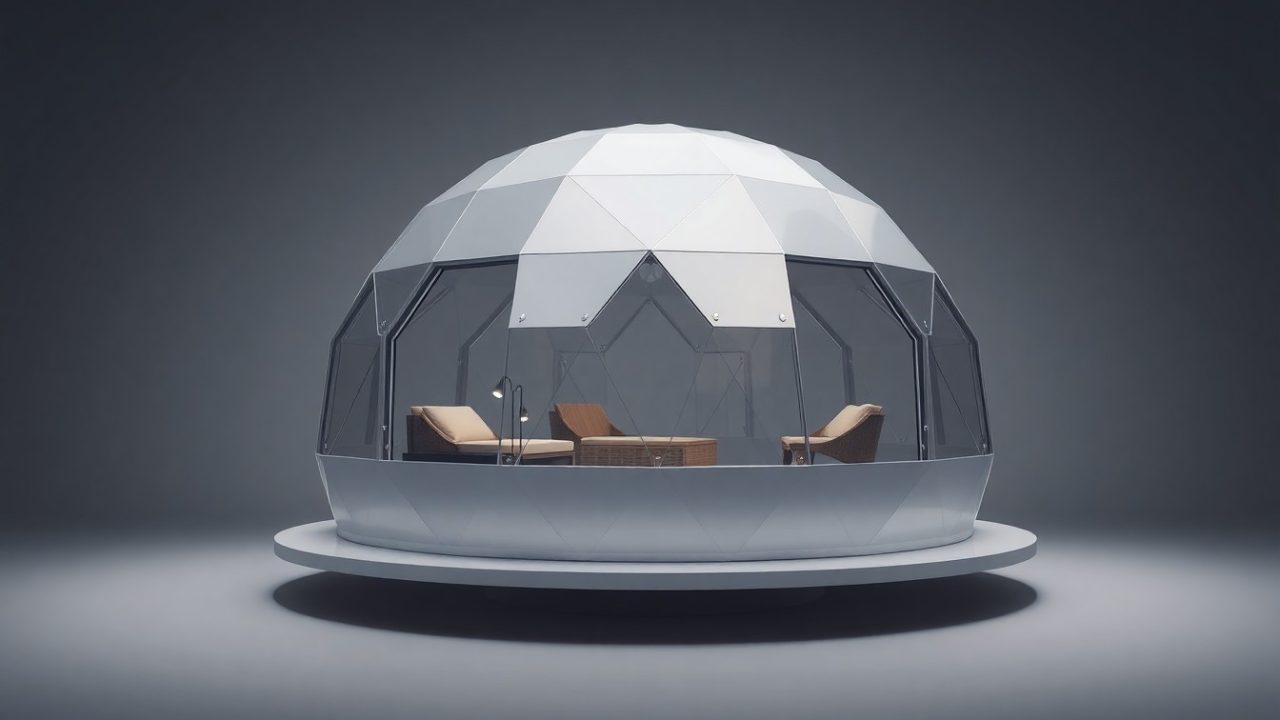
Here’s what you need to know about the booming business of sleeping under the stars. Luxury travel is undergoing a serious shift, and geodesic dome accommodations are at the center of it. The global travel experience sector is currently worth 271 billion dollars and is projected to hit 342 billion by 2029, with dome resorts sitting right in the fastest-growing slice of that market. What’s driving this isn’t just wanderlust — it’s a fundamental change in what wealthy travelers actually want. They’re choosing immersive, shareable experiences over marble lobbies and thread counts. From an investment standpoint, dome resorts also have a real operational edge. They can be built in weeks, scaled incrementally, and placed in remote locations traditional hotels simply can’t reach. Glamping dome listings on platforms like Airbnb are expected to surge in 2026 specifically. So if you’re curious about this space, now is the time to start paying attention before that wave fully crests.
Here’s a claim that will annoy every boutique hotel designer working today: the most coveted room in luxury travel right now has no walls, no minibar, and was assembled in a field. It’s a dome. And it’s winning.
The assumption has long been that luxury means permanence. Marble lobbies. Concierge desks. Thread counts discussed in hushed, reverent tones. But a fast-moving shift in traveler psychology is dismantling that logic entirely. The wealthiest, most experience-hungry travelers on earth are increasingly choosing to sleep inside a geodesic bubble in the desert over a five-star suite in the city.
This isn’t a fringe movement. It’s a restructuring of what premium hospitality means in the 2020s.
The $342 Billion Experience Economy Driving Dome Demand
To understand why dome resorts are exploding, you have to understand the broader economic current they’re riding. The global travel experience sector reached $271 billion in 2025 and is projected to climb to $342 billion by 2029. That’s not hotel revenue. That’s the specific slice of travel spending dedicated to doing something memorable, something that can’t be replicated at home or described in a TripAdvisor star rating.
Dome accommodations sit squarely at the intersection of that demand. They’re categorized as experience-driven stays, a designation that carries real commercial weight. Resorts investing in geodesic dome structures are tapping into the fastest-growing segment of the entire travel industry.
The timing matters. Glamping dome listings on platforms like Airbnb are poised for strong growth in 2026 specifically, as travel preferences continue shifting toward unique and immersive experiences. Resorts that move now are positioning themselves at the front of a wave that’s still building.
What Dome Resorts Actually Offer That Hotels Cannot
The case for dome investment isn’t purely philosophical. There are hard operational advantages that traditional hotel construction simply cannot match.
Geodesic dome structures are described across the hospitality industry as uniquely durable and weather-resilient. Their geometry distributes stress evenly across the entire surface, making them far more resistant to wind, snow load, and temperature extremes than conventional buildings. For resort operators eyeing remote or dramatic landscapes, that’s not a small thing.
| Feature | Traditional Hotel Room | Premium Dome Accommodation |
|---|---|---|
| Construction Timeline | 12–24 months typical | Weeks to months; modular |
| Location Flexibility | Fixed; infrastructure-dependent | Remote, off-grid, scenic sites |
| Weather Resilience | Standard building codes | Geodesic geometry distributes load |
| Guest Experience Novelty | Familiar; expected | Immersive; highly shareable |
| Scalability | Capital-intensive expansion | Add units incrementally |
| Revenue Premium | Rate driven by amenities | Rate driven by experience scarcity |
The scalability point deserves emphasis. Hotels grow through massive capital expenditure: new wings, new floors, new permits, new timelines. Dome resorts grow incrementally. An operator can add three units in a season, test demand, and expand from there. That’s a fundamentally different risk profile.
According to Hypedome’s hospitality analysis, the core benefits driving hotel investment in glamping domes include diversification of revenue streams, improved customer retention, new marketing opportunities, and the ability to deploy pop-up accommodation in previously inaccessible locations. Each of those addresses a specific pain point that traditional hospitality has struggled with for years.
The Psychology of Paying More to Sleep in a Bubble
Why would a traveler who can afford any hotel on earth choose a dome? The answer lies in a framework that luxury hospitality professionals have been tracking for several years: the five C’s of luxury travel. Culture, Cuisine, Community, Content, and Customization.
Dome resorts score unusually high across all five. They’re placed in culturally significant landscapes. They emphasize locally sourced food experiences. They create intimate community among small groups of guests. They generate extraordinary visual content. And they offer a level of customization, choosing your vista, your level of seclusion, your sky-gazing setup, that a standard hotel room simply cannot replicate.
“As travel preferences continue to shift toward unique and immersive experiences, glamping domes are poised for strong growth in 2026.”
— Jumei Tents Industry Analysis, 2026
There’s also a subtler psychological force at work. The all-inclusive resort, long dismissed as a budget traveler’s compromise, is experiencing a significant revival. Exhausted, overstimulated travelers are rediscovering the appeal of contained, curated environments where every decision is made for them. Dome resorts offer a premium version of that same impulse: a world simplified down to you, the landscape, and the sky.
Geodesic Dome Resorts
Traditional 5-Star Hotels
Boutique Hotels
| Metric | Geodesic Dome Resorts | Traditional 5-Star Hotels | Boutique Hotels |
|---|---|---|---|
| Exclusivity |
88 |
78 |
82 |
| Immersive Nature |
96 |
42 |
61 |
| Instagrammability |
94 |
55 |
74 |
| Physical Comfort |
72 |
97 |
88 |
| Location Flexibility |
91 |
28 |
45 |
| Sustainability Appeal |
85 |
41 |
67 |
| Memorable Experience |
97 |
63 |
79 |
Moab and Beyond: Where Dome Resorts Are Taking Root
The geographic spread of premium dome development tells its own story. Moab, Utah, has emerged as a notable hub, with resorts there increasingly investing in high-quality geodesic dome structures to boost revenue and improve the guest experience. The red rock landscape is almost absurdly well-suited to the format: dramatic, remote, and impossible to recreate indoors.
But Moab is just one data point in a global pattern. Dome resorts have established footholds in Patagonia, the Scottish Highlands, the Sahara, Iceland’s volcanic interior, and the rice terraces of Bali. The common thread isn’t geography. It’s the presence of a landscape so compelling that guests will pay a significant premium simply to be immersed in it overnight.
The operational model varies. Some resorts integrate domes as a premium tier within an existing property, offering them alongside traditional rooms. Others build dome-only properties from the ground up, leaning entirely into the experiential identity. Both approaches are producing measurable revenue gains.
The Risk Calculus That Makes Dome Investment Attractive
Resort operators are not purely romantic about this. The financial case for dome investment is grounded in reduced operational risk compared to conventional construction.
Traditional resort expansion carries enormous sunk costs before a single guest checks in. Permits, foundations, structural engineering, interior fit-out: the capital is deployed years before any return materializes. A geodesic dome installation can be operational within weeks of a decision being made. If demand doesn’t materialize in one location, units can be relocated.
That portability is genuinely novel in hospitality. It transforms a fixed asset into something closer to a flexible one, reducing the financial exposure that has historically made resort development a high-stakes bet.
Premium dome investments also support improved customer retention, according to Hypedome’s operator research. Guests who have a genuinely memorable stay are more likely to return and more likely to refer others. In an industry where customer acquisition costs are significant, that retention effect has real dollar value.
What the Dome Trend Reveals About the Future of Luxury
The deeper implication of the dome resort boom isn’t really about domes at all. It’s about a fundamental reorientation in what wealthy travelers are actually buying.
For decades, luxury travel was sold as an upgrade on comfort. Better beds. Better food. Better service ratios. The implicit promise was that the experience would be familiar, just more so. Dome resorts break that contract entirely. They offer discomfort-adjacent novelty: sleeping in a structure that looks like a spacecraft, in a landscape that feels genuinely wild, with none of the insulation that five-star hotels traditionally provide between the guest and the world.
And travelers are paying more for it, not less.
That inversion should unsettle every traditional hotelier who still believes that luxury is primarily about removing friction. The evidence from dome resort operators suggests that the right kind of friction, the productive tension between comfort and wildness, is precisely what the most affluent segment of the travel market is now willing to pay a premium to experience.
The marble lobby had a good run. But the night sky through a transparent ceiling is proving to be a harder act to follow.
Frequently Asked Questions
Frequently Asked Questions

You Might Also Like

Japan’s Luggage Crisis Is Growing as Weak Yen Turns Tourists Into Hoarders
Japan’s tourism boom has created an unexpected side effect that nobody quite planned for: suitcases,…
Norwegian Just Opened a Winter Sun Route Bergen Travelers Have Been Waiting For
For travelers living in western Norway, flying somewhere warm for the winter has long meant…

Why Neology Brought a Top Legal Mind Into Its Mobility Vision
When a company operating at the intersection of transportation infrastructure and emerging technology brings in…
Leave a Reply