
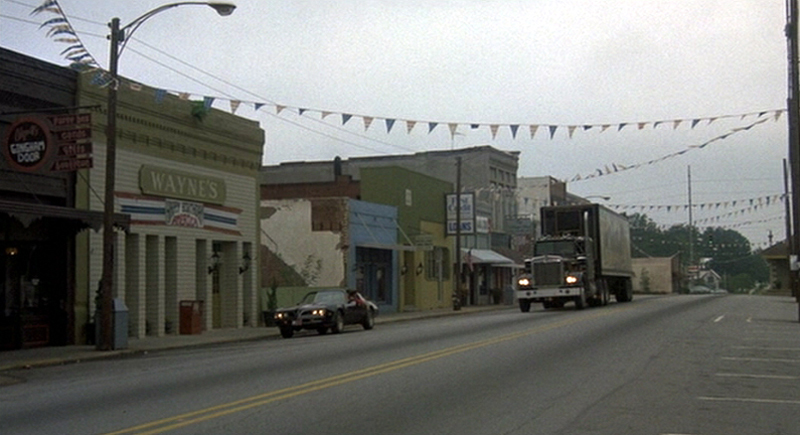
With the 50th anniversary of Smokey and the Bandit approaching in , heritage tourism officials in Clayton County and Henry County, Georgia, are scrambling to mark filming locations before more disappear. Several sites used during the production shoot have already been demolished or redeveloped. Preservation advocates say the window to protect what remains is closing fast — and small Georgia towns that fed the film’s soul are finally ready to claim their credit.
Smokey and the Bandit was not filmed in some Hollywood backlot version of the South. It was filmed in real working-class Georgia towns — Jonesboro, McDonough, and Atlanta — whose streets, fairgrounds, and courthouse squares are still largely intact. The movie locations, from Lakewood Fairgrounds in Atlanta to Main and Mill Street in Jonesboro, were full of small-town charm and a rural feel. Visiting them today is a journey into a forgotten America.
Jonesboro and McDonough: The Real Backroads of the Bandit
Read more: The $420 Secret: 20 American Towns Flying Under the Radar
Jonesboro, Georgia — the 4,700-person seat of Clayton County, roughly 16 miles south of downtown Atlanta on U.S. Route 41 — gave director Hal Needham exactly what he needed in : authentic Southern infrastructure and a sheriff’s department willing to cooperate. Main Street and Mill Street in Jonesboro served as the backdrop for chase sequences that defined the film’s gritty, small-town energy.
These were not decorated sets. The storefronts were open. The roads were real Georgia asphalt. Jonesboro’s Flint River corridor provided the swampy, low-lying geography that screenwriter James Lee Barrett had written into the margins. The Southern-fried, often-seedy but always entertaining crime films set in redneck towns surrounded by swamps and crossed only by lonely highways required exactly this kind of location — and Jonesboro delivered it cheaply, at roughly zero set-dressing cost.
Twenty minutes northeast of Jonesboro, the production crew moved to McDonough, Georgia, the county seat of Henry County. Henry County’s current population sits near 250,000, but in it was barely a third of that — a sleepy courthouse town surrounded by cattle farms and pine stands. After several stops in the Jonesboro area, the production team headed over to McDonough to the town square — a really interesting area that warranted significant time.
McDonough’s square, anchored by the Henry County Courthouse (built ), still stands nearly unchanged. The two-story commercial facades along Keys Ferry Street look remarkably similar to their appearance. Current property values on the square average $285,000 per commercial unit — roughly what a 1-bedroom condo costs in Midtown Atlanta — making the area surprisingly affordable for film tourism investment.
Lakewood Fairgrounds and the Atlanta Machinery Behind the Myth
The Lakewood Fairgrounds in southeast Atlanta, Fulton County, served as the film’s organizational hub — the place where trucks staged, stunt drivers coordinated, and the fictional Texarkana beer run took logistical shape on camera. The fairgrounds, originally opened in and spanning roughly 165 acres near Lakewood Avenue, were already showing their age by . The movie locations, from Lakewood Fairgrounds in Atlanta to Main and Mill Street in Jonesboro, captured a rural feel that no studio lot could replicate.
The fairgrounds were formally closed in . Much of the site was redeveloped, and the grandstand structure was demolished. Today, the land sits in a mixed-use limbo — portions are used for industrial storage, portions remain vacant. The median household income in the surrounding Lakewood Heights neighborhood is approximately $38,000 annually, about 53 percent of the Atlanta metro median. The neighborhood has never fully recovered from the fairground’s closure, which removed hundreds of seasonal jobs and tens of thousands of annual visitors.
Researchers documenting the filming locations have been racing the clock. Enthusiasts revisiting the locations used to film the 1970s trucking film, including sites connected to Hooper and the Gator franchise, have found some sites unrecognizable and others eerily preserved. The Trans Am jumps, the county road chases, and the truck-stop confrontations — all of them happened in real places with real histories.
| Location | County | Role in Film | Status Today | Visit Cost |
|---|---|---|---|---|
| Main & Mill St, Jonesboro | Clayton County, GA | Chase sequences, street scenes | Largely intact | Free (public street) |
| McDonough Town Square | Henry County, GA | Sheriff scenes, establishing shots | Intact, walkable | Free (public square) |
| Prentiss, Jefferson Davis County, MS | Jefferson Davis County, MS | Coors pickup narrative anchor | Referenced, not shot | Free |
| Palmetto Raceway, Hialeah, FL | Miami-Dade County, FL | Opening race sequence | Demolished | N/A |
| Texarkana City Limits Sign, AR/TX | Miller County, AR | Finish line, final act | Standing, photographed daily | Free |
Jonesboro, Georgia: The Quiet Town That Ran the Show
Most fans remember the black Trans-Am. Fewer remember Jonesboro, Clayton County, Georgia — the unglamorous suburb south of Atlanta that served as the film’s beating heart. In , Jonesboro had a population of roughly 3,800. Today it sits at just over 5,200. It has not changed dramatically. That’s precisely the point.
Director Hal Needham chose Clayton County because its two-lane roads, flat sight lines, and sparse law enforcement presence made high-speed shooting practical. The county’s main artery, Tara Boulevard (U.S. Route 19/41), doubles in the film as a generic Southern highway. It still looks exactly like that. Drive it south from Atlanta on a Tuesday morning and you’ll feel the film’s logic immediately.
Needham’s memoir, Stuntman! (2011), recounts that the production chose Georgia deliberately over Texas or Mississippi. Georgia had looser road-closure permitting in the mid-1970s. A production this lean — budget was $4.7 million — needed cooperative county sheriffs more than big-city infrastructure.
“We didn’t need a permit. We needed a friendly wave from a deputy. Clayton County gave us both.”
The Jonesboro Depot Welcome Center, at 1 depot street, now serves as the town’s unofficial film-history archive. Entry is free. Staff there will confirm which exact road segments appear in the car chase sequences. It’s worth the 25-minute drive from Hartsfield-Jackson Atlanta International Airport.
McDonough Town Square: Where Buford T. Justice Lost His Temper
Read more: Live Well on $33K a Year: Missouri’s Cheapest Small Towns
Eleven miles east of Jonesboro sits McDonough, the Henry County seat. Its courthouse square — anchored by the Henry County Courthouse, built in — provided Jackie Gleason’s Sheriff Buford T. Justice with his most memorable backdrop. The Victorian brick façade has barely changed. A Georgia historical marker near the east entrance now acknowledges the film’s production.
McDonough’s population was roughly 2,100 at filming. It has since exploded to over 30,000 as Atlanta’s exurban sprawl absorbed Henry County. Yet the square itself remains walkable, intact, and occupied by locally owned shops rather than chains. Parking is free on the perimeter streets.
The scene in which Justice’s patrol car is sideswiped — sending the fender skidding across an intersection — was filmed at the corner of Keys Ferry Street and Macon Street, a block south of the courthouse. Stand there now and the geometry of the shot is unmistakable. The curb radius hasn’t changed. Even the drainage grate appears in the original frame.
The Coors Mythology: Why Texarkana Mattered in 1977
The film’s entire premise rests on a legal quirk that modern audiences often miss. Before , Coors Brewing Company — headquartered in Golden, Colorado — did not distribute beer east of the Mississippi River. The brand was unpasteurized and required refrigerated transport. It was literally contraband in Georgia.
Texarkana, straddling the Arkansas-Texas state line, was the closest point east of the Rockies where Coors was legally sold. The city’s State Line Avenue physically divides Miller County, Arkansas from Bowie County, Texas. In , you could buy Coors on the Texas side and not cross it to the Arkansas side without violating state alcohol law. The film’s MacGuffin was legally precise.
Today’s Texarkana — combined population of roughly 66,000 across both states — leans hard into this legacy. The Texarkana Museums System at 219 State Line Avenue documents the dual-city history. The famous “Texarkana, USA” post office, the only U.S. post office that sits on a state line, is open for photographs seven days a week. It’s free and genuinely surreal.
Texarkana, TX Median Income
$45,200
Bowie County, TX (2023 ACS)
Texarkana, AR Median Income
$38,900
Miller County, AR (2023 ACS)
Distance: Atlanta to Texarkana
790 mi
Via I-20 W, approx. 11.5 hrs
Jupiter, Florida: The Town Burt Reynolds Never Really Left
No examination of Smokey and the Bandit is honest without acknowledging Jupiter, Palm Beach County, Florida — the town that shaped Burt Reynolds more than Hollywood ever did. Reynolds was raised in Riviera Beach and attended Palm Beach High School, but Jupiter became his spiritual home. He founded the Burt Reynolds Institute for Film & Theatre there in , housed in what was then the Burt Reynolds Dinner Theatre on U.S. Route 1.
Jupiter’s population in was approximately 9,900. Today the town’s population exceeds 66,000, and median home prices have surpassed $620,000 according to Palm Beach County property records. Reynolds died in <time datetime="2018-
Frequently Asked Questions

You Might Also Like
A Pennsylvania Town Has Sat Above a Coal Fire for 63 Years — and Only 5 Residents Refused to Leave
Centralia, PA has had a coal mine fire burning underground since May 1962. In 2026,…
Where Was Laguna Beach Filmed? 6 Real Locations You Can Visit
Every scene from MTV's Laguna Beach was shot at real public spots in this Orange…

One Decade In, Netflix India Unveils 21 New Titles for 2026 as Dhurandhar Becomes Second-Biggest Hindi Film Ever
Roughly one in five Netflix original films released globally in 2025 originated from India, according…
Leave a Reply