
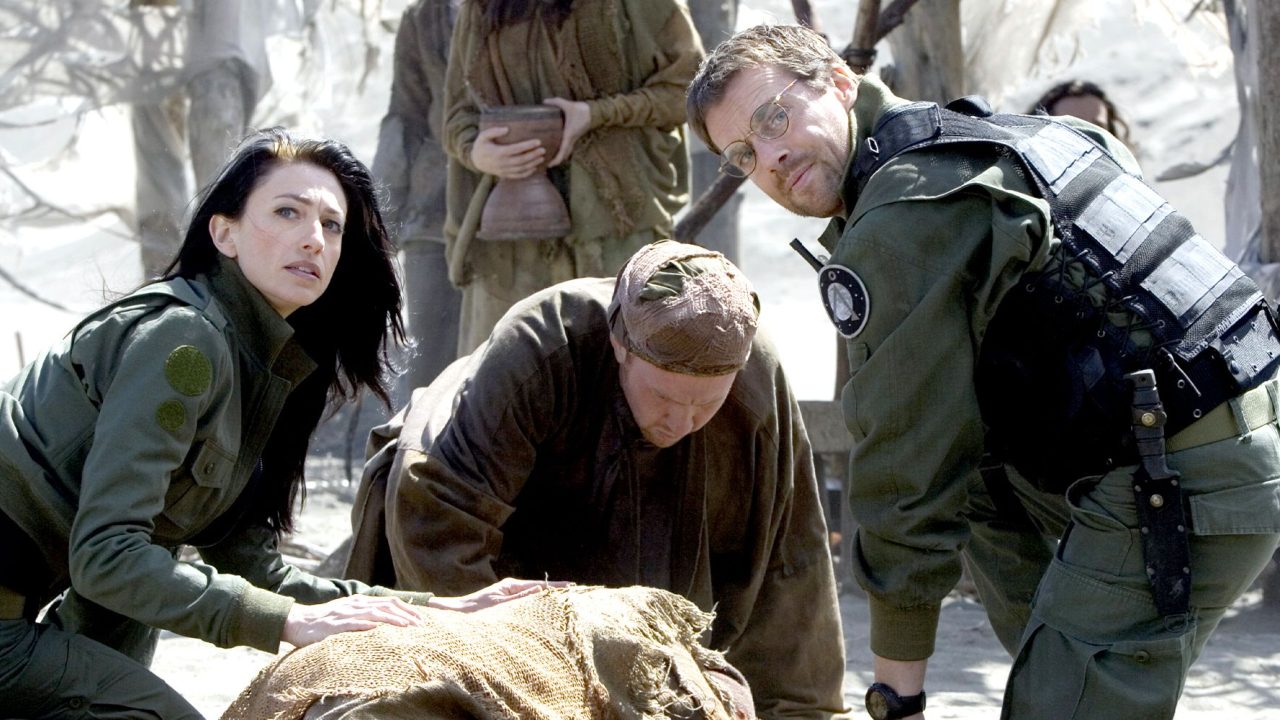
Few science fiction series from the twentieth century have earned the kind of enduring devotion that Stargate SG-1 continues to command decades after its premiere. The show built something rare in genre television — a format that felt both endlessly exploratory and genuinely meaningful, episode after episode, season after season.
The premise itself sounds almost too simple on paper: a team of military and civilian specialists travel through an ancient alien portal to explore other worlds. But what Stargate SG-1 did with that foundation is what separates it from the crowded field of science fiction that came before and after it.
With renewed interest in the franchise and ongoing conversations about what made the original series so effective, it’s worth examining exactly why SG-1 stands as one of the greatest sci-fi achievements of its era — and why its episodic structure, in particular, was central to that success.
Why the Stargate SG-1 Premise Worked So Well
Science fiction, as a genre, lives and dies on its central concept. Space empires at war, dystopian governments, alien invasions — these premises have been recycled so many times that the freshness wears off quickly. What Stargate SG-1 understood, almost instinctively, was that the premise needed to be a vehicle, not the destination.
The Stargate itself — a ring-shaped device that connects distant planets through wormhole technology — was the perfect engine for storytelling. It allowed the writers to essentially reset the world every week. A new planet. A new civilization. A new problem. And yet the characters who stepped through that gate remained consistent, grew over time, and carried emotional weight from one story to the next.
That balance between the procedural and the serialized is something a lot of modern television has abandoned in favor of pure long-form storytelling. SG-1 proved you didn’t have to choose. You could have both.
The Episodic Format and Why It Still Matters
There’s a tendency now to treat episodic television — stories that largely resolve within a single episode — as a relic of an older, less sophisticated era. Streaming culture has conditioned audiences to expect everything to connect, every thread to pull toward a season-long payoff.
But Stargate SG-1 made the case that episodic storytelling, done well, carries its own kind of meaning. When a story resolves in 44 minutes, the writers are forced to make every scene count. There’s no room to delay consequences, stall character development, or pad out a conflict for three episodes before anything actually happens.
Each self-contained episode of SG-1 functioned almost like a short story — complete, purposeful, and often thematically rich in ways that serial drama rarely achieves. The show could be funny one week, genuinely harrowing the next, and philosophically provocative the week after that, without any of those tonal shifts feeling jarring because each episode was its own contained world.
That tonal flexibility is something the show’s creative team clearly understood and leaned into deliberately. It’s a large part of why the series feels, even now, like it never overstays its welcome across ten full seasons.
What Made the Ten Seasons Feel Consistent
Sustaining quality across ten seasons of television is genuinely difficult. Most long-running series experience visible decay — a moment where the premise feels exhausted, the characters feel static, or the writers are clearly running out of ideas. SG-1 largely avoided that fate.
Several factors contributed to that consistency:
- Character grounding: The core team remained emotionally believable throughout, even as the mythology around them expanded dramatically.
- Premise flexibility: The Stargate’s ability to send the team anywhere in the universe meant the show was never structurally trapped by its own setting.
- Tonal range: The series moved comfortably between action, comedy, horror, and drama without losing its identity.
- Episodic discipline: Individual episodes were written to stand alone, which kept the writing sharp and prevented the narrative bloat that plagues many long-form sci-fi series.
- Mythology that served the story: The show’s larger arc — involving the Goa’uld, the Asgard, and other alien civilizations — expanded organically rather than overwhelming the week-to-week experience.
How SG-1 Compares to Other Sci-Fi Series of Its Era
| Series | Format | Seasons | Notable Strength |
|---|---|---|---|
| Stargate SG-1 | Episodic with serialized arcs | 10 | Tonal flexibility and premise longevity |
| The X-Files | Mixed episodic and mythology | 11 | Atmospheric tension and monster-of-the-week format |
| Babylon 5 | Heavily serialized | 5 | Long-form political storytelling |
| Star Trek: Deep Space Nine | Episodic shifting to serialized | 7 | Character depth and moral complexity |
The table above reflects the broader landscape of 1990s and early 2000s sci-fi television. SG-1 occupied a distinctive middle ground — neither as mythology-heavy as Babylon 5 nor as purely procedural as early X-Files. That balance turned out to be its greatest structural asset.
The Legacy That Streaming Culture Keeps Rediscovering
There’s a reason Stargate SG-1 keeps finding new audiences. Streaming platforms have made it easier than ever for viewers who missed the original run to discover the show, and many of them report the same experience: they expect something dated and instead find something that feels remarkably well-constructed.
The show’s episodic confidence — its willingness to tell a complete, satisfying story in a single hour — feels almost countercultural now. In an era where many prestige dramas deliberately withhold resolution to keep audiences hooked, SG-1’s approach of actually finishing what it started each week reads as a form of respect for the viewer’s time.
That’s not nostalgia talking. It’s a genuine structural achievement, and it’s why the series continues to hold up as one of the most complete sci-fi runs the twentieth century produced.
Frequently Asked Questions
How many seasons did Stargate SG-1 run?
Stargate SG-1 ran for ten seasons, making it one of the longest-running science fiction series of its era.
What made Stargate SG-1’s episodic format distinctive?
The show combined self-contained weekly stories with a broader serialized mythology, allowing individual episodes to feel complete while still contributing to a larger narrative arc.
Is Stargate SG-1 considered the greatest sci-fi series of the 20th century?
The show is widely regarded as one of the finest sci-fi series of its era, with particular praise directed at its premise flexibility and tonal consistency across ten seasons.
Why does Stargate SG-1 still attract new viewers today?
Its episodic structure and strong character work have made it accessible to new audiences on streaming platforms, many of whom find it more satisfying than expected given its age.
What is the central premise of Stargate SG-1?
The series follows a team of military and civilian specialists who travel through an ancient alien portal called the Stargate to explore other worlds and encounter alien civilizations.
How does SG-1 compare to other sci-fi series from the same period?
SG-1 occupied a distinctive middle ground between heavily serialized shows like Babylon 5 and more purely episodic series, which contributed to both its longevity and its consistent quality.




Leave a Reply