
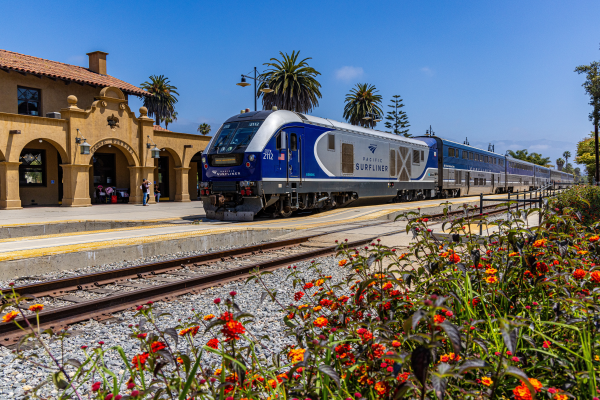
Here is the contrarian truth nobody in California transportation planning wants to say out loud: we have been building highways to fix a problem that trains already solved a century ago.
The Pacific Coast between Los Angeles and San Luis Obispo is one of the most spectacular stretches of land in North America. It is also, on a summer Friday afternoon, one of the most miserable drives you will ever attempt. Bumper-to-bumper traffic on the 101, overheating engines, missed dinner reservations, and the creeping suspicion that the vacation started badly before it even began.
For years, travelers along this corridor have had limited rail options. That changes on May 4, 2026.
What the New Daily Pacific Surfliner Roundtrip Actually Offers
The LOSSAN Rail Corridor Agency, the Santa Barbara County Association of Governments (SBCAG), and the Ventura County Transportation Commission (VCTC) have jointly announced a new daily Pacific Surfliner roundtrip connecting Los Angeles and San Luis Obispo, launching May 4, 2026.
This is not a weekend pilot. It is not a seasonal experiment. It is a permanent daily service addition to one of Amtrak’s most beloved corridors on the West Coast.
The collaboration between LOSSAN, SBCAG, and VCTC represents something relatively rare in California: three regional agencies moving in the same direction at the same time. Anyone who has watched California infrastructure projects stall for decades under competing jurisdictional claims will recognize how significant that alignment is.
The Pacific Surfliner already serves the coastal corridor, but added daily frequency means more flexibility. Travelers who previously had to time their trips around a narrow window of departures now have a genuine alternative schedule.
| Travel Option | Approx. Duration | Key Drawback | Key Advantage |
|---|---|---|---|
| Driving via US-101 | 3–5+ hours (traffic-dependent) | Unpredictable delays, parking costs | Door-to-door flexibility |
| Pacific Surfliner (existing) | Approx. 5–6 hours | Limited departure windows | Scenic coastal views, no parking stress |
| Pacific Surfliner (new daily roundtrip, May 4, 2026) | Approx. 5–6 hours | No door-to-door service | Added daily frequency, coastal access, regional tourism support |
| Flying (LAX to SBP) | 1 hour flight, 3+ hours total | Cost, airport friction, carbon footprint | Speed for longer distances |
The Corridor’s Tourism Economy and Why Regional Agencies Pushed Hard for This
San Luis Obispo County alone draws millions of visitors annually. The Central Coast wine country, Hearst Castle, Pismo Beach, and the broader Paso Robles wine region collectively represent an enormous slice of California’s tourism economy.
Ventura County, which sits between Los Angeles and Santa Barbara along the same corridor, has long struggled with the perception that it is merely a place you drive through to get somewhere else. Better rail access changes that narrative. A traveler who can hop off in Ventura, spend a few hours, and catch a later train northward is a traveler who spends money locally.
VCTC’s involvement signals something specific. The Ventura County Transportation Commission has been working for years to position the county as a destination, not a throughway. Rail frequency is one of the clearest indicators of a place’s tourism infrastructure maturity. When trains run daily and reliably, hotels, restaurants, and tour operators can build their business models around that predictability.
SBCAG, representing Santa Barbara County, faces a different challenge. Santa Barbara is already a well-established destination, but its geographic isolation, bookended by mountains and ocean, makes surface transportation a genuine constraint. The new service gives Santa Barbara one more reliable connection to the enormous Los Angeles visitor market.
“The Pacific Surfliner adds a new daily roundtrip between Los Angeles and San Luis Obispo starting May 4, 2026.”
— LOSSAN, SBCAG, and VCTC joint announcement via official channels
A Personal Reckoning With What Rail Frequency Actually Means
Consider a traveler, call her Maya, a graphic designer based in Silver Lake who has been making the LA-to-SLO trip twice a year for the better part of a decade. She visits a college friend who settled in Morro Bay after graduation. For years, Maya drove. Then she tried the train once, almost by accident, after her car went into the shop two days before a planned trip.
She arrived in San Luis Obispo four hours after leaving Union Station, having eaten a decent sandwich, finished two chapters of a novel, and watched the Pacific slide past her window somewhere around Gaviota. She did not grip a steering wheel once.
But the return train left at an inconvenient hour. She either had to cut her trip short or stay an extra night she hadn’t budgeted for. She chose the extra night, spent money she hadn’t planned to spend, and came home a day late to a pile of urgent client emails.
That is the problem with limited frequency. It is not that the train is bad. It is that a single daily option forces travelers into rigid itineraries. The new roundtrip does not eliminate that rigidity entirely, but it adds one more viable departure window. For travelers like Maya, that is the difference between choosing rail and defaulting back to the car.
The Broader Mobility Argument That California Keeps Avoiding
California has spent decades in a peculiar loop. The state acknowledges its car dependency, funds studies about transit alternatives, and then watches those alternatives underfunded into irrelevance while highway expansion budgets remain intact.
The new Pacific Surfliner roundtrip is not a revolution. It is one train, one additional daily round-trip, on an existing corridor. But the collaboration between LOSSAN, SBCAG, and VCTC to make it happen suggests that regional agencies are learning to move faster than state-level bureaucracy.
The LOSSAN Rail Corridor Agency manages the busiest intercity passenger rail corridor in the United States outside the Northeast. More than 3 million passengers ride Pacific Surfliner trains annually. That number has room to grow, but only if the service is frequent enough to be genuinely useful rather than a novelty.
The announcement from LOSSAN, SBCAG, and VCTC frames the new service as a mobility and tourism initiative simultaneously. That dual framing is deliberate. Mobility arguments alone rarely generate public enthusiasm. Tourism arguments do. Combining them gives the new service a broader constituency of supporters, from environmentalists to hotel associations.
There is still the question of whether one additional roundtrip is enough to meaningfully shift travel behavior along the corridor. Behavioral economists who study transportation choices have long noted that people default to familiar modes, usually cars, unless alternatives are both convenient and frequent. One new daily train is a start. It is not a transformation.
But transformation in California transportation has always moved in increments, not leaps. The Coaster in San Diego started modestly. Metrolink expanded slowly. Each additional service frequency is a proof-of-concept for the next one.
Maya, for her part, has already looked up the new schedule. She is planning her summer trip to Morro Bay around the new departure window. She is not certain it will be perfect. But she is willing to try the train again, and that willingness is exactly what LOSSAN, SBCAG, and VCTC are counting on.
The most powerful thing a new train route can do is not move freight or hit a ridership target. It is change the mental map of what feels possible, so that next time, the car keys stay on the hook.
Frequently Asked Questions

You Might Also Like

Four Seasons Firenze Is Turning Spring Into Something Quietly Extraordinary
Florence in spring is already one of Europe’s most quietly spectacular experiences — but this…

Marriott and Sun Group Are Bringing 10 New Resorts to Vietnam by 2030
Ten new hotels and nearly 4,500 rooms are coming to Vietnam — and the partnership…
297 Flights Grounded Across the Middle East and Thousands Are Still Waiting
Nearly 2,139 flights across the Middle East and Turkey have been grounded or delayed in…
Leave a Reply