
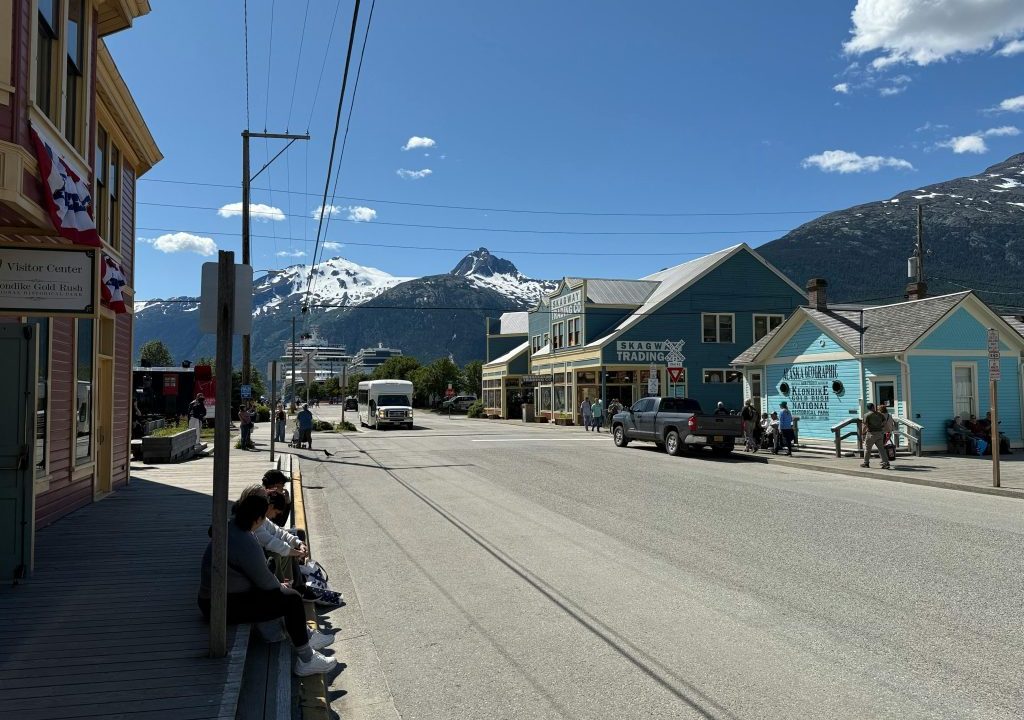
The first thing you notice is the darkness. You pull into the Anton Anderson Memorial Tunnel on a gray Alaska afternoon, your headlights catching the rough-cut walls of a mountain that’s been hollowed out since World War II, and for 2.5 miles there is nothing ahead of you but a single lane of road, a set of railroad tracks, and the faint glow of the exit. When you emerge on the other side, blinking into the light of Passage Canal, the town of Whittier, Alaska appears like something you half-convinced yourself couldn’t be real.
One building. Fourteen stories. Roughly 272 people. This is the whole story, except it isn’t — not by a long shot.
One Building, One Town: What Life Inside Begich Towers Actually Looks Like
Begich Towers is not a novelty. It is the functional, beating heart of a real municipality. Inside its 14 floors, you’ll find private apartments, a bed and breakfast, the post office, a convenience store, the police department, city hall, a health clinic, and a church. Children who grow up in Whittier can walk to school through an interior hallway without ever stepping outside — a practical necessity when annual rainfall reaches approximately 174 inches and winter storms come in fast off Prince William Sound.
The building was originally constructed in 1956 as a military barracks under the name Hodge Building. It was renamed in the 1970s after Congressman Nick Begich of Alaska, who disappeared in a plane crash in 1972 alongside House Majority Leader Hale Boggs. That history gives the tower an added layer of gravity that most residents are quietly aware of.
Ask longtime residents why they stay, and the answers tend to be specific rather than sentimental. The fishing is exceptional — Passage Canal is a gateway to some of the most productive salmon and halibut waters in southcentral Alaska. The rent is low compared to Anchorage, which sits about 60 miles to the northwest. And there is a kind of radical simplicity to daily life that some people find genuinely liberating. You know your neighbors. You know your neighbors’ neighbors. You cannot be anonymous here.
The Military Secret That Built a Town on Purpose
Whittier did not happen by accident. The U.S. Army chose this location in 1941 specifically because it is one of the few ice-free ports in southcentral Alaska, sheltered by the Chugach Mountains on three sides and reachable via a rail corridor that could be kept defensible. The goal was to move troops and supplies through the region without detection from Japanese forces in the Pacific — and Whittier’s natural geography made it nearly invisible from the air and sea.
By the end of the war, Whittier had grown into a full military installation with thousands of personnel, a dedicated rail line, and infrastructure that dwarfed what most Alaskan towns of its size ever saw. The Army drilled the tunnel — then rail-only — through Maynard Mountain, connecting Whittier to the existing Alaska Railroad network. For decades, civilians could only enter by train.
The Army formally departed in the early 1960s, leaving behind two enormous concrete structures: Begich Towers and the even larger Buckner Building. Civilians who remained — many of them former military families who had simply decided to stay — made Begich Towers their home. The Buckner Building became something else entirely.
The Ghost in the Mountain: Buckner Building and What It Represents
If Begich Towers is Whittier’s living center, the Buckner Building is its haunted periphery. Once marketed by the Army as a “city under one roof” capable of housing roughly 1,000 soldiers with everything from a gym to a theater, the Buckner Building has sat largely empty and deteriorating since the military left. It is now considered one of the largest abandoned structures in Alaska.
The building is not open to the public, though it draws a particular kind of traveler — urban explorers, historians, and people drawn to the specific texture of mid-century military architecture left to the elements. According to the Alaska Department of Transportation, the tunnel that connects Whittier to the rest of Alaska handles significant seasonal traffic, much of it tourists who have heard about both buildings and want to see them firsthand.
The Buckner Building raises a question that small communities across America grapple with regularly: what do you do with the physical remnants of a past that shaped you but no longer serves you? Whittier doesn’t have an easy answer. The building is too large to ignore, too expensive to tear down, and too historically significant to many residents to demolish without conversation.
The Tunnel Economy: What Tourism Has Done to Whittier’s Identity
When the Anton Anderson Memorial Tunnel opened to vehicle traffic in 2000, Whittier changed. The town had always been accessible in summer by boat and floatplane, but the tunnel made it reachable by any driver with a full tank of gas and a curiosity about what lay at the end of the mountain. Summer visitor numbers swelled. Charter fishing operations expanded. Kayak tour companies set up in the harbor. Cruise ships began using Whittier as an embarkation point for Prince William Sound glacier tours.
The tunnel itself is a destination. It operates on a timed alternating schedule — cars and the Alaska Railroad share the single bore, so vehicle traffic is only allowed in one direction at a time, with trains given priority. Travelers must check the schedule before entering, which adds a logistical layer that feels almost theatrical. You are not just driving to a town. You are negotiating with a mountain.
The toll to use the tunnel is roughly $13 for a standard passenger vehicle as of recent years, a small fee that still surprises first-time visitors who aren’t expecting a toll road deep inside Alaska. That revenue contributes to tunnel maintenance managed by the state. According to U.S. Census Bureau data, Whittier’s year-round population has remained relatively stable — hovering between 200 and 300 for decades — even as seasonal visitor volume has increased significantly since the tunnel opened.
What Whittier Gets Right That Bigger Places Keep Missing
There is something clarifying about a town that has been forced — by geography, weather, and history — to be radically honest about what a community actually requires. Whittier doesn’t have the luxury of sprawl. It can’t rely on the assumption that residents will drive 20 minutes for essentials. Everything needed to sustain daily life must exist within walking distance, because for roughly half the year, going anywhere means negotiating with a two-and-a-half-mile tunnel and a mountain that gets 14 feet of rainfall annually.
What Whittier has built — a functional municipality inside a single building, with genuine civic infrastructure and a harbor economy that draws both local fishermen and summer tourists — is a compressed version of something that urban planners spend careers theorizing about. The residents didn’t plan it this way. They inherited a military installation and made it theirs.
- Begich Towers contains the post office, police department, health clinic, city hall, a convenience store, and a bed and breakfast
- The building’s interior hallways connect all essential services, allowing residents to move through them without going outdoors in severe weather
- Whittier has its own mayor and city council, functioning as an incorporated city under Alaska state law
- The harbor supports both commercial fishing operations and a robust summer charter industry targeting halibut and salmon
- The town sits at the terminus of the Portage Valley, offering access to Portage Glacier — one of the most visited glaciers in Alaska
The town is not utopian. Residents deal with the same friction that any small, isolated community faces — limited retail options, long winters, the particular social pressure of knowing everyone around you intimately. But the community that has formed inside Begich Towers has developed something rare: a genuine density of daily interaction that most American towns, no matter their size, have largely lost.
What’s Next for the Town That Lives in One Building
Whittier sits at an interesting inflection point. Summer tourism via the tunnel and the cruise industry continues to grow, bringing economic opportunity that the town’s small permanent population couldn’t generate alone. At the same time, that same tourism pressure raises familiar questions about what a place owes to the people who actually live there year-round versus the hundreds of thousands who pass through in summer.
The Buckner Building remains the largest unresolved question on Whittier’s horizon. Remediation and potential demolition have been discussed at the municipal and state level, but the financial scale of the project — and the building’s complicated status as both a liability and a piece of Alaska’s military history — has prevented clear resolution. Some community members have advocated for partial stabilization and historical designation; others want it gone entirely.
Meanwhile, the Alaska DOT continues to manage the Anton Anderson Memorial Tunnel as essential infrastructure, not a tourist attraction — though it functions as both. For anyone planning a visit, the tunnel schedule is published online and operates daily, with extended summer hours to accommodate peak traffic. The drive from Anchorage takes approximately 90 minutes under normal conditions.
Whittier won’t change the way most American towns change — through gradual expansion, new development pushing outward from a center. It is physically constrained in ways that most places are not. That constraint is, depending on your perspective, either the thing that limits it or the thing that made it what it is. For the roughly 272 people who call it home, it is simply the place they live — and by every account, they’d rather be there than anywhere a tunnel isn’t required to reach.
Related: A ₹3,800 Weekend in Mussoorie Showed Me Everything Tourists Get Wrong About This Hill Station
Why do almost all of Whittier’s residents live in one building?
Nearly all of Whittier’s roughly 272 residents live in Begich Towers, a 14-story concrete building that houses apartments alongside essential services like a post office, health clinic, police department, and city hall. The extreme weather — with annual rainfall reaching approximately 174 inches and severe winter storms rolling in off Prince William Sound — makes the self-contained building a highly practical living arrangement rather than simply a novelty.
How do you get to Whittier, Alaska?
Whittier is only accessible by road through the Anton Anderson Memorial Tunnel, a 2.5-mile single-lane tunnel that cuts through a mountain originally hollowed out during World War II. The tunnel also carries railroad tracks alongside the roadway, making it a unique shared-use passage and the town’s sole land connection to the rest of Alaska.
What is the history behind Begich Towers?
Begich Towers was originally built in 1956 as a military barracks called the Hodge Building, constructed as part of the U.S. Army’s strategic use of Whittier’s ice-free port. It was later renamed in the 1970s after Congressman Nick Begich of Alaska, who disappeared in a plane crash in 1972 alongside House Majority Leader Hale Boggs — a piece of history that adds a quiet sense of gravity to daily life in the building.
Why do people choose to live in Whittier year-round?
Residents cite several practical reasons for staying. The fishing is exceptional, with Passage Canal offering access to some of the most productive salmon and halibut waters in southcentral Alaska. Rent is considerably lower than nearby Anchorage, roughly 60 miles to the northwest. Many residents also value the tight-knit simplicity of community life — in a town of 272 people, anonymity is essentially impossible, and that closeness is something many find genuinely appealing.
Why did the U.S. military originally build a town in Whittier?
The U.S. Army deliberately selected Whittier’s location in 1941 because it is one of the few ice-free ports in southcentral Alaska, offering year-round strategic maritime access. The town was sheltered by the Chugach Mountains, making it an ideal and defensible military installation. That purposeful, engineered origin is a large part of why Whittier’s infrastructure — including its famous single-building community — looks unlike anywhere else in the United States.

You Might Also Like

$55K in Oklahoma City Quietly Outspends $85K in Most Coastal Cities
$795/mo for a Tulsa 2BR vs $2,340 for an Austin 1BR. Oklahoma leads 2026's affordability…

The $420 Secret: 20 American Towns Flying Under the Radar
20 overlooked American towns—from Ouray, CO to Natchitoches, LA—offer world-class experiences at half the cost…
8 Ghost Towns Worth the Detour — Bannack Leads at 4.8 Stars
Over 3,800 ghost towns dot the American West. These 8 have 4,647 verified ratings and…
Leave a Reply