
▶ Read transcript
Here’s what you need to know about Virgin Atlantic’s new nonstop London to Seoul route. The service launched on March 29, 2026, operating daily between Heathrow and Incheon International Airport on a Boeing 787-9. The flight cuts journey time down to around 11 hours, compared to 18 to 20 hours on connecting routes through Middle Eastern hubs. That’s a significant difference, but it comes at a cost. Economy fares start at £799 one way, Premium at £1,493, and Upper Class at £3,113, making this one of the pricier direct Asia routes out of the UK. The route also connects to Korean Air’s network through Virgin’s new SkyTeam alliance membership, which opened up in early 2026. If you’re weighing whether the price is worth it, do the math on your actual trip length. Saving nearly a full day of travel each way could genuinely give you more time on the ground.
Here is the contrarian truth nobody wants to say out loud: a new direct flight route does not make a destination more accessible. It makes it more crowded.
That might sound ungrateful, especially when the route in question connects two of the world’s most culturally rich cities. But before you start planning your Seoul itinerary around Virgin Atlantic’s shiny new daily service from London Heathrow to Incheon International Airport, it’s worth sitting with that idea for a moment.
Because the story of this route, which officially launched on March 29, 2026, is not simply a story about convenience. It’s a story about what happens when two very different travel cultures collide, and what a single airline decision can do to the rhythm of a place.
The Morning the Route Became Real for One London Traveler
Claire, a 34-year-old graphic designer from Hackney, had been planning a trip to Seoul for three years. She had spreadsheets. She had a Pinterest board with 200 pins. She had watched every episode of a Korean street food documentary series twice.
What she did not have was a direct flight from London. Every route she found required a stopover in Dubai, Doha, or Helsinki. The total journey time, door to door, hovered around 18 to 20 hours depending on the connection.
Then, in early 2026, she saw the announcement. Virgin Atlantic confirmed it would operate a daily nonstop service between Terminal 3 at Heathrow and Incheon International Airport, aboard a Boeing 787-9. The flight time: roughly 11 hours. The launch date: March 29, 2026.
Claire booked within 48 hours. Economy class. £799 one way.
What the Fares Actually Look Like Across Cabin Classes
| Cabin Class | Starting Fare (One Way) | Aircraft | Frequency |
|---|---|---|---|
| Economy | £799 | Boeing 787-9 | Daily |
| Premium | £1,493 | Boeing 787-9 | Daily |
| Upper Class | £3,113 | Boeing 787-9 | Daily |
Those numbers are not cheap. At £799 for Economy, the London–Seoul route sits at a premium compared to heavily discounted indirect routes through Middle Eastern hubs. But the math changes when you factor in the value of 7 to 9 hours not spent in a transit lounge in Doha.
For Claire, that math was personal. She had a 10-day trip. Shaving nearly a full day off her travel time, each way, meant two extra days in Seoul. That felt worth the price difference.
The Strategic Logic Behind Virgin Atlantic’s Seoul Decision
Virgin Atlantic did not choose Seoul randomly. The airline targeted the route specifically to capture growing tourism demand between Korea and the UK, as well as onward connections across Asia. Incheon International Airport is one of the most efficient transit hubs in the world, routinely ranked among the top airports globally for passenger experience and connectivity.
The timing also aligns with a significant alliance shift. Korean Air, South Korea’s flag carrier, is one of the founding members of the SkyTeam alliance. Virgin Atlantic joined SkyTeam in early 2026, making this route a natural extension of a deepening commercial relationship between the two carriers.
South Korean aviation and tourism officials welcomed the launch publicly. Korean officials described the partnership as a catalyst for bilateral travel and economic exchange, language that signals genuine governmental enthusiasm rather than diplomatic boilerplate.
Virgin Atlantic Direct (2026)
Stopover via Dubai/Doha
Stopover via Helsinki
| Metric | Virgin Atlantic Direct (2026) | Stopover via Dubai/Doha | Stopover via Helsinki |
|---|---|---|---|
| Journey Comfort |
88 |
55 |
62 |
| Total Travel Time |
92 |
38 |
44 |
| Cultural Immersion |
65 |
72 |
80 |
| Cost Efficiency |
42 |
68 |
74 |
| Crowd Levels |
35 |
78 |
82 |
| Destination Accessibility |
95 |
70 |
66 |
| Environmental Impact |
48 |
55 |
60 |
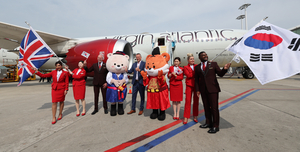
On April 14, 2026, Virgin Atlantic marked the route’s early weeks with an event in Seoul, bringing together travel industry figures and press to celebrate what the airline positioned as a milestone in UK–South Korea connectivity.
What Seoul Actually Offers the Traveler Who Finally Gets There
Claire landed at Incheon on a Tuesday morning in early April. She had slept for four hours on the flight, eaten a meal she described as “genuinely good, which I did not expect,” and arrived feeling something she had never felt after a long-haul journey: functional.
Seoul rewarded the effort immediately. The city is not one thing. It is art museums beside ancient palaces beside rooftop bars beside street food markets that operate until 3 a.m. It is skyscrapers visible from hiking trails inside the city limits. It is a subway system so intuitive that Claire navigated it alone within 20 minutes of arriving.
South Korea’s appeal is genuinely difficult to categorize. The country offers art, history, food, tradition, futurism, coastline, and mountains, often within the same 48-hour stretch. That breadth is not a marketing claim. It is a structural feature of a country that compressed centuries of cultural development into a few decades of rapid modernization.
For British travelers, Seoul has historically required either a strong commitment to indirect routing or a willingness to pay premium fares on Korean Air. The Virgin Atlantic entry changes that calculus, introducing competition and, more importantly, a second daily departure option for travelers who prefer a British carrier.
The Tension Claire Did Not Anticipate
By day four, Claire noticed something. The neighborhoods she had bookmarked from her research were already busy with tourists. Not overwhelmingly so, not yet. But the particular quality of a place that feels like it belongs to the people who live there was already thinning at the edges.
She had not expected to feel ambivalent about a route she had celebrated. But the arrival of easy direct access from London was not her discovery alone. It was everyone’s discovery simultaneously.
“I wanted Seoul to feel like a secret I had kept for three years. But a daily direct flight from Heathrow means it belongs to everyone now. Which is probably the right outcome. I just had to grieve the version I had imagined.”
— Claire, London-based traveler, April 2026
This is the honest emotional texture of what a new route does. It democratizes access. It distributes the experience more widely. And it changes the experience for everyone who arrives, including the people who had been dreaming about it longest.
The Route’s Broader Impact on UK–South Korea Travel in 2026
Industry observers noted that the Virgin Atlantic launch represents a significant shift in the competitive landscape for long-haul travel between the UK and East Asia. Previously, travelers seeking direct or near-direct service to Seoul from London relied primarily on Korean Air and indirect options via Gulf carriers.
The addition of a daily Virgin Atlantic service introduces pricing pressure and schedule flexibility that benefits travelers across all budget levels. It also signals broader airline confidence in the UK–South Korea travel corridor as a commercially viable, year-round market rather than a seasonal one.
For South Korea, the route is an economic signal as much as a travel one. Tourism from the UK represents a high-spending visitor segment, and bilateral cultural exchange between the two countries has grown steadily through the global popularity of Korean cinema, music, and food.
Claire came home with 4,000 photographs, a suitcase heavier than it left, and a genuine desire to return. She also came home with a more complicated feeling about what it means to love a place and then help make it easier for everyone else to find.
The flight took 11 hours. The processing is still ongoing.
Frequently Asked Questions
Frequently Asked Questions

You Might Also Like
Over 840 Flights Hit Canada’s Busiest Airports And Thousands Are Stranded
Seventy-six flights cancelled and 773 more delayed in a single day — that is the…

Canada Joins a Global Wave of Super Visa Changes Families Should Know About
Canada’s Parent and Grandparent Super Visa — one of the most popular long-term family travel…
Southeast Asia’s High-Speed Rail Push Is Moving Faster Than Most Realise
Southeast Asia is in the middle of a rail revolution — and it’s moving faster…
Leave a Reply