
▶ Read transcript
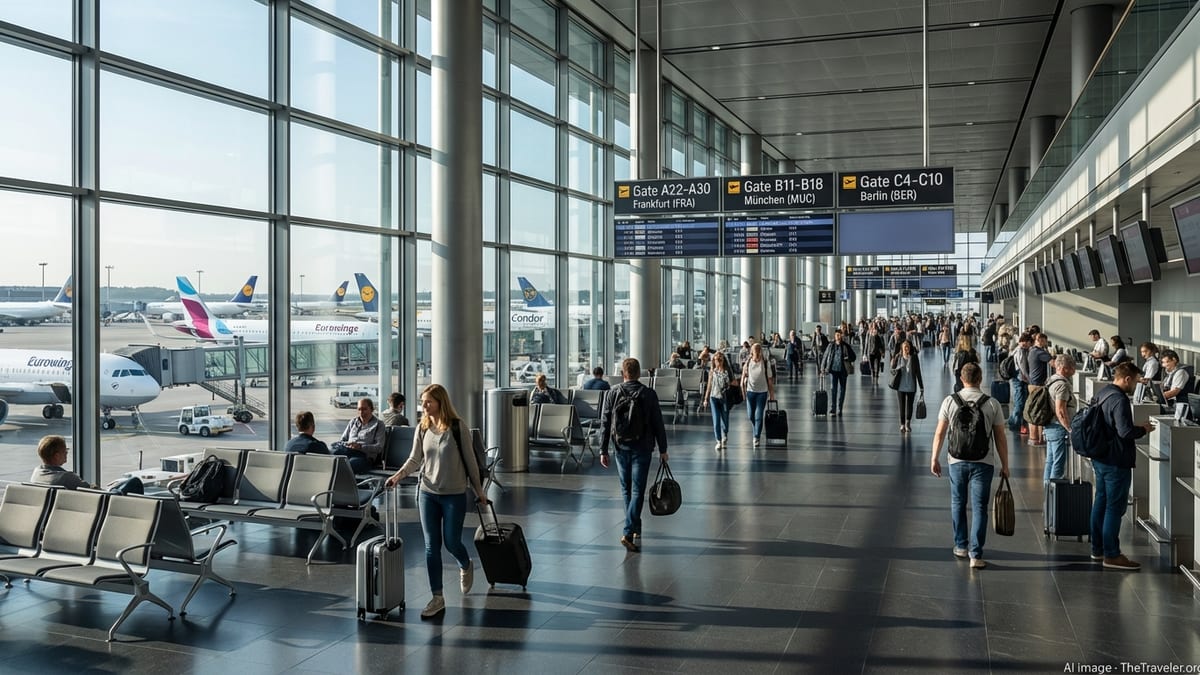
Here’s what you need to know about the Lufthansa pilot strike that brought German aviation to a standstill. Over two days, 122 flights were outright canceled and another 743 were delayed across seven major German airports, including Frankfurt, Munich, Berlin, Hamburg, and Dusseldorf. The scale of disruption was enormous — those delays alone affected somewhere between 74,000 and 260,000 individual travelers. Frankfurt took the hardest hit because it’s Lufthansa’s primary global hub, connecting to nearly 300 airports in over 100 countries. When Frankfurt stalls, the ripple effects reach passengers mid-connection from Tokyo, New York, and São Paulo. And recovery after a strike like this is slow — planes end up at the wrong airports and crew rest rules prevent quick fixes. If your flight was canceled, look into EU Regulation 261/2004, which may entitle you to rebooking, meals, accommodation, or even financial compensation.
What would you do if you arrived at one of Europe’s busiest airports, bags packed and boarding pass in hand, only to discover your flight simply no longer existed?
That’s not a hypothetical. For thousands of passengers at Frankfurt, Berlin, Munich, Hamburg, Dusseldorf, Hanover, and airports across Germany, that scenario played out in real time during a two-day Lufthansa pilots strike that shook the country’s aviation network to its core.
The numbers are stark. According to travel industry tracking, 122 flights were outright canceled. Another 743 were delayed. Across Germany’s seven major aviation hubs, the ripple effects spread far beyond missed connections and frustrated itineraries.
Why Frankfurt’s Role in the Lufthansa Strike Made Everything Worse
Frankfurt Airport is not just a German airport. It is a global connector, serving scheduled routes to nearly 300 airports in over 100 countries, ranking consistently inside the world’s top 15 busiest airports by passenger volume.
Roughly 10 million people live within 100 kilometers of Frankfurt Airport, a catchment area that dwarfs Munich, Berlin, and Hamburg combined. When Frankfurt stalls, the disruption is not local. It cascades globally.
Frankfurt is Lufthansa’s primary hub. While the carrier has shifted some long-haul routes toward Munich in recent years, Frankfurt remains the beating heart of the airline’s network. A pilots strike that grounds aircraft here doesn’t just delay a domestic hop to Hamburg. It strands travelers mid-connection from Tokyo, São Paulo, and New York.
| Airport | City / Region | Role in Lufthansa Network | Strike Impact Level |
|---|---|---|---|
| Frankfurt (FRA) | Rhine-Main Region | Primary global hub | Critical |
| Munich (MUC) | Bavaria | Secondary long-haul hub | Severe |
| Berlin (BER) | Capital Region | Domestic and European routes | High |
| Hamburg (HAM) | Northern Germany | Regional hub, 5 new airlines in 2024/25 | High |
| Dusseldorf (DUS) | Rhine-Ruhr | Densely populated catchment area | Moderate-High |
| Hanover (HAJ) | Lower Saxony | Regional domestic connections | Moderate |
743 Delays and 122 Cancellations: The Human Scale of a Two-Day Walkout
Raw numbers can feel abstract. But consider what 743 delayed flights actually means on the ground. Each delayed aircraft carries between 100 and 350 passengers. That translates to somewhere between 74,000 and 260,000 individual journeys thrown into uncertainty.
The 122 cancellations represent something harder to recover from. A delay means waiting. A cancellation means rebooking, fighting for hotel vouchers, or simply abandoning the trip.
The timing matters too. Strikes in the aviation sector rarely land at convenient moments for management. They are calibrated for maximum disruption, often targeting high-traffic windows when load factors peak and the cost of every grounded aircraft multiplies.
For travelers, the knock-on effect is relentless. A canceled morning departure from Frankfurt means a missed connection in London or Dubai. That missed connection ripples into a lost meeting in Singapore or a delayed return home from New York. Modern aviation is a network, and networks fail at their nodes.
Why German Aviation Strikes Hit Harder Than Almost Anywhere in Europe
Germany’s geography concentrates aviation demand in a handful of major hubs. The country has 27 airports with scheduled service, but the lion’s share of traffic flows through Frankfurt and Munich. When those two nodes falter simultaneously, the entire system seizes.
The Rhine-Ruhr region alone, the vast conurbation that includes Dusseldorf and extends toward Cologne and beyond, is one of the most densely populated zones in Western Europe. Millions of residents depend on Dusseldorf Airport for business and leisure travel. Add Hamburg, a city that attracted five new airline partners in 2024 and 2025 as part of a broader effort to diversify its route network, and you begin to understand the reach of any disruption at this scale.
“Frankfurt has scheduled connections to nearly 300 airports in more than a hundred countries. A global Top 15 airport, Frankfurt ranks as the most connected airport in Germany by a significant margin.”
— HowToGermany.com, airport infrastructure overview
Berlin’s story is structurally different. The capital’s aviation history is shaped by its Cold War past. When airports were expanding across West Germany, West Berlin was an enclave surrounded by East Germany, physically unable to build a major hub. East Berlin, under Soviet influence, had little incentive to invest in civilian aviation infrastructure. The result: Berlin BER, which only opened in 2020 after decades of planning, still punches below its weight relative to Germany’s largest city by population.
That historical imbalance means Frankfurt carries an outsized burden in Germany’s air travel ecosystem. When pilots walk out there, the consequences multiply in ways that a strike at a more peripheral airport simply cannot replicate.
What Comes After a Strike: The Slow Road Back to Normal Schedules
Post-strike recovery in aviation follows a predictable but painful pattern. Aircraft end up parked at wrong airports. Crew rest requirements under aviation safety regulations prevent the kind of rapid redeployment that airlines would prefer. Schedules built days or weeks in advance shatter and must be reconstructed from scratch.
For Lufthansa specifically, recovery is complicated by the scale of its network. The airline operates not just as a point-to-point carrier but as a connecting machine. Getting a single long-haul widebody back into proper rotation after a two-day stoppage requires repositioning, crew scheduling, and slot coordination at multiple international airports.
Travelers who booked through third-party platforms face a specific challenge. Airlines typically prioritize direct booking customers for rebooking on the first available flights. Passengers who booked through online travel agencies often find themselves waiting in longer queues, both virtually and physically.
The broader question looming over Germany’s aviation sector is whether this strike represents an isolated dispute or a symptom of deeper structural tension between airline management and pilot unions across Europe. Labor relations in aviation have been strained since the pandemic era, when airlines extracted significant concessions from employees during the collapse of air travel. As the industry surged back to record passenger numbers, the renegotiation of those terms became inevitable.
Lufthansa is not alone in facing this pressure. But as Germany’s flag carrier and one of Europe’s largest airline groups, the stakes of its labor disputes are uniquely high. A two-day strike at a regional carrier is a local inconvenience. A two-day walkout across Frankfurt, Munich, Berlin, Hamburg, Dusseldorf, and Hanover simultaneously is a European event.
The next round of negotiations between Lufthansa management and its pilots union will determine whether this two-day disruption becomes a footnote or a prelude. Europe’s aviation summer season is approaching fast. The stakes of getting this right, for airlines, airports, and the hundreds of thousands of passengers who pass through Germany’s hubs every week, could not be higher.
A pilots strike doesn’t just cancel flights. It reminds every traveler of a simple, uncomfortable truth: the entire system depends on people who, at any moment, can simply decide not to show up.
Frequently Asked Questions

You Might Also Like
Why Millions Are Suddenly Choosing Finland Over Every Other Summer Destination
Finland has quietly become one of the most sought-after summer destinations in the world —…
One Airline Is Behind 75% of Charleston Airport’s Cancellations Right Now
Up to 75% of flight cancellations at Charleston International Airport on March 24, 2026, were…
Gulf Air and Qatar Airways Disruptions Leave Muscat Travelers Stranded
Three flight cancellations and a string of delays are disrupting travel through Seeb International Airport…
Leave a Reply