
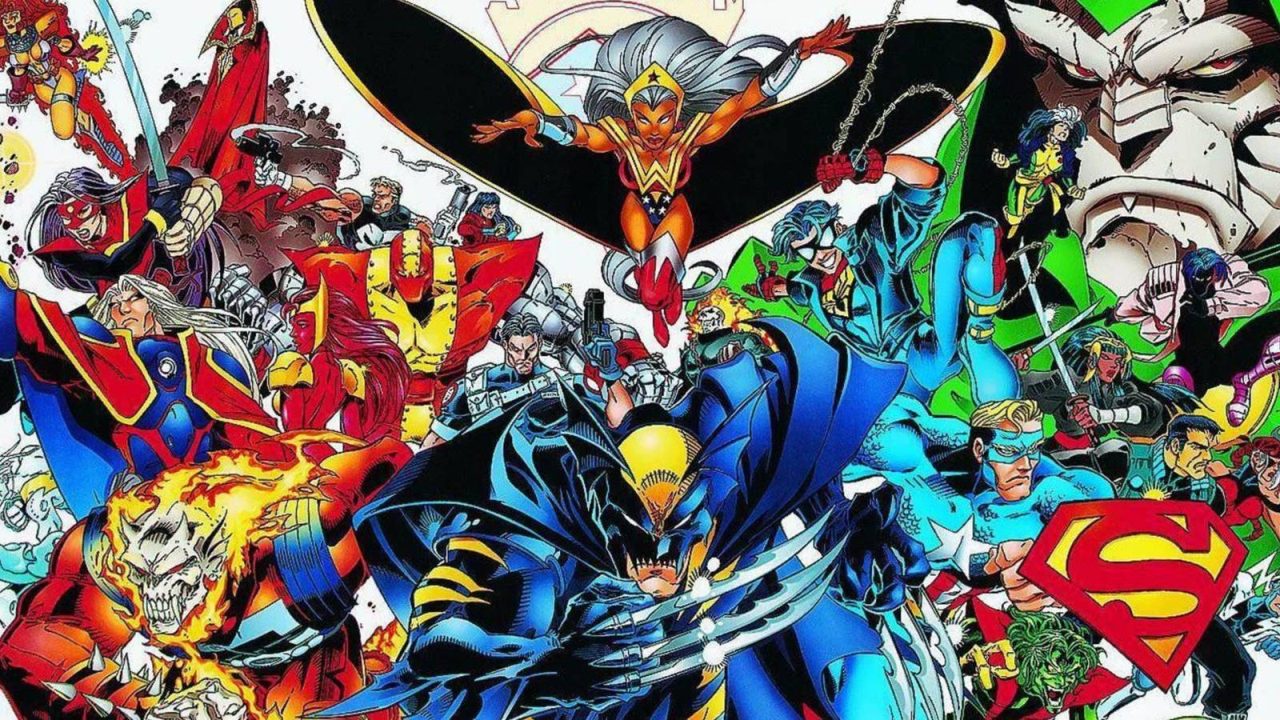
What if Marvel and DC — the two most powerful forces in comic book history — didn’t just cross over, but actually merged their entire universes into one? That’s exactly what happened in 1996, and nearly 30 years later, nothing in comics has come close to matching the sheer ambition of what they pulled off.
The Amalgam Comics universe, born from the landmark Marvel vs. DC crossover event, remains one of the most creatively daring experiments in superhero publishing history. It wasn’t just a team-up. It was a full collision — characters fused together, a shared mythology invented from scratch, and an entirely new publisher created specifically to house it all. For one brief, strange moment in the mid-1990s, the Big Two became one.
Decades on, fans still talk about it. And the more you look at what was actually attempted, the more remarkable it seems that it happened at all.
What the Amalgam Universe Actually Was
The Amalgam Comics imprint emerged directly from the Marvel vs. DC crossover series, which pitted characters from both publishers against each other in direct combat. The results of those battles helped determine which characters from each universe would be fused together into entirely new hybrid heroes.
The concept was genuinely unlike anything that had been done before. This wasn’t a guest appearance or a shared story arc. Marvel and DC literally co-published a line of comics under a fictional third publisher — “Amalgam Comics” — as if this merged universe had existed all along, complete with fake history, fake back-issue references, and letter columns written in character.
The result was a roster of hybrid characters that blended some of the most iconic names from both sides of the aisle. Dark Claw merged Batman and Wolverine. Super-Soldier fused Superman and Captain America. Spider-Boy combined Spider-Man and Superboy. Doctor Strangefate blended Doctor Strange, Doctor Fate, and Charles Xavier into a single, reality-bending figure.
The Characters That Made the Amalgam Universe Unforgettable
Part of what made Amalgam work — when it worked — was the genuine creativity behind the fusions. These weren’t random pairings. The best combinations found characters with thematic or visual overlap and pushed them into genuinely interesting new territory.
| Amalgam Character | Marvel Component | DC Component |
|---|---|---|
| Dark Claw | Wolverine | Batman |
| Super-Soldier | Captain America | Superman |
| Spider-Boy | Spider-Man | Superboy |
| Doctor Strangefate | Doctor Strange / Professor X | Doctor Fate |
| Iron Lantern | Iron Man | Green Lantern |
| JLX | X-Men | Justice League |
The line launched with 12 one-shot titles in 1996, followed by another wave of 12 in 1997. Each issue was designed to feel like it could have been pulled from a long-running series — complete with references to stories that never actually existed. That level of world-building commitment, sustained across 24 individual comics, is still impressive by any standard.
Why Nothing Has Topped It in the 30 Years Since
Marvel and DC have crossed over before Amalgam, and they’ve done it after. But the Amalgam experiment stands apart because it went further than any collaboration between the two companies has gone since.
Most crossovers keep each publisher’s characters and continuity safely separate. Characters visit. They fight or team up. Then they go home. Amalgam didn’t do that. It asked what would happen if the universes didn’t just meet — but permanently merged into something new. That required both companies to surrender a degree of creative control that, in the current era of tightly managed IP, seems almost unimaginable.
The comics industry in the 1990s was a different animal. The speculator boom had inflated sales and encouraged experimentation. Both Marvel and DC were willing to take swings that today’s corporate structures might never greenlight. Amalgam was one of those swings — and it connected in a way that still resonates with readers who experienced it.
There have been occasional hints over the years that another Marvel/DC crossover could happen, but nothing approaching the full creative merger that Amalgam represented has materialized. The rights landscape is more complicated now. The stakes — financial and otherwise — are higher. And both companies are now owned by massive entertainment conglomerates with film and television franchises to protect.
What Amalgam Meant for Comics Fans Then — and Now
For readers who grew up in the 1990s, Amalgam was a genuine event. The idea that you could hold a comic featuring a character who was simultaneously Batman and Wolverine — published with the apparent blessing of both companies — felt like something that shouldn’t have been possible.
There’s also a nostalgic warmth to the line that has only grown over time. The comics themselves vary in quality, as any anthology of 24 one-shots would. But the best of them — particularly titles built around Dark Claw and Doctor Strangefate — captured something genuinely exciting about the concept. They felt like windows into a universe that deserved to be explored further.
The fact that Amalgam ended after just two waves of comics is part of what makes it loom so large in memory. It arrived, it dazzled, and it disappeared — leaving behind a mythology that fans have spent three decades wishing someone would return to.
Could the Amalgam Universe Ever Come Back?
That question has circulated in comics fan communities for years. Both Marvel and DC have acknowledged the fondness readers have for the Amalgam era, but neither company has announced any concrete plans to revisit it.
The challenges are significant. Coordinating a creative collaboration of that scale between two competing publishers — both now subsidiaries of larger corporations — would require a level of corporate alignment that has proven difficult to sustain. The original Amalgam deal was the product of a specific moment in comics history that may simply not be replicable.
Still, the appetite is clearly there. Every few years, the conversation reignites online, new readers discover the original issues, and the argument gets made again that Dark Claw deserves another shot. Whether that ever translates into actual comics remains to be seen.
Frequently Asked Questions
What is the Amalgam Comics universe?
Amalgam Comics was a joint imprint created by Marvel and DC in 1996, publishing 24 one-shot comics featuring hybrid characters that merged heroes and villains from both publishers into single new figures.
Which characters appeared in Amalgam Comics?
Notable Amalgam characters included Dark Claw (Batman and Wolverine), Super-Soldier (Superman and Captain America), Spider-Boy (Spider-Man and Superboy), and Doctor Strangefate (Doctor Strange, Professor X, and Doctor Fate).
How many Amalgam Comics were published?
Two waves of 12 one-shot comics each were published — the first in 1996 and the second in 1997 — for a total of 24 individual issues.
Is Amalgam Comics connected to the Marvel vs. DC crossover?
Yes. The Amalgam imprint grew directly out of the Marvel vs. DC crossover event, with the outcomes of character battles in that series influencing which characters were merged together.
Will Amalgam Comics ever return?
No official return has been announced by either Marvel or DC, though fan interest in the concept has remained strong for nearly 30 years.
Why was Amalgam Comics so unusual?
Unlike standard crossovers, Amalgam presented a fully merged universe with its own fictional history, fake back-issue references, and in-character letter columns — as though the imprint had always existed independently of both companies.




Leave a Reply