
Latin America accounts for roughly 8% of global air passenger traffic, yet the region produces less than 2% of the world’s commercial aircraft components. That gap has long frustrated aviation leaders across South America. Now, one partnership signed under the bright lights of a major international air show is aiming to close it.
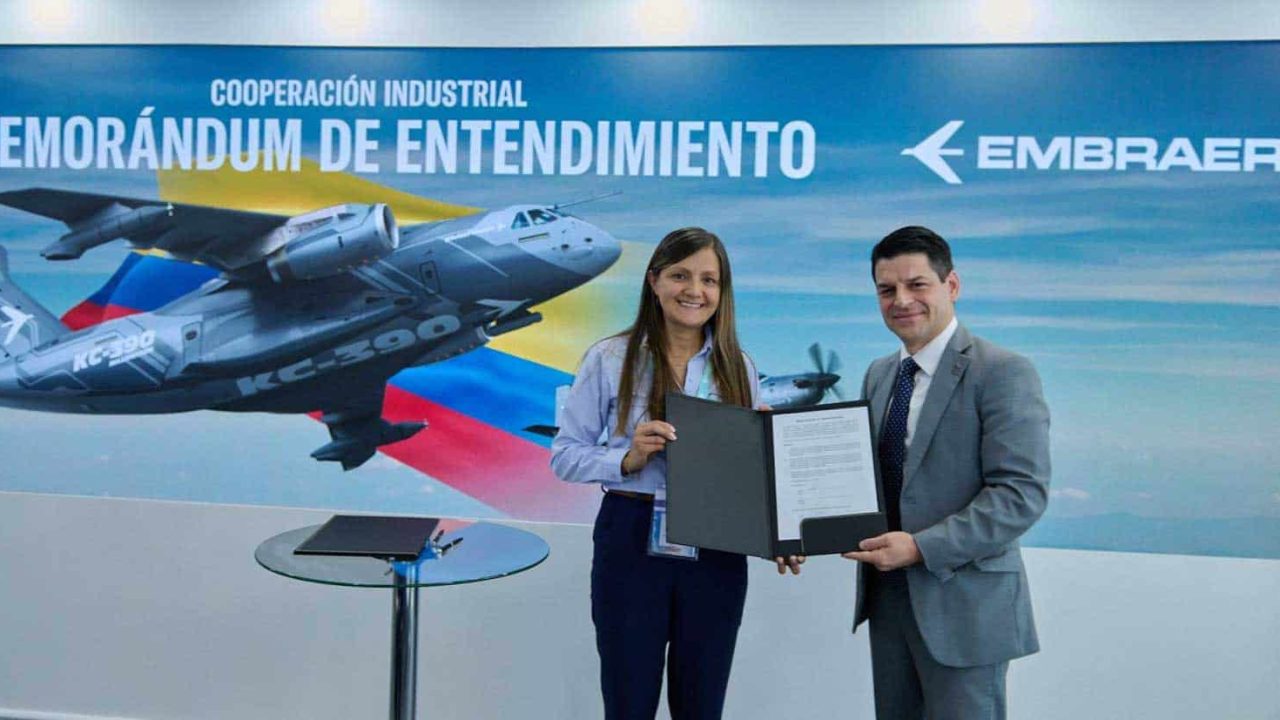
On April 9, 2026, Brazil’s Embraer and Colombia’s Colombian Aeronautical Industry Corporation (CIAC) signed a Memorandum of Understanding at FIDAE, the International Air and Space Fair held in Santiago, Chile. The agreement is designed to expand industrial cooperation, integrate Colombia into Embraer’s global supply chain, and open new doors for the country’s aerospace sector.
This isn’t just a corporate handshake. It’s a signal that Latin America is ready to build, not just buy. Here are five reasons this deal matters, ranked from important to genuinely transformative.
5. FIDAE 2026 Gave This Deal Its Global Stage
Location matters in diplomacy, and FIDAE is no ordinary venue. The International Air and Space Fair is one of the most significant aerospace events in the Western Hemisphere, drawing defense contractors, commercial aviation leaders, and government delegations from across the globe.
Signing the MoU at FIDAE was a deliberate choice. It placed the Embraer-CIAC agreement in front of a global audience at the exact moment the industry was watching. That visibility matters enormously for a country like Colombia, which has long sought recognition as a serious aerospace player rather than simply a market for imported aircraft.
The optics signal intent. When Embraer, one of the world’s top three commercial aircraft manufacturers, chooses to announce a partnership at a hemisphere-wide event, it tells competitors and investors that this collaboration is built for scale.
| Partnership Element | Detail | Significance |
|---|---|---|
| Agreement Type | Memorandum of Understanding (MoU) | Framework for deeper cooperation |
| Signed At | FIDAE 2026, Santiago, Chile | Global aerospace audience |
| Partners | Embraer & CIAC (Colombia) | Brazil-Colombia industrial bridge |
| Primary Goal | Industrial aerospace cooperation | Supply chain integration |
| Secondary Goal | Technology transfer | Elevates Colombia’s manufacturing base |
4. Colombia Gains Access to Embraer’s Cutting-Edge Technology
Embraer is not a minor player. Founded in 1969 in São José dos Campos, Brazil, the company has delivered more than 8,000 aircraft to customers in over 100 countries. Its E-Jet family and defense platforms are recognized worldwide for engineering excellence.
Through this agreement, Colombia’s aerospace sector gains something it has struggled to access independently: direct entry into a world-class technology ecosystem. CIAC will be positioned to work alongside Embraer’s engineers, learning manufacturing processes, quality standards, and supply chain logistics that typically take decades to develop organically.
This kind of technology transfer is rare. Most aerospace companies guard their intellectual property fiercely. The fact that Embraer is opening this door for Colombia suggests the partnership is built on genuine long-term strategic alignment, not just a short-term commercial arrangement.
3. CIAC’s Integration Into Embraer’s Global Supply Chain Is a Structural Shift
The language in the MoU is specific and ambitious. According to Embraer’s official statement, the goal is to “evaluate opportunities to integrate CIAC into Embraer’s global” supply chain network. That phrase carries enormous weight.
Global aerospace supply chains are extraordinarily difficult to enter. They require certified manufacturing facilities, rigorous quality control systems, and the ability to meet delivery schedules measured in days, not weeks. Companies spend years and hundreds of millions of dollars achieving the certifications required.
If CIAC successfully integrates into Embraer’s supply chain, Colombia would join a select group of countries contributing components to aircraft that fly passengers across six continents. That is not a symbolic achievement. It translates directly into skilled jobs, engineering expertise, and sustained foreign investment flowing into the Colombian economy.
2. The Deal Builds a Brazil-Colombia Aerospace Bridge With Regional Implications
Brazil and Colombia are the two largest economies in South America by some measures, yet industrial cooperation between them has historically lagged behind their economic weight. This MoU begins to change that equation in a concrete, sector-specific way.
Fabio Caparica, Vice President of Contracts at Embraer Defense and Security, has emphasized that strengthening Colombia’s aerospace industry is a primary goal of the partnership. That framing is significant. It positions the deal not as Embraer extracting value from a smaller market, but as a genuine capacity-building effort.
Other Latin American nations will be watching closely. If Colombia successfully leverages this partnership to grow its aerospace manufacturing base, it creates a template. Peru, Ecuador, and Chile all have nascent aerospace ambitions. A successful Embraer-CIAC model could inspire similar agreements across the region, gradually shifting Latin America from consumer to contributor in global aviation.
“Our goal is to further strengthen the Colombian aerospace industry and evaluate opportunities to integrate CIAC into Embraer’s global supply chain network.”
— Fabio Caparica, VP of Contracts, Embraer Defense & Security
Number 1: This Partnership Reframes Colombia as an Aerospace Destination, Not Just an Aviation Market
Here is the most consequential dimension of the Embraer-CIAC deal, and the reason it ranks above all other factors on this list. It changes the story Colombia tells about itself to the world.
For decades, Colombia has been a significant aviation market. The country’s geography, with its mountains, rivers, and remote communities, makes air travel essential rather than optional. Airlines like Avianca have deep roots in Colombian culture. But being a strong aviation market and being an aerospace manufacturing nation are entirely different identities.
The MoU with Embraer signals a deliberate national ambition to cross that threshold. CIAC is not a startup. It is an established institution with real engineering capacity. Pairing that foundation with Embraer’s global network and technological depth creates a credible path toward Colombia becoming a country that builds aviation infrastructure, not just uses it.
| Country/Entity | Aircraft Production Role | Supply Chain Integration | Aerospace Workforce Size | Annual Aerospace Revenue (Est.) | Global Market Share |
|---|---|---|---|---|---|
| Brazil (Embraer) | Full commercial aircraft manufacturer | Deep global integration (Tier 1) | ~18,000 employees | ~$5.5B USD | ~1.5% |
| Colombia (CIAC) | MRO & component manufacturing | Emerging Tier 2-3 supplier | ~2,500 employees | ~$320M USD | ~0.1% |
| Mexico | Aerospace components & assemblies | Strong North American integration | ~55,000 employees | ~$9.8B USD | ~0.4% |
| Argentina | Defense & regional aircraft | Limited global supply chain | ~8,000 employees | ~$1.2B USD | ~0.1% |
| Chile | MRO services focus | Moderate regional integration | ~3,000 employees | ~$450M USD | ~0.08% |
For travelers, this shift matters in ways that may not be immediately obvious. A stronger domestic aerospace industry means more locally maintained aircraft, faster turnaround times for repairs, and eventually, lower costs as supply chain dependencies on distant manufacturers decrease. It also means more direct international routes, as a country with deeper aerospace ties attracts more airline partnerships and code-sharing agreements.
The broader travel industry should pay attention here. Aerospace capacity and tourism infrastructure are more connected than they appear. Countries with robust aviation manufacturing attract engineering talent, which drives urbanization, which expands hotel and hospitality sectors. Colombia’s cities, already experiencing a tourism renaissance, stand to benefit from the economic multiplier effects of aerospace investment.
Bogotá, Medellín, and Cali have each worked hard to reframe their international image over the past two decades. A growing aerospace sector adds another layer of credibility to that transformation, attracting business travelers, engineering conferences, and international delegations that bring sustained economic activity rather than seasonal tourism spikes.
What Travelers and Industry Watchers Should Do With This Information
The Embraer-CIAC MoU is not a finished product. It is a starting point. MoUs are frameworks, not contracts. The real test comes in the months and years ahead, as both organizations move from signed intentions to actual industrial programs.
For travelers planning trips to Colombia, the near-term impact is minimal. Flights will not suddenly become cheaper or more frequent because of a document signed in Santiago. But the medium-term trajectory is worth watching. Colombia’s aviation infrastructure has been expanding steadily, and this partnership adds institutional momentum to that growth.
For industry observers, the deal is a data point in a larger trend: Latin America’s most capable nations are actively working to move up the aerospace value chain. Brazil did it with Embraer itself, building a company from scratch that now competes globally. Colombia is not starting from scratch, but it is starting with a serious partner.
The most interesting question the Embraer-CIAC deal raises is not whether Colombia can build aircraft parts. It almost certainly can. The question is whether this partnership marks the beginning of a sustained industrial policy or remains a well-intentioned agreement that never fully activates. History suggests the difference between those two outcomes comes down to one thing: whether both sides keep showing up after the cameras leave FIDAE.



Leave a Reply