
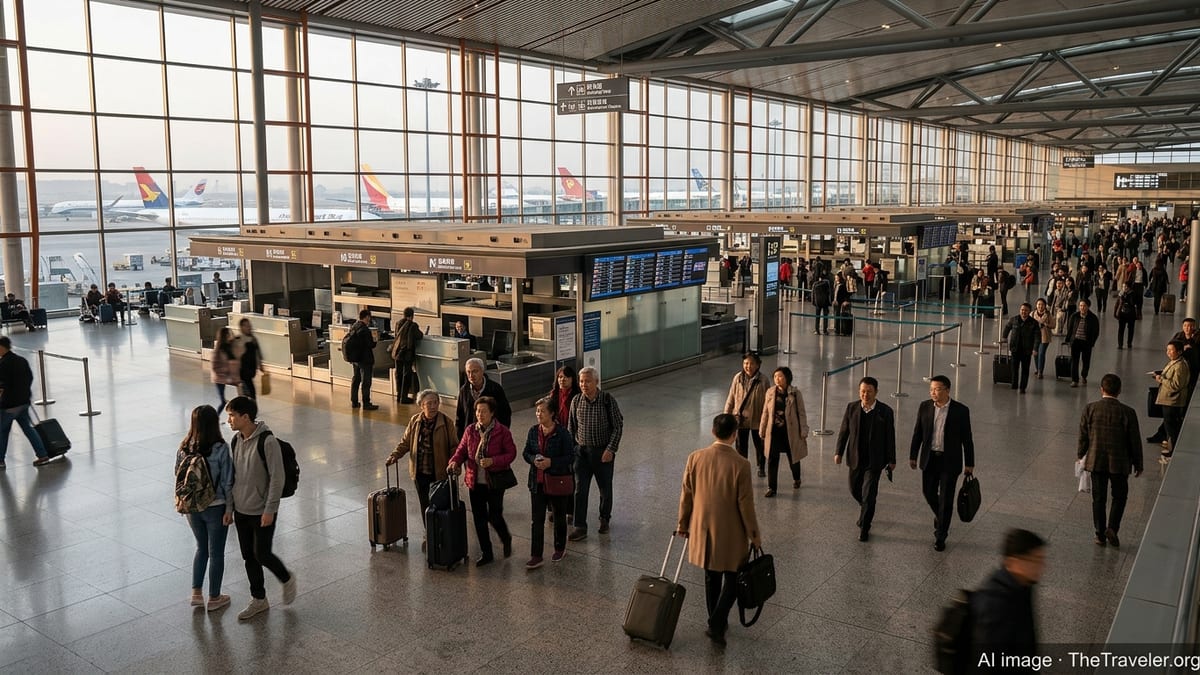
Li Wei booked her Hainan flight three weeks in advance and still barely got a seat. The island province, known to mainland Chinese as their Hawaii, was sold out. Hotels charged double. Duty-free shops had queues stretching past their entrances and into the afternoon heat.
This was Spring Festival 2026, and Li Wei’s story wasn’t unusual. It was the rule.
China’s tourism sector didn’t simply bounce back in 2026. It accelerated past every pre-pandemic benchmark, reshaped regional economies, and sent a signal to the global travel industry: the world’s largest domestic travel market is fully back, and bigger than ever.
Here are the five benchmarks that defined China’s extraordinary tourism year, counted down from impressive to genuinely historic.
Why China’s 2026 Tourism Numbers Demand Global Attention
Most post-pandemic recovery stories follow a predictable arc: a slow crawl back to 2019 levels, followed by cautious optimism. China’s 2026 tourism story isn’t that arc. It’s a vertical line.
Recent industry analyses show China’s domestic market not only recovering but expanding well beyond pre-pandemic benchmarks, according to reporting by The Traveler. Meanwhile, inbound tourism is on a trajectory that no other market currently matches.
The implications extend far beyond China’s borders. When the world’s most populous country unleashes its travel appetite at scale, airlines reroute, hotels reprice, and destination economies restructure.
| Benchmark | 2026 Figure | Significance |
|---|---|---|
| CNY Domestic Tourism Growth | +19% YoY | Record Spring Festival mobility |
| CNY Domestic Trips | 596 million+ | Highest single-holiday volume |
| Projected Domestic Visitor Spend | $968 billion | Largest domestic travel economy |
| Inbound Tourism CAGR (2026–2030) | 8.5% | Fastest-growing inbound market globally |
| Spring Festival Spending Trend | Travel over goods | Structural shift in consumer behavior |
5: Spring Festival Spending Shifted Decisively Toward Travel
For years, China’s New Year holiday meant gift-buying, red envelopes, and department store crowds. 2026 marked a clear pivot. Consumers prioritized experiences over products, choosing domestic journeys over purchases, according to data analyzed by CEIC Data.
This isn’t a minor trend. It reflects a generational shift in how Chinese consumers — particularly those under 40 — define celebration. The Spring Festival, traditionally tied to home-cooked meals and family gifts, became a travel occasion at unprecedented scale.
Retailers felt the contrast directly. Travel platforms reported booking surges while some traditional retail categories saw softer performance during the same holiday window. The vacation replaced the purchase as China’s primary expression of prosperity.
4: CNY Holiday Trips Crossed 596 Million Journeys
The sheer logistics of Chinese New Year travel have always been staggering. In 2026, they became something close to incomprehensible. Domestic tourism during the Chinese New Year holiday grew 19% year-over-year, reaching 596 million trips, as reported by Baiguan News.
To put that in perspective: 596 million trips is nearly twice the entire population of the United States moving across a single country during a single holiday. Train stations processed hundreds of millions of passengers. Airports operated at maximum capacity for days.
The infrastructure held. That itself is a remarkable story about China’s investment in transport networks over the past decade.
3: Hainan and Experiential Destinations Led the Domestic Boom
Not every destination benefited equally. The 2026 domestic surge concentrated heavily on experiential destinations: tropical islands, cultural heritage sites, and cities with strong live-event scenes. Hainan province emerged as a particular focal point.
The island’s duty-free shopping policy made it a domestic alternative to international shopping trips. Travelers who might previously have flown to Tokyo or Seoul for retail experiences redirected spending to Sanya and Haikou instead. This redirection had measurable economic effects for the province.
Meanwhile, platforms like Fliggy reported significant booking surges as AI-assisted travel planning gained mainstream adoption. Agentic AI tools began handling itinerary curation at scale, reducing friction for first-time domestic travelers in ways that accelerated the overall volume.
2: Inbound Tourism Is Projected to Grow at 8.5% CAGR Through 2030
While domestic travel grabbed headlines during Spring Festival, the quieter but equally consequential story was happening at international arrival gates. China’s inbound tourism market is projected to grow at a compound annual rate of 8.5% between 2026 and 2030, making it the fastest-growing inbound market globally, according to analysis published by the World Tourism Forum.
That figure deserves context. An 8.5% annual compound rate sustained over four years means inbound arrivals could nearly double from their current base by 2030. For airlines, hotels, and destination management companies, this represents one of the most significant capacity planning challenges in the industry.
“China’s domestic tourism market is not only recovering but expanding beyond pre-pandemic benchmarks, turning the country into a self-sustaining travel powerhouse.”
— The Traveler, 2026
Historically, Hong Kong has led visitor statistics to mainland China, with over 80 million visits recorded in peak years. Myanmar and Vietnam also feature prominently in arrival data, reflecting strong regional connectivity. However, 2026’s inbound recovery was notably broader, with Western visitor numbers climbing as visa friction reduced for several nationalities.
For U.S. travelers, the path to China still involves a standard visa application process through a consulate or authorized visa center. Early preparation remains essential given processing timelines. But the appetite is measurably returning, and China’s expanded visa-on-arrival programs for select countries are beginning to show results in arrival data.
1: $968 Billion in Domestic Visitor Spending Makes China Tourism History
This is the number that makes every other figure in this list feel like a supporting act.
The World Travel and Tourism Council projects that China’s domestic visitor spending will reach $968 billion in 2026, as cited by Mize. Nearly one trillion dollars. Spent domestically. In a single year.
To appreciate the scale: the entire tourism GDP of Macao — the world’s most tourism-dependent economy at 70.8% of GDP — generates a fraction of that figure. Even the Maldives and Aruba, the globe’s next most tourism-concentrated economies, operate in entirely different financial weight classes.
China’s number isn’t just large. It represents a structural feature of the global travel economy. When Chinese consumers redirect spending from goods to experiences, from imported luxury to domestic travel, the ripple effects touch every sector: hospitality, aviation, food and beverage, entertainment, and retail all reconfigure around this demand signal.
The $968 billion figure also illuminates why global travel brands have been reconfiguring their China strategies. It’s not merely about recovery; it’s about positioning for a market that now operates at a scale no other country’s domestic tourism sector approaches.
International brands that treated China as one market among many are now treating it as a category unto itself, with dedicated product development, localized platform strategies, and pricing architectures built specifically for this consumer base.
What This Countdown Means for Travelers and the Industry
The order of these benchmarks matters. The spending shift toward experiences over goods (number 5) is the behavioral root. The holiday mobility surge (number 4) is its first visible expression. Destination concentration in places like Hainan (number 3) shows how that mobility is channeling. Inbound growth (number 2) confirms China is reopening its doors as fast as it’s filling them. And the $968 billion projection (number 1) explains why every major travel company is watching.
For travelers planning to visit China, the practical reality is that the country has never been more geared toward welcoming visitors. Infrastructure is exceptional. Digital payment systems are increasingly accessible to foreigners. Cultural exchange is being actively promoted at the governmental level.
For the industry, the real takeaway is structural. China’s tourism boom isn’t a rebound story with a natural ceiling. The behavioral pivot toward experiential spending, combined with rising middle-class incomes and improving transport infrastructure, creates a compounding dynamic that is still in its early stages.
A market approaching one trillion dollars in domestic visitor spending, growing its inbound segment at 8.5% annually, represents something the global travel economy hasn’t seen before. The question now isn’t whether China will lead global travel in the coming decade. It’s whether the rest of the world’s destinations are ready to receive what’s coming.


Leave a Reply