
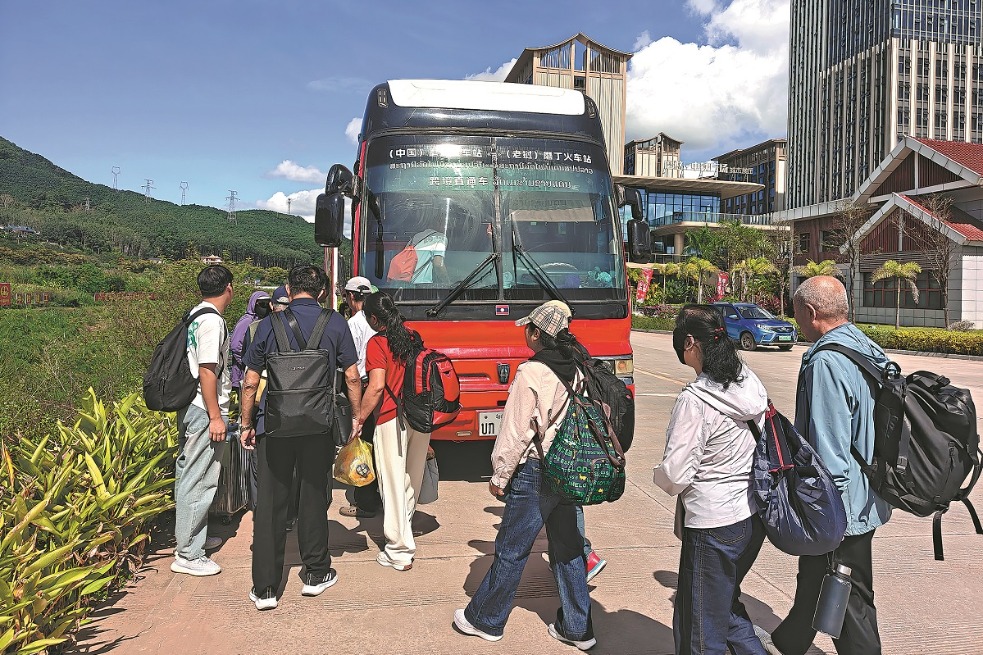
Forget the bullet train hype. The most transformative transport link between China and Southeast Asia right now rolls on rubber tires.
That might sound absurd given the billion-dollar China-Laos Railway that opened to global fanfare. But a quiet bus launch in November 2025 is doing something the railway alone never could: reaching the people and villages that high-speed rail simply cannot touch.
This is the story of a bus route that is bigger than it looks.
The Boten-Mohan Corridor and the November 3 Launch
On November 3, 2025, Laos and China officially launched a cross-border shuttle bus service between Boten, in Laos’s remote Luang Namtha province, and Mohan, on the Chinese side of the border in Yunnan. The ceremony was attended by representatives from both governments, signaling the political weight behind what might otherwise seem like a regional transit upgrade.
The route was not born in isolation. It was designed to serve as a feeder system for the China-Laos Railway, enabling seamless road-to-rail connections for international passengers. Travelers from remote Luang Namtha villages can now board a bus, reach the railway at Boten, and continue all the way to Kunming or south to Vientiane without a single painful transfer gap.
Luang Namtha is a province that most international travelers breeze past on a map. It sits in the far northwest of Laos, wedged between Myanmar, China, and the rest of the country. Its villages are heavily ethnic-minority, its roads have historically been poor, and its economic isolation has been persistent. For decades, connectivity here meant a slow, bumpy road trip or nothing at all.
That changed in November.
Why Travel Time Between Kunming and Vientiane Matters More Than You Think
Before the China-Laos Railway opened its cross-border passenger service, traveling between Kunming, the capital of Yunnan province, and Vientiane, the capital of Laos, took several days. Multiple border crossings, unreliable road connections, and long layovers made the journey an endurance test for traders and tourists alike.
The cross-border passenger service on the China-Laos Railway has dramatically compressed that timeline. Combine this with the new bus feeder route, and the regional connectivity picture looks genuinely different from what existed even eighteen months ago.
The China-Laos Railway, operated by the Laos-China Railway Company, uses Electric Multiple Unit trains capable of reaching 160 kilometers per hour. That speed is significant in a region where mountain terrain once made overland travel punishing. But speed means little if passengers cannot access the stations in the first place.
That last-mile problem is exactly what the new bus route solves.
| Connection Point | Country | Role in Route |
|---|---|---|
| Boten | Laos (Luang Namtha Province) | Southern bus terminus; China-Laos Railway connection point |
| Mohan | China (Yunnan Province) | Northern bus terminus; Chinese border crossing hub |
| Luang Namtha Villages | Laos | Remote origin points now served by feeder bus connections |
| Kunming | China (Yunnan Province Capital) | Major rail destination northbound from Boten |
| Vientiane | Laos (National Capital) | Major rail destination southbound from Boten |
The Belt and Road Blueprint Hidden in Plain Sight
None of this is accidental. The new bus route is a visible expression of the China-Laos Economic Corridor, a major infrastructure and economic development initiative that forms a key pillar of China’s Belt and Road Initiative. The BRI has attracted both admiration and skepticism globally, but in Laos, its physical footprint is undeniable.
Laos is the only landlocked country in Southeast Asia. It borders Myanmar and China’s Yunnan province to the north, Vietnam to the east, Cambodia to the south, and Thailand to the southwest. Its geography has always made trade expensive and slow. Every kilometer of new infrastructure carries outsized economic significance here.
“Since opening, the service connects directly with the China-Laos Railway, enabling seamless road-to-rail transport for international passengers.”
— China Daily, November 2025
The economic logic is straightforward. Better connectivity lowers the cost of moving goods, reduces travel time for traders, and makes Laos a more attractive destination for Chinese tourists. Yunnan alone has a population exceeding 47 million people, many of whom live within a short train ride of the Laos border. Even capturing a fraction of that potential tourism market changes the calculus for Luang Namtha’s hospitality and agriculture sectors.
What Remote Villages in Luang Namtha Actually Gain
The emotional heart of this story is not the rail terminus at Boten or the gleaming border facilities at Mohan. It is the villages further down the road in Luang Namtha that have operated for generations in near-total economic isolation.
These communities, many of them home to ethnic minorities including Akha, Tai Lue, and Khmu peoples, have traditionally relied on subsistence agriculture and small-scale trade at local markets. Getting produce to Chinese buyers meant long, expensive truck journeys on inadequate roads. Receiving goods from China meant the same in reverse.
The new bus route directly lowers those friction costs. Village traders can now reach the Boten-Mohan crossing faster and more cheaply than before. Chinese buyers can make day trips or short visits to source local goods. The service creates a new commercial pulse where there was barely a heartbeat.
| Transport Link | Type | Launch Year | Key Route | Connectivity Reach | Est. Cost Scale |
|---|---|---|---|---|---|
| Boten-Mohan Shuttle Bus | Cross-border road service | 2025 | Boten (Laos) → Mohan (China) | Remote villages to rail hubs | Low (millions USD) |
| China-Laos Railway | High-speed rail | 2021 | Vientiane → Kunming | Major cities and rail stations | $6 billion+ |
| GMS Highway Network | Regional road corridors | 2008 | Multiple ASEAN–China routes | Urban and peri-urban areas | Billions (multi-phase) |
| Mekong River Cargo Route | Inland waterway freight | 1990s (modernized 2000s) | Yunnan → Thailand/Myanmar/Laos | River-adjacent communities | Moderate (infrastructure upgrades) |
| Kunming–Bangkok Expressway (planned) | Road (under development) | TBD | Kunming → Bangkok via Laos | Intercity and rural corridors | Estimated $8–10 billion |
Tourism adds another layer. Luang Namtha province is home to Nam Ha National Protected Area, one of Laos’s finest ecotourism destinations. The province has been drawing trekkers and nature travelers for years, but the journey from China was always an obstacle. A direct bus connection to Yunnan cities, plugged into a high-speed rail network, removes that obstacle in a meaningful way.
A Connectivity Model That Southeast Asia Is Watching Closely
The Boten-Mohan bus route is being observed carefully by policymakers across the Mekong subregion. Thailand, Vietnam, Cambodia, and Myanmar all share borders with China and have their own Belt and Road infrastructure projects underway. The question being asked in transport ministries from Bangkok to Hanoi is whether a bus-rail integrated model can deliver economic results that pure railway investment cannot achieve alone.
The early signals from the China-Laos Railway’s three-year milestone are encouraging. Cross-border travel volumes have grown steadily. The new bus service adds a crucial dimension by widening the geographic catchment area for rail passengers on both sides of the border.
For travelers, the practical implications are significant. A journey that once required a private vehicle, an unreliable shared van, or a very long walk across the Lao-Chinese border is now a scheduled, official service with government backing. Predictability matters enormously for traders who need to plan shipments and for tourists who want certainty over chaos.
What began as a railway has become something closer to a regional nervous system, with the new bus route acting as a crucial nerve ending reaching into places the tracks themselves will never go.
The most powerful infrastructure is rarely the most visible. Sometimes it is a bus stop at the edge of a mountain village in Luang Namtha, waiting to carry someone somewhere they could never quite afford to go before.
Frequently Asked Questions

You Might Also Like

Woodland Tools Just Turned America’s Garden Walks Into a National Contest
This spring, a new kind of travel contest is pulling Americans off their couches and…

Brazil Is Opening Its Doors to Tourism Investment and Travelers Are Taking Notice
Three of South America’s most compelling destinations are making a coordinated push to reshape how…

Emirates and Qatar Airways Hit by Double Crisis as Flights Collapse
Thousands of travelers across the UAE are stranded, scrambling to rebook, or facing hours-long delays…
Leave a Reply