
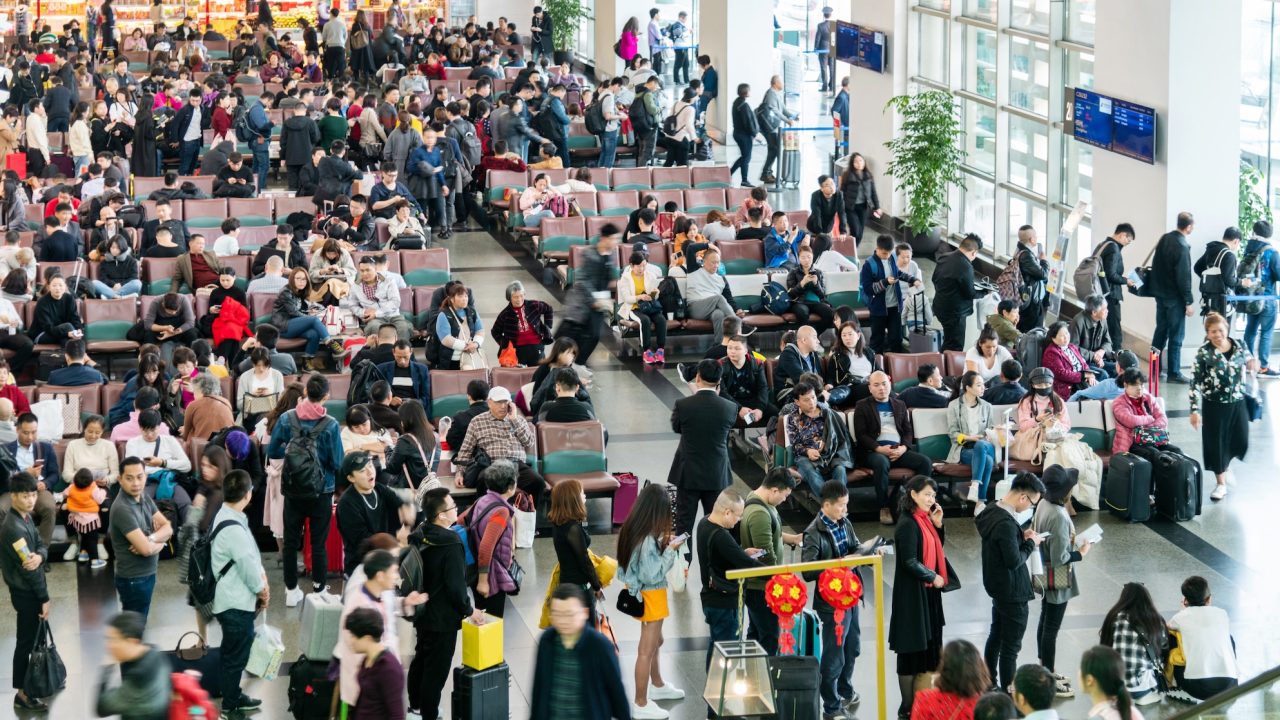
By 2050, the world’s airlines will be carrying more than twice as many passengers as they do today. That’s not a hopeful estimate — it’s the central finding of the International Air Transport Association’s latest Long-Term Demand Projections, released in March 2026, and it carries enormous implications for travelers, airports, airlines, and the planet.
The numbers are striking on their own. Global Revenue Passenger Kilometers — the aviation industry’s standard measure of traffic — stood at 9 trillion in 2024. Under IATA’s mid-range forecast, that figure climbs to 20.8 trillion RPKs by 2050. That’s not incremental growth. That’s a transformation of the entire industry.
The force behind it? Emerging markets. As economies develop across Asia, Africa, Latin America, and the Middle East, hundreds of millions of people will gain the income and infrastructure access needed to fly for the first time. What’s coming isn’t just more flights — it’s a fundamentally different global aviation system.
What IATA’s Long-Term Demand Projections Actually Show
IATA’s Long-Term Demand Projections (LTDP) are the industry’s most closely watched forecast tool. The March 2026 edition projects a compound annual growth rate (CAGR) of 3.1% from 2024 through 2050 — a rate that, sustained over nearly three decades, produces the doubling effect at the heart of the forecast.
The projections are presented in three scenarios, each reflecting different assumptions about economic growth, geopolitical conditions, and consumer behavior. All three show substantial expansion — the question is only how fast.
| Scenario | Projected RPKs by 2050 |
|---|---|
| Lower-growth scenario | 19.5 trillion RPKs |
| Mid-range scenario | 20.8 trillion RPKs |
| Optimistic scenario | 21.9 trillion RPKs |
The baseline — 9 trillion RPKs recorded in 2024 — makes the scale of projected growth easier to visualize. Even the most conservative forecast would see the industry’s traffic nearly double. The optimistic scenario would see it more than double, approaching a figure that would have seemed implausible just a generation ago.
Why Emerging Markets Are the Engine of This Growth
The aviation industry has long been dominated by routes connecting North America, Europe, and parts of East Asia. That picture is changing. The primary driver of growth between now and 2050 is expected to be strong economic development in emerging markets — regions where rising incomes are converting potential travelers into actual ones.
When a country’s middle class expands, air travel tends to follow. People fly for work, for family, for tourism. Infrastructure gets built to accommodate them. Airlines launch new routes. Airports expand. The cycle feeds itself. Across large swaths of South and Southeast Asia, sub-Saharan Africa, and Latin America, that cycle is still in early stages — which is precisely why the growth projections are so large.
The 3.1% annual growth rate projected by IATA reflects this dynamic. It accounts for the fact that mature markets like Western Europe and the United States will grow more slowly, while developing regions will expand at significantly faster rates as they catch up.
The Challenges That Come With Doubling Demand
More passengers isn’t automatically good news for everyone involved. IATA’s March 2026 forecast explicitly acknowledges that this level of growth comes with significant operational challenges — and the industry will need to confront them head-on.
Some of the most pressing concerns include:
- Airport capacity: Many of the world’s busiest airports are already operating near their limits. Doubling global passenger numbers means either expanding existing infrastructure or building new airports at a pace that hasn’t been seen in decades.
- Air traffic management: More flights mean more complex airspace. Controllers, routing systems, and communication infrastructure will all need to scale alongside demand.
- Workforce: Pilots, engineers, cabin crew, and ground staff will need to be trained and recruited in far greater numbers, particularly in fast-growing regions where aviation talent pipelines are still developing.
- Environmental sustainability: Doubling the industry’s traffic while meeting climate commitments is one of the most difficult challenges aviation faces. Sustainable aviation fuels, newer aircraft technology, and operational efficiencies will all be part of the response — but the scale of the task is significant.
These aren’t abstract concerns. Airlines and governments that fail to plan for this growth now risk bottlenecks, delays, and capacity crises that affect millions of travelers.
What This Means for Travelers Between Now and 2050
For the average person who flies — whether for work or leisure — the long-term growth in air travel demand has real, practical implications.
On the positive side, increased demand typically accelerates competition. More routes, more airlines entering new markets, and more pressure on pricing tend to benefit consumers over time, particularly in regions where air travel has historically been expensive or inaccessible.
On the other hand, the strain on infrastructure could mean more congestion at major hub airports, longer security queues, and more frequent delays if investment doesn’t keep pace with passenger numbers. The experience of flying through a major hub in 2040 will depend heavily on decisions being made right now about terminals, runways, and staffing.
For travelers in emerging markets specifically, the forecast signals something more fundamental: the realistic prospect of affordable, accessible air travel within their lifetimes — something that previous generations in those regions could not take for granted.
What the Aviation Industry Needs to Do Next
IATA’s projections are a planning tool as much as a forecast. The March 2026 LTDP is designed to give airlines, airports, governments, and infrastructure investors a clear picture of what’s coming — and the time to prepare for it.
The 2024-to-2050 window is long enough to build airports, train workforces, and develop new aircraft generations. But it’s not infinitely long. Major infrastructure projects take decades from planning to completion. Airlines that want to serve the routes of 2040 need to be placing aircraft orders, training pilots, and negotiating landing rights well before that decade arrives.
The forecast also serves as a signal to policymakers. Governments that invest in aviation infrastructure now — particularly in fast-growing regions — stand to capture significant economic benefit. Those that don’t risk being left behind as the center of gravity in global air travel continues to shift.
Frequently Asked Questions
Where does the air travel growth forecast come from?
The projections come from IATA’s Long-Term Demand Projections (LTDP), published in March 2026, which model global passenger demand through 2050.
How much will global air travel grow by 2050?
Under IATA’s mid-range scenario, global RPKs will grow from 9 trillion in 2024 to 20.8 trillion by 2050 — more than doubling over the period.
What is the projected annual growth rate for aviation?
IATA projects a compound annual growth rate (CAGR) of 3.1% from 2024 to 2050.
What is driving the increase in air travel demand?
The primary driver identified in the IATA forecast is strong economic development in emerging markets, which is expected to bring large new populations of travelers into the aviation system.
What are the main challenges the aviation industry faces with this growth?
IATA’s forecast highlights significant operational challenges, including airport capacity constraints, air traffic management complexity, workforce development needs, and environmental sustainability pressures.
Is there a scenario where growth could be lower than expected?
Yes. IATA’s LTDP includes a lower-growth scenario projecting 19.5 trillion RPKs by 2050, compared to 20.8 trillion in the mid-range and 21.9 trillion in the optimistic scenario.



Leave a Reply