
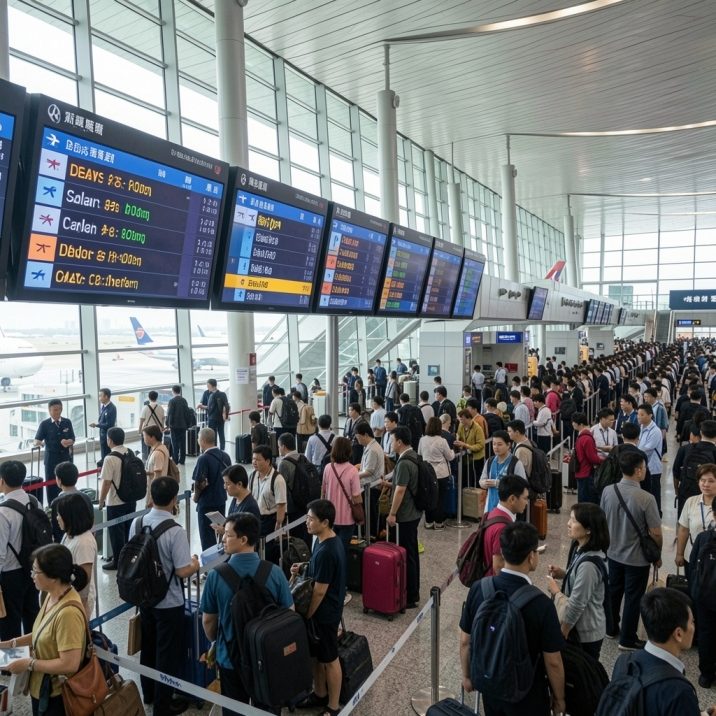
A total of 152 flight delays and 29 cancellations are rippling across Asia’s busiest aviation corridors, hitting passengers in Thailand, Malaysia, Indonesia, China, and India simultaneously and turning what should have been routine travel days into hours of uncertainty at departure gates.
The disruptions are not isolated to a single airline or airport. Carriers including Gulf Air, Qatar Airways, Batik Air, China Eastern, and Air India are among those caught up in a wave of schedule changes that is stretching across the region’s most trafficked hubs. For anyone flying through Southeast or South Asia right now, the situation on the ground is considerably more complicated than a boarding pass suggests.
This is one of those disruption events that tends to compound quickly. When major connecting hubs slow down, the knock-on effects touch flights that have nothing to do with the original cause — and passengers are often the last to find out.
Where the Disruptions Are Hitting Hardest
The pattern of delays and cancellations spans a wide geographic arc. In Southeast Asia, Kuala Lumpur and Jakarta are reporting rising wait times, while Manado — a smaller Indonesian hub — is dealing with specific flight removals from its schedule. Thailand is also seeing a steady stream of schedule changes across its network.
Further north, China’s aviation situation is described as intensive. Three cities in particular are under pressure: Shanghai, Chongqing, and Kunming. Operations at these airports are being closely monitored as the disruptions continue to develop.
India rounds out the picture, with Delhi and Bengaluru both experiencing heavy traffic conditions that have led to numerous setbacks. These are two of India’s most critical aviation gateways, and congestion at either one tends to have cascading effects on both domestic and international routes.
Airlines and Airports Affected by Asia Flight Disruptions
The scale of what passengers are facing becomes clearer when laid out by location and carrier. Here is what the current disruption landscape looks like based on confirmed reporting:
| Country | Affected Cities/Airports | Nature of Disruption |
|---|---|---|
| Malaysia | Kuala Lumpur | Increased wait times, delays |
| Indonesia | Jakarta, Manado | Delays, specific flight cancellations |
| Thailand | Bangkok (network-wide) | Steady schedule changes |
| China | Shanghai, Chongqing, Kunming | Intensive operational pressure |
| India | Delhi, Bengaluru | Heavy traffic, numerous setbacks |
Airlines confirmed as part of the broader disruption picture include:
- Gulf Air
- Qatar Airways
- Batik Air
- China Eastern
- Air India
The combination of Gulf and Qatar Airways appearing on this list is particularly notable for passengers connecting through the Middle East on their way to or from Asia. Delays on those long-haul legs can mean missed connections and extended layovers at hubs like Doha or Bahrain — airports that are already among the world’s busiest transit points.
What This Means If You Are Traveling Through the Region
For passengers currently in transit or preparing to depart from any of the affected cities, the practical reality is straightforward: check your flight status directly with your airline before heading to the airport. The total figure of 152 delays means there is a statistically significant chance that a flight touching one of these hubs is running behind schedule.
Travellers connecting through Kuala Lumpur or Jakarta face a particular challenge. Both airports serve as major regional hubs, meaning a delay on an inbound flight can easily strip away a connection buffer that looked more than adequate when the itinerary was booked.
Those flying with Batik Air, which operates extensively across the Indonesian archipelago and into Southeast Asia, should pay close attention to any updates from the carrier, given that Manado — one of its key regional ports — is specifically experiencing flight removals rather than just delays. A cancellation is a materially different situation from a delay, and passengers are typically entitled to rebooking or, in some cases, compensation depending on the airline’s home jurisdiction and applicable passenger rights rules.
Travellers on Air India routes through Delhi or Bengaluru are facing congestion-driven delays, which tend to be harder to predict in terms of resolution time than weather-related or technical disruptions. Heavy traffic situations can clear relatively quickly or stretch for hours depending on how air traffic control manages the backlog.
The Bigger Picture Behind Asia’s Aviation Pressure
Asia’s aviation sector has been operating under sustained pressure as travel demand across the region continues to run at high levels. The combination of recovering tourism, growing business travel, and increasing low-cost carrier capacity has pushed many airports close to or beyond their practical operational limits on busy travel days.
When disruptions occur simultaneously across multiple countries — as appears to be the case here — it often reflects broader systemic strain rather than a single triggering event. Observers of the region’s aviation market have noted that staffing levels, air traffic management capacity, and ground handling resources at several major hubs have struggled to keep pace with the pace of demand recovery since 2023.
The 29 cancellations recorded alongside the 152 delays suggest that some airlines have made the calculated decision to remove flights entirely rather than allow them to run severely late — a common triage approach during high-disruption periods that protects downstream scheduling at the cost of immediate passenger inconvenience.
What Passengers Should Watch For Next
The situation across these five countries is described as ongoing and developing. Passengers should treat current delay and cancellation figures as a snapshot rather than a final count, as conditions at airports like Shanghai, Delhi, and Kuala Lumpur can shift significantly within a matter of hours.
Practical steps for affected travellers include contacting airlines directly for rebooking options, checking whether travel insurance policies cover delay-related expenses, and monitoring official airport communication channels for real-time updates. Those with flexible itineraries may find it worth exploring whether alternative routing through less-affected hubs is available.
Airlines operating in the affected corridors are expected to issue updated advisories as the disruption picture becomes clearer. Until then, building in extra time and staying close to airline notifications is the most reliable approach for anyone moving through the region.
Frequently Asked Questions
Which airlines are affected by the current Asia flight disruptions?
Gulf Air, Qatar Airways, Batik Air, China Eastern, and Air India are among the carriers confirmed as part of the disruption, alongside others operating through the affected hubs.
How many flights have been delayed or cancelled?
According to the source reporting, 152 delays and 29 cancellations have been recorded across the affected countries.
Which airports are most affected right now?
Kuala Lumpur, Jakarta, Manado, Shanghai, Chongqing, Kunming, Delhi, and Bengaluru are all cited as experiencing significant disruptions.
Is Manado experiencing delays or full cancellations?
Manado is specifically reported to be managing flight removals — meaning cancellations — rather than delays alone, which is a more serious situation for affected passengers.
What should I do if my flight is caught up in these disruptions?
Check your flight status directly with your airline, arrive at the airport with extra time, and contact your carrier about rebooking options if your flight has been cancelled.
Are the specific causes of the disruptions known?
Heavy traffic conditions are cited for Delhi and Bengaluru, while operational pressure is noted across Chinese airports.




Leave a Reply