
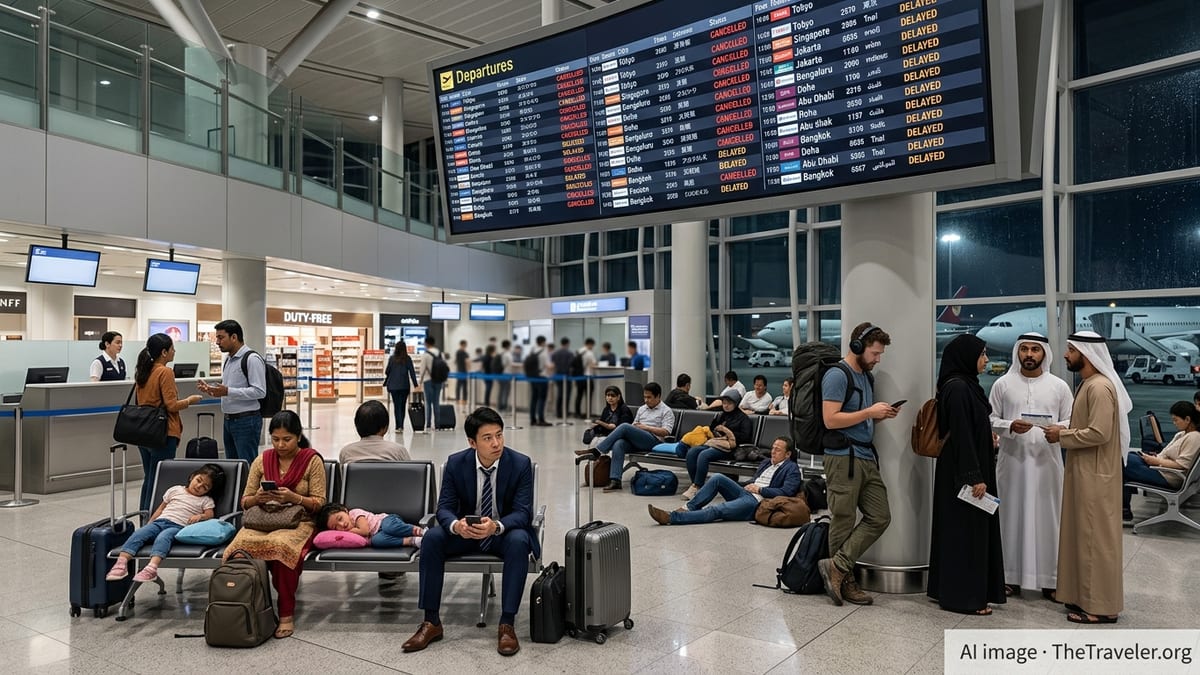
A total of 195 flights were cancelled and 2,660 flights delayed across Asia in a single day, leaving thousands of passengers stranded at some of the region’s busiest airports. The scale of the disruption touched multiple countries simultaneously — Thailand, Singapore, Japan, Indonesia, Qatar, and beyond — turning what should have been routine travel days into hours of uncertainty and frustration.
Major carriers including All Nippon Airways, China Eastern, Gulf Air, and Saudia were among those hit hardest. The chaos spread across hub airports in Tokyo, Bengaluru, Jakarta, and Abu Dhabi, with passengers left waiting at gates, scrambling for rebooking options, and searching for answers that were slow to come.
The causes were not simple. Operational failures, adverse weather conditions, and logistical breakdowns all converged to create a disruption that no single fix could resolve quickly. When that many variables stack up at once, the ripple effects move fast — a delayed departure in one city becomes a missed connection in another, and within hours an entire network is under pressure.
(function(){var wrp=document.getElementById(“paap_stat_69c89d831e9a20.44247046”);if(!wrp)return;var ids=[“paap_stat_69c89d831e9a20.44247046_c0″,”paap_stat_69c89d831e9a20.44247046_c1”];var dur=1800;function ease(t){return 1-Math.pow(1-t,3);}function anim(){ids.forEach(function(id){var el=document.getElementById(id);if(!el)return;var tgt=parseFloat(el.getAttribute(“data-target”))||0;var pfx=el.getAttribute(“data-prefix”)||””;var sfx=el.getAttribute(“data-suffix”)||””;var dec=parseInt(el.getAttribute(“data-decimals”))||0;var st=null;function step(ts){if(!st)st=ts;var p=Math.min((ts-st)/dur,1);var v=ease(p)*tgt;el.textContent=pfx+v.toFixed(dec)+sfx;if(p<1)requestAnimationFrame(step);}requestAnimationFrame(step);});}if("IntersectionObserver" in window){var obs=new IntersectionObserver(function(e){e.forEach(function(en){if(en.isIntersecting){anim();obs.disconnect();}});},{threshold:0.2});obs.observe(wrp);}else{anim();}})();
What Caused the Mass Flight Disruptions Across Asia
The disruption was not the result of one isolated incident. According to available information, a combination of operational failures, weather-related challenges, and logistical issues hit multiple countries at roughly the same time. That kind of multi-source disruption is particularly difficult for airlines to manage because the usual workarounds — rerouting aircraft, repositioning crews, borrowing gate capacity — become unavailable when the problems are spread across an entire region.
Japan, Thailand, Singapore, Indonesia, and Qatar were all affected, alongside several other nations. That geographic spread underscores how interconnected modern aviation has become. A disruption in Tokyo doesn’t stay in Tokyo. Flights feeding into and out of that hub carry passengers whose onward journeys touch dozens of other airports across Asia, the Middle East, and beyond.
For airlines like All Nippon Airways, which operates one of the largest domestic and international networks out of Japan, any significant disruption at Tokyo-area airports creates cascading problems that take days — not hours — to fully resolve.
Airlines and Airports at the Center of the Chaos
The disruption touched a wide range of carriers and locations. Here is a breakdown of what was confirmed:
| Category | Details |
|---|---|
| Total Cancellations | 195 flights |
| Total Delays | 2,660 flights |
| Countries Affected | Thailand, Singapore, Japan, Indonesia, Qatar, and others |
| Key Airports Disrupted | Tokyo, Bengaluru, Jakarta, Abu Dhabi |
| Airlines Impacted | All Nippon Airways, China Eastern, Gulf Air, Saudia |
| Causes Identified | Operational failures, weather conditions, logistical issues |
(function(){function loadChartJs(cb){if(window.Chart){cb();return;}var s=document.createElement(“script”);s.src=”https://cdn.jsdelivr.net/npm/chart.js@4.4.0/dist/chart.umd.min.js”;s.onload=cb;document.head.appendChild(s);}function initChart(){var cv=document.getElementById(“paap_chart_69c89d831ea2f7.71811425”);if(!cv)return;var dv=[“2,660″,”195″];new Chart(cv,{type:”bar”,data:{labels:[“Flights Delayed”,”Flights Cancelled”],datasets:[{data:[2660,195],backgroundColor:[“#3b82f6″,”#10b981″],borderRadius:6,borderSkipped:false}]},options:{indexAxis:”y”,responsive:true,maintainAspectRatio:false,animation:{duration:1200,easing:”easeOutQuart”},plugins:{legend:{display:false},tooltip:{callbacks:{label:function(ctx){return dv[ctx.dataIndex]||ctx.formattedValue;}}}},scales:{x:{grid:{color:”#e5e7eb”},ticks:{color:”#6b7280″}},y:{grid:{display:false},ticks:{color:”#1a1a1a”,font:{weight:600}}}}}});}var cv=document.getElementById(“paap_chart_69c89d831ea2f7.71811425”);if(!cv)return;if(“IntersectionObserver” in window){var obs=new IntersectionObserver(function(e){e.forEach(function(en){if(en.isIntersecting){loadChartJs(initChart);obs.disconnect();}});},{threshold:0.1});obs.observe(cv);}else{loadChartJs(initChart);}})();
The numbers tell one part of the story. But behind each cancelled or delayed flight is a real person — a traveller missing a business meeting, a family separated mid-journey, someone who booked months in advance only to spend the day in an airport terminal with no clear timeline for when they would get home.
Who Was Affected and What It Means for Travellers
The airports named in this disruption — Tokyo, Bengaluru, Jakarta, and Abu Dhabi — are not peripheral hubs. They are major international gateways that handle enormous passenger volumes daily. When those airports experience simultaneous pressure, the effects are felt far beyond the region.
Passengers flying with Gulf Air and Saudia, both carriers with strong Middle Eastern route networks, would have found connections to and from Abu Dhabi thrown into disarray. China Eastern operates one of the largest international footprints of any Asian carrier, meaning disruptions on its network can affect travellers heading to Europe, North America, and across Asia-Pacific. All Nippon Airways passengers in Tokyo faced their own set of complications, particularly those relying on tight domestic-to-international connections.
For travellers caught in the middle of all this, the practical reality is grim: missed connections often mean overnight stays, rebooking fees if travel insurance doesn’t cover the gap, and the stress of navigating foreign airports without clear guidance from airline staff who are themselves stretched thin.
What Passengers Should Expect Going Forward
Disruptions of this scale rarely resolve within a single day. Airlines typically need 24 to 72 hours to fully recover their networks after a widespread multi-country event — repositioning aircraft, resetting crew schedules, and clearing the backlog of rebookings all take time.
Travellers with upcoming journeys through any of the affected airports or on any of the named carriers should monitor their flight status closely and check directly with their airline for rebooking options. Most carriers activate flexible rebooking policies during major disruption events, though passengers often need to be proactive in requesting them.
Travel insurance holders should document everything — screenshots of cancellation notices, receipts for any additional expenses, and written confirmation from the airline of any changes. These records are essential when filing claims later.
The broader lesson here is one that frequent travellers already know: Asia’s aviation network is vast, deeply connected, and highly sensitive to simultaneous pressure points. When weather, operations, and logistics fail at once across multiple countries, the system doesn’t bend — it breaks, and recovery is slow.
Frequently Asked Questions
How many flights were cancelled and delayed in this disruption?
A total of 195 flights were cancelled and 2,660 flights were delayed across multiple Asian countries.
Which airlines were most affected by the disruptions?
All Nippon Airways, China Eastern, Gulf Air, and Saudia were among the carriers significantly impacted.
Which airports saw the worst disruptions?
Major disruptions were reported at airports in Tokyo, Bengaluru, Jakarta, and Abu Dhabi.
What caused so many flights to be cancelled and delayed?
The disruptions were attributed to a combination of operational failures, weather conditions, and logistical issues occurring simultaneously across the region.
Which countries were affected by the flight disruptions?
Thailand, Singapore, Japan, Indonesia, and Qatar were among the confirmed affected countries, along with several others in the region.
What should passengers do if their flight was affected?
Passengers should contact their airline directly for rebooking options and document all expenses and cancellation notices, particularly if they plan to file a travel insurance claim.



Leave a Reply