
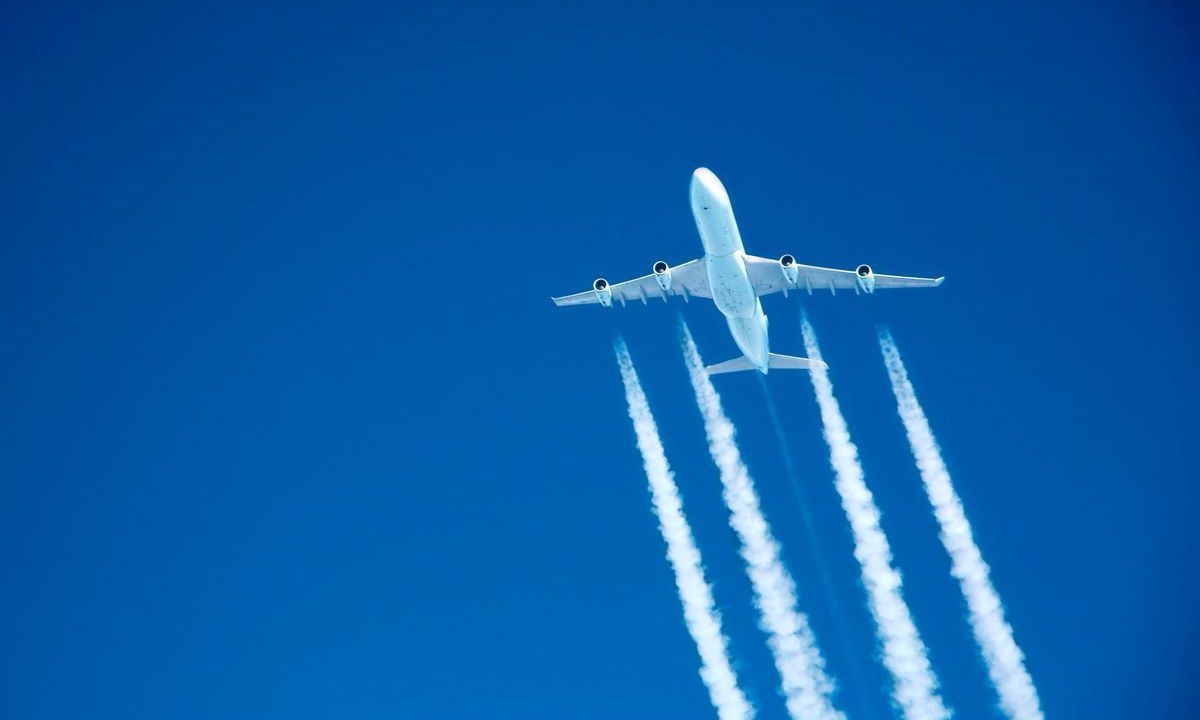
Aviation is responsible for far more climate damage than most people realize — and the part scientists understand least isn’t carbon dioxide. It’s everything else.
A new report from the Aviation Non-CO₂ Expert Network (ANCEN) has confirmed what researchers have long suspected: the non-CO₂ effects of aviation remain poorly understood, with scientific uncertainties that dwarf those surrounding CO₂ emissions. As the global aviation sector continues to grow, that knowledge gap is becoming harder to ignore.
The report is designed to lay the scientific groundwork needed for policymakers, regulators, and researchers — particularly across Europe and North America — to begin addressing these environmental blind spots in a meaningful way.
What Are Aviation’s Non-CO₂ Climate Effects — and Why Do They Matter?
When a plane burns jet fuel, it releases more than carbon dioxide. It also emits water vapor, nitrogen oxides, soot particles, and sulfur compounds. At cruising altitude, these emissions interact with the atmosphere in complex ways — forming contrail cirrus clouds, triggering chemical reactions that alter ozone concentrations, and influencing how heat moves through the atmosphere.
Collectively, these are known as non-CO₂ climate effects, and according to the ANCEN report, they are understood to contribute significantly to aviation’s overall climate impact. The challenge is that scientists still can’t pin down exactly how much — or under what conditions the effects are most severe.
This is not a minor footnote. If non-CO₂ effects are as significant as current estimates suggest, then focusing climate policy solely on aviation’s carbon footprint could mean dramatically underestimating the sector’s true environmental toll.
What the ANCEN Report Actually Found
The report is candid about the state of current knowledge. Researchers have identified several core challenges that make these effects difficult to measure, model, or regulate with confidence.
- Incomplete knowledge of atmospheric conditions — the altitude, temperature, and humidity at which planes fly all affect how emissions behave, and those variables are not fully captured in current models.
- Limited observational data — there simply isn’t enough real-world measurement of what happens to aviation emissions once they enter the upper atmosphere.
- Greater uncertainty than CO₂ — while scientists have a relatively clear picture of how CO₂ accumulates and warms the planet, the non-CO₂ effects involve more variables, shorter timescales, and more complex interactions.
- Research gaps in both Europe and the United States — the report specifically highlights the need for coordinated scientific effort across both regions.
The ANCEN network was established precisely to begin closing these gaps — bringing together experts to identify what is known, what isn’t, and what research needs to happen next.
| Effect Type | Known Contribution | Level of Scientific Certainty |
|---|---|---|
| CO₂ emissions | Significant | Relatively well understood |
| Non-CO₂ effects (combined) | Significant — possibly greater than CO₂ | High uncertainty remains |
| Contrail cirrus formation | Contributes to warming | Partially understood |
| Nitrogen oxide interactions | Affects ozone levels | Incompletely modeled |
| Water vapor at altitude | Atmospheric influence | Limited observational data |
Why Policymakers Can’t Wait for Perfect Data
One of the more uncomfortable tensions in this space is that regulators may need to act before scientists have definitive answers. Aviation is expanding globally. More flights mean more emissions — CO₂ and otherwise — and the window for early intervention is shrinking.
The ANCEN report is framed as a tool for exactly this moment. By identifying specific research gaps and knowledge needs, it gives policymakers a clearer picture of what they’re working with — and what they’re not. That transparency matters when designing emissions targets, carbon pricing schemes, or operational changes like adjusted flight paths that might reduce contrail formation.
Supporters of stronger aviation climate policy argue that the burden of uncertainty should not fall on the climate. In other words, the fact that non-CO₂ effects are hard to quantify is not a reason to exclude them from regulation — it’s a reason to invest more heavily in understanding them.
Critics, meanwhile, point to the risk of poorly designed policy based on incomplete science, which could impose costs on airlines and passengers without delivering proportionate environmental benefits.
What This Means for Travelers and the Aviation Industry
For anyone who flies regularly, this research has real implications — even if they’re not immediately visible at the departure gate.
If non-CO₂ effects are eventually incorporated into aviation climate regulations, airlines could face pressure to change more than just their fuel efficiency. Flight paths, cruising altitudes, engine technologies, and scheduling could all come under scrutiny. Those changes, if mandated, would likely have cost implications that ripple through to ticket prices.
For the aviation industry, the ANCEN report represents both a challenge and an opportunity. Airlines and aircraft manufacturers that invest early in understanding and reducing non-CO₂ effects may be better positioned as regulations evolve. Those that wait for final scientific consensus may find themselves caught off guard.
The report also underscores the importance of transatlantic coordination. Because aviation is inherently global, research and regulatory frameworks developed independently in Europe and the United States risk being misaligned — creating gaps that emissions can slip through.
What Comes Next in Non-CO₂ Aviation Research
The ANCEN report is a starting point, not a finish line. Its primary purpose is to map the scientific terrain — identifying where knowledge is solid, where it’s uncertain, and where it barely exists at all.
The next steps, as the report envisions them, involve the scientific community, regulators, and the aviation sector working together to fill those gaps. That means more observational data collection at altitude, improved atmospheric modeling, and greater information-sharing between European and American research institutions.
Whether that collaboration moves quickly enough to inform near-term policy decisions remains to be seen. But with aviation’s climate footprint under increasing scrutiny — and growing public and political pressure on the sector — the urgency is real.
Frequently Asked Questions
What is the ANCEN report?
ANCEN stands for Aviation Non-CO₂ Expert Network. Their report examines the current state of scientific knowledge about aviation’s non-CO₂ climate effects and identifies key research gaps, particularly in Europe and North America.
What are aviation’s non-CO₂ climate effects?
These include the atmospheric impacts of water vapor, nitrogen oxides, soot, and contrail cirrus clouds produced by aircraft — effects that are separate from, and potentially as significant as, CO₂ emissions.
Are non-CO₂ effects worse than CO₂ from aviation?
The ANCEN report confirms that non-CO₂ effects are understood to contribute significantly to aviation’s overall climate impact, but the exact magnitude remains uncertain due to gaps in current scientific knowledge.
Why is there so much uncertainty about these effects?
The report points to incomplete knowledge of atmospheric conditions at cruising altitude and limited real-world observational data as key reasons why non-CO₂ effects are harder to measure and model than CO₂.
Will this report lead to new aviation regulations?
The report is intended to support policymakers and regulators, but specific regulatory outcomes have not been confirmed at this stage.
Does this affect passengers or ticket prices?
Not directly yet, but if non-CO₂ effects are incorporated into future climate regulations, changes to flight operations and airline costs could eventually affect travelers. No specific policy changes have been confirmed based on this report.




Leave a Reply