
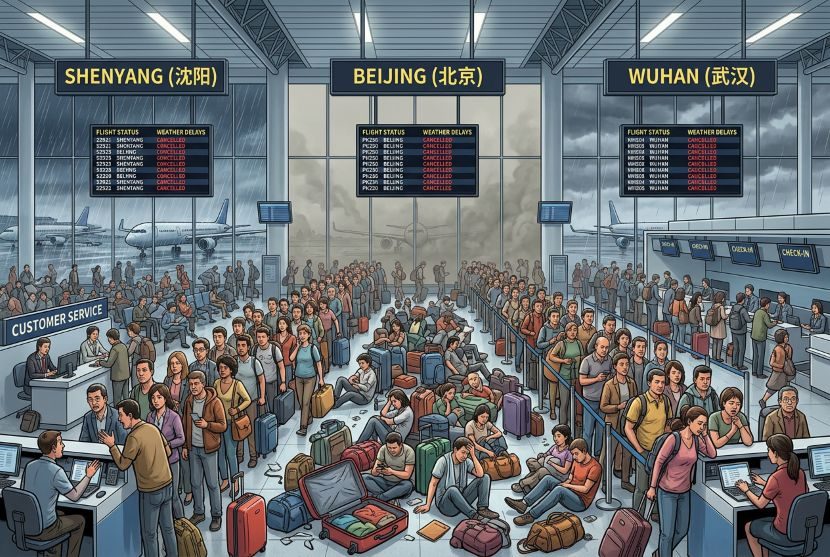
More than 740 flights were disrupted across China in a single day, leaving thousands of travelers stranded at airports from Beijing to Wuhan to Shenyang. The wave of cancellations and delays — 55 flights cancelled and 687 delayed — represents one of the more significant weather-driven aviation disruptions to hit the country’s busiest air corridors in recent months.
For anyone with a ticket on China Southern, Air China, or China Eastern, the situation has been particularly difficult. These three carriers bore the heaviest share of the disruptions, and passengers caught in the middle are now facing the kind of uncertainty that no itinerary can prepare you for.
If you’re traveling through any of the affected airports or have a connection routed through northern or central China, here’s what you need to know right now.
What Triggered the Disruptions Across China’s Air Network
Severe weather conditions across Asia are being cited as the root cause of the cascading flight disruptions. Weather-related cancellations are among the most difficult for airlines to manage because they affect multiple airports simultaneously, making rebooking and rerouting significantly more complicated than a single mechanical issue or staffing problem.
When one hub gets hit, delays ripple outward. A plane that can’t land in Shenyang means it can’t depart for its next destination. That knock-on effect is precisely what appears to have happened here, turning what might have been a localized disruption into a network-wide crisis affecting hundreds of flights.
The three airports with the most significant passenger impact are in Shenyang, Wuhan, and Beijing — three of China’s major aviation hubs that together handle enormous daily passenger volumes. When all three face simultaneous disruptions, the strain on the broader system becomes severe.
The Scale of China’s Flight Cancellations and Delays at a Glance
To understand the full picture, it helps to look at the numbers in context. Here’s a breakdown of what has been confirmed from the available information:
| Disruption Type | Number of Flights |
|---|---|
| Cancellations | 55 |
| Delays | 687 |
| Total Disrupted Flights | 742 |
The airlines most directly affected include:
- China Southern Airlines — one of the country’s largest carriers by passenger volume, with extensive domestic and regional routes
- Air China — the national flag carrier, operating major routes through Beijing Capital and other key hubs
- China Eastern Airlines — a major carrier with significant operations across central and eastern China
The airports bearing the heaviest disruption load are located in:
- Shenyang — a major northeastern hub serving Liaoning province
- Wuhan — central China’s largest city and a critical connecting point for domestic routes
- Beijing — home to Capital International Airport and Daxing International Airport, among the busiest in the world
Why Passengers in These Cities Are Feeling It Hardest
Being stuck at an airport is frustrating under any circumstances. But the combination of multiple airlines being affected at multiple airports simultaneously creates a particularly difficult situation for passengers trying to rebook.
When only one airline is disrupted, travelers often have the option of switching to a competitor’s flight. When China Southern, Air China, and China Eastern are all experiencing significant delays at the same time, the available seats on alternative flights shrink fast. Passengers who need to reach their destination urgently — for business, for medical reasons, for family emergencies — have very few good options.
Travelers at Shenyang, Wuhan, and Beijing airports are the ones most directly affected, but the ripple effects extend further. Anyone whose itinerary includes a connection through these cities may find their onward journey disrupted even if their originating airport is operating normally.
For international travelers transiting through Beijing in particular, the situation adds a layer of complexity. A delayed domestic leg can cause a missed international connection, triggering a chain of rebooking complications that can extend a journey by many hours — or in some cases, by a full day.
What Affected Travelers Should Do Right Now
If you have a flight on China Southern, Air China, or China Eastern departing from or connecting through Shenyang, Wuhan, or Beijing, the most important first step is to check your flight status directly through your airline’s official app or website before heading to the airport.
Arriving at an airport only to discover your flight has been cancelled wastes time and adds stress. Most major Chinese carriers have mobile apps that provide real-time updates, and customer service lines — though they can be heavily congested during mass disruption events like this one — remain the best channel for rebooking assistance.
A few practical steps worth taking right now:
- Check your flight status on your airline’s official platform before leaving for the airport
- Contact your airline directly to understand your rebooking options — weather cancellations typically trigger passenger protection policies
- If you have travel insurance, review your policy for weather-related delay coverage
- Keep all receipts for meals, accommodation, or transport incurred as a result of the disruption, as these may be reimbursable
- Monitor airport announcements and your airline’s social media channels for real-time updates
What Comes Next as Weather Conditions Persist
The key question for travelers is how long these conditions will last. Weather-driven disruptions of this scale typically resolve within 24 to 48 hours once conditions improve, but the backlog of delayed and rescheduled flights can take longer to clear. Airlines generally prioritize getting grounded aircraft back into rotation and working through cancellations in chronological order.
Passengers who have had flights cancelled should expect airlines to offer rebooking on the next available service, but given the volume of disruptions across three major carriers simultaneously, “next available” may mean waiting a day or more during peak periods.
The situation remains fluid. Travelers with upcoming flights through any of the affected airports over the next 48 hours should stay in close contact with their airline and avoid making any non-refundable onward travel arrangements until their flight status is confirmed.
Frequently Asked Questions
Which airlines have been most affected by the flight disruptions in China?
China Southern, Air China, and China Eastern Airlines are confirmed as the three carriers bearing the heaviest share of the disruptions.
How many flights have been cancelled and delayed?
According to the available information, 55 flights were cancelled and 687 flights were delayed, bringing the total number of disrupted flights to 742.
Which airports are seeing the worst disruptions?
Passengers at airports in Shenyang, Wuhan, and Beijing are reported to be most directly affected by the weather-related disruptions.
What is causing the flight cancellations and delays?
Severe weather conditions across Asia have been identified as the primary cause of the cascading disruptions affecting China’s aviation network.
Am I entitled to compensation if my flight was cancelled due to weather?
Weather cancellations are generally treated differently from airline-caused disruptions under most passenger protection rules — compensation eligibility will depend on your airline’s specific policies and your ticket type. Checking directly with your carrier is the most reliable course of action.
How long are the disruptions expected to last?
A specific timeline has not been confirmed. Weather-driven disruptions of this scale typically begin to ease once conditions improve, but flight backlogs can persist for 24 to 48 hours or longer after normal operations resume.




Leave a Reply