
▶ Read transcript
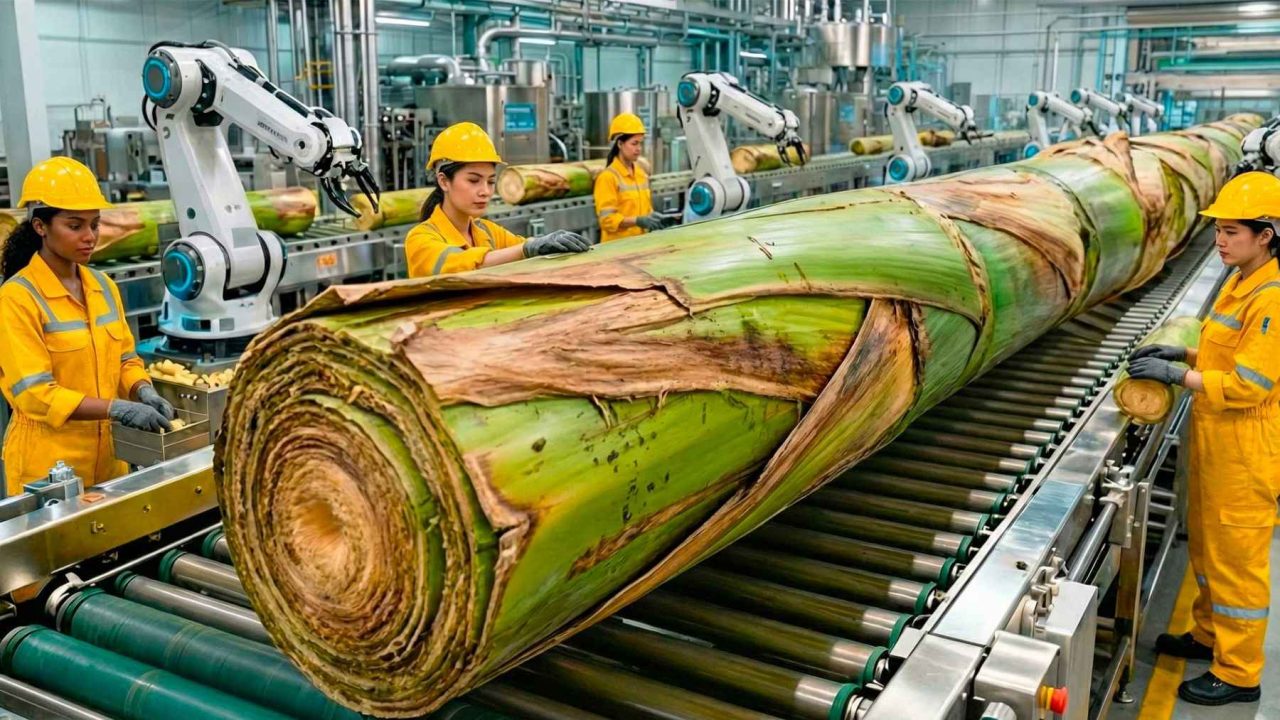
Here’s what you need to know about banana fiber and why it could change the textile industry. Every year, banana farms generate tens of millions of tons of leftover plant trunks, and until recently, farmers just burned them or left them to rot. It turns out those discarded trunks contain fiber stronger than jute or sisal, with tensile strength reaching around 570 megapascals. The problem was always extraction — pulling fiber by hand was too slow and costly to scale. That’s changing now with decortication machines that mechanically strip the fiber quickly and efficiently. Innovators are also placing small processing units directly on farms, since the fresh trunks are too heavy to haul long distances. The result is a supply chain that’s finally starting to make financial sense. If you care about sustainable materials, keep an eye on brands and manufacturers beginning to source banana fiber, because that’s your clearest signal this revolution is moving from the lab into the products you actually buy.
Maria Aparecida had grown bananas in Santa Catarina, Brazil, her entire adult life. Every year, after the fruit was cut and shipped, she watched her workers chop down the massive green trunks and leave them to decompose in the field. It felt wasteful, but nobody had ever offered a better option. Then, in early 2025, a technician from a local SENAI institute arrived with a small decortication machine and changed everything she thought she knew about her own crop.
Maria’s story is not unique. It is playing out across banana-growing regions from coastal Brazil to the Philippines, as researchers, entrepreneurs, and textile engineers race to industrialize a resource that has been discarded for generations. The stakes are enormous: millions of tons of biomass, a fiber that outperforms jute and sisal, and an industry hungry for sustainable alternatives to cotton and synthetic textiles.
Here are the five most important breakthroughs pushing banana pseudostem fiber from agricultural afterthought to genuine industrial material.
The Scale of Banana Biomass Waste Reaches 220 Tons Per Hectare
Before understanding the breakthroughs, it helps to grasp the sheer size of the problem being solved. A single hectare of banana cultivation can generate around 220 tons of pseudostem residue in certain high-yield production systems. Multiply that across the vast plantations of Brazil, India, Ecuador, and the Philippines, and the total waste runs into tens of millions of tons every year.
In Brazil alone, producer states like Santa Catarina and São Paulo generate enormous volumes of this biomass after each harvest cycle. Traditionally, farmers burned the trunks, left them to rot, or shredded them as mulch. Each option wastes a resource that, it turns out, contains remarkably strong fiber.
The fiber locked inside those trunks has tensile strength values that can reach around 570 megapascals when extracted mechanically. That number matters because it surpasses classic natural fibers like jute and sisal, which have long been the workhorses of rope, sacking, and coarse textile manufacturing. Banana fiber is not just an ecological curiosity; it is a genuinely competitive industrial material.
Decortication Machines Solve the Extraction Bottleneck
For decades, banana fiber extraction was done by hand, a slow and labor-intensive process that made commercial-scale production nearly impossible. The mechanical answer is a process called decortication, in which rotating drums or bladed rollers scrape away the soft pulpy material surrounding the fiber bundles, leaving clean, long strands behind.
The logistics challenge is real. Fresh pseudostems are extremely heavy and full of water, making long-distance hauling economically unviable. This has pushed innovators toward decentralized, farm-adjacent processing units that extract and dry fiber on-site before the lighter, dried product is transported to mills. That shift is critical to making the entire supply chain work financially.
Banana Pseudostem Fiber
Cotton
Jute
| Metric | Banana Pseudostem Fiber | Cotton | Jute |
|---|---|---|---|
| Tensile Strength |
82 |
60 |
70 |
| Sustainability |
95 |
42 |
80 |
| Moisture Absorption |
74 |
88 |
68 |
| Biodegradability |
92 |
75 |
88 |
| Cost Efficiency |
78 |
65 |
72 |
| Availability |
70 |
90 |
75 |
| Processing Ease |
55 |
85 |
65 |
Controlled Drying Unlocks Consistent Fiber Quality at Industrial Scale
Extracting fiber is only half the problem. Banana pseudostem fiber is notoriously hygroscopic, meaning it absorbs and releases moisture readily. Without controlled drying, fiber quality varies dramatically from batch to batch, making it unreliable for textile manufacturing.
Does your farm produce enough volume to justify equipment investment (roughly 1 hectare or more under cultivation)?
Banana fiber processing is not applicable to your situation. Consider exploring other agricultural waste valorization strategies relevant to your crop type.
Do you have access to a decortication machine or a local SENAI-type technical institute that can provide one?
Your farm scale may be too small for independent processing. Look into joining a cooperative or farmer collective that pools pseudostem biomass to share equipment costs and meet minimum buyer volumes.
Is there a textile manufacturer, fiber buyer, or export channel within viable transport distance of your farm?
Equipment access is your critical gap. Contact local agricultural development institutes, government programs, or NGOs working on sustainable fiber initiatives to source or lease a decortication machine before proceeding.
Can your current workforce be trained or expanded to handle pseudostem harvesting and fiber extraction alongside normal fruit operations?
Market linkage is missing. Research fiber export networks, connect with sustainable textile brands seeking banana fiber, or explore local craft and paper industries as initial buyers while building larger commercial relationships.
Strong adoption candidate. You have the land, equipment access, market channel, and labor capacity to integrate banana pseudostem fiber extraction into your operation. Begin with a pilot batch, document fiber quality, and negotiate supply agreements with buyers.
Labor capacity is your bottleneck. Explore whether seasonal workers, mechanization upgrades, or staggered harvest scheduling can resolve the workforce gap before committing to full fiber production integration.
Controlled drying chambers, calibrated to specific temperature and humidity profiles, are solving this. They produce fiber with consistent moisture content, predictable tensile properties, and better compatibility with industrial spinning equipment. This consistency is what transforms banana fiber from a craft material into a genuine industrial feedstock.
| Fiber Type | Tensile Strength (MPa) | Primary Use | Renewability |
|---|---|---|---|
| Banana Pseudostem | Up to ~570 | Textiles, paper, composites | High (waste stream) |
| Jute | ~393–800 | Sacking, rope, textiles | High (cultivated) |
| Sisal | ~400–700 | Rope, composites, paper | High (cultivated) |
| Cotton | ~287–800 | Clothing, textiles | Moderate (water-intensive) |
Paper manufacturers have also taken notice. Banana fiber pulp produces sheets with good strength and a distinctive texture, suitable for specialty papers, packaging, and artisan stationery. Some mills are blending banana pulp with recycled paper fiber to improve sheet integrity while reducing virgin wood pulp consumption.
Brazil’s SENAI Institute Brings Banana Fiber Into the Fashion Supply Chain
Academic interest in banana fiber is decades old. Industrial application is newer, and Brazil is emerging as a focal point. The FIESC (Federation of Industries of the State of Santa Catarina) has highlighted banana fiber projects developed at the SENAI Institute of Textile Technology, Apparel and Design. These projects are not laboratory experiments; they are working prototypes of fabrics made from processed pseudostem fiber, tested against commercial textile standards.
“Traditionally considered waste, these trunks are now being transformed into valuable raw materials for industries like clothing and paper.”
— Summary of the emerging banana fiber industry, April 2026
The SENAI work matters because it connects the agricultural waste stream directly to the fashion supply chain, an industry under intense pressure to reduce its reliance on water-hungry cotton and petroleum-derived synthetics. Banana fiber fabric has a natural luster and a texture that designers find appealing. It can be spun into yarn, woven, or blended with other fibers to adjust its drape and softness.
The challenge ahead is scaling. Moving from a research prototype to consistent commercial fabric production requires investment in both farm-level processing infrastructure and mill-level spinning capacity. Brazil’s industrial ecosystem, backed by FIESC and SENAI, is better positioned than most to make that leap.
The Banana Têxtil Initiative and Its BRICS Awards Recognition Signal Global Momentum
The single development that most clearly signals banana fiber’s arrival as a serious industrial sector is the international recognition now following it. The Banana Têxtil initiative, a Brazilian project focused on converting pseudostem waste into commercial textile fiber, reached the final of the BRICS Solutions Awards. That competition evaluates sustainability innovations across the economies of Brazil, Russia, India, China, and South Africa, some of the world’s largest agricultural producers.
Reaching the BRICS final places banana fiber technology in front of policymakers, investors, and industrial buyers across five major economies. It signals that the solution is replicable, not just in Brazil but in any country where bananas are grown at scale. India, the world’s largest banana producer, has its own tradition of banana fiber use in temple offerings and handicrafts. Industrializing that tradition with modern decortication and drying technology could unlock a supply chain of enormous scale.
The timing matters too. Published findings and project profiles emerging in April 2026 reflect a sector that has moved past proof-of-concept and is actively solving the logistics, quality, and investment problems that separate a promising material from a commercial one. The combination of mechanical extraction, controlled drying, SENAI’s textile engineering expertise, and international competitive recognition has compressed what might have been a 20-year development timeline into something much faster.
There is a deeper irony worth sitting with. The banana plant produces one of the world’s most consumed fruits, yet only a small fraction of the plant ever becomes food. The rest, the pseudostem, the leaves, the flower bracts, has always been treated as a problem to dispose of. The realization that this biomass contains fiber stronger than jute, suitable for clothing, paper, and composite materials, means that banana farming may eventually be valued as much for what surrounds the fruit as for the fruit itself.
The farms that once burned their trunks may one day sell the fiber for more than they earn from the bananas.
Frequently Asked Questions
Frequently Asked Questions

You Might Also Like
The Golden Fossil Lie: Jurassic Rocks Fooled Scientists for Decades
A 183-million-year-old Jurassic fossil's golden sheen wasn't pyrite at all. Scientists cracked open the truth…
The Tupperware-Sized Box That Could Revolutionize Space Mining
A Tupperware-sized box and hungry microbes on the ISS extracted metals from a real meteorite.…

The Retirement Paradox: Why Financial Security Can’t Fix Feeling Unneeded
A 2026 study of 296 retirees reveals that social participation, not savings, predicts life satisfaction.…
Leave a Reply