The Tupperware-Sized Box That Could Revolutionize Space Mining
A Tupperware-sized box and hungry microbes on the ISS extracted metals from a real meteorite. The BioAsteroid experiment may reshape space mining forever.
The Tupperware-Sized Box That Could Revolutionize Space Mining
Audio Briefing~1:02
Click play to listen to key points
▶ Read transcript
Here’s what you need to know about a tiny experiment that could change the future of space mining. Scientists sent a container about the size of a Tupperware box to the International Space Station, filled it with microbes and a chunk of real meteorite, and let biology do the work. The results, published in 2026, showed that living organisms successfully extracted 18 out of 44 tracked elements from that meteorite fragment while floating in actual microgravity. No drills, no massive machinery, just bacteria and fungi quietly dissolving metals out of rock the same way they do in some Earth mining operations today. This matters because asteroids are loaded with platinum-group metals that are increasingly scarce and geopolitically sensitive down here. The takeaway is this: if you follow space resource news, shift your attention away from the sci-fi heavy equipment stories and start watching the biomining research. That’s where the real breakthroughs appear to be happening.
The conventional picture of space mining involves massive robotic rigs, nuclear-powered drills, and trillion-dollar infrastructure floating somewhere between Earth and the asteroid belt. It is a vision borrowed from science fiction and scaled up to cosmic proportions. It is also, quite possibly, completely wrong.
The most promising advance in space resource extraction right now did not involve a single drill bit. It involved a container roughly the size of a Tupperware lunch box, a handful of microbes, and a chunk of meteorite orbiting Earth at 17,500 miles per hour. The results, published in 2026 in the journal npj Microgravity, suggest that the future of mining in space might look less like an industrial revolution and more like a biology lesson.
Why the BioAsteroid Experiment Changes the Conversation
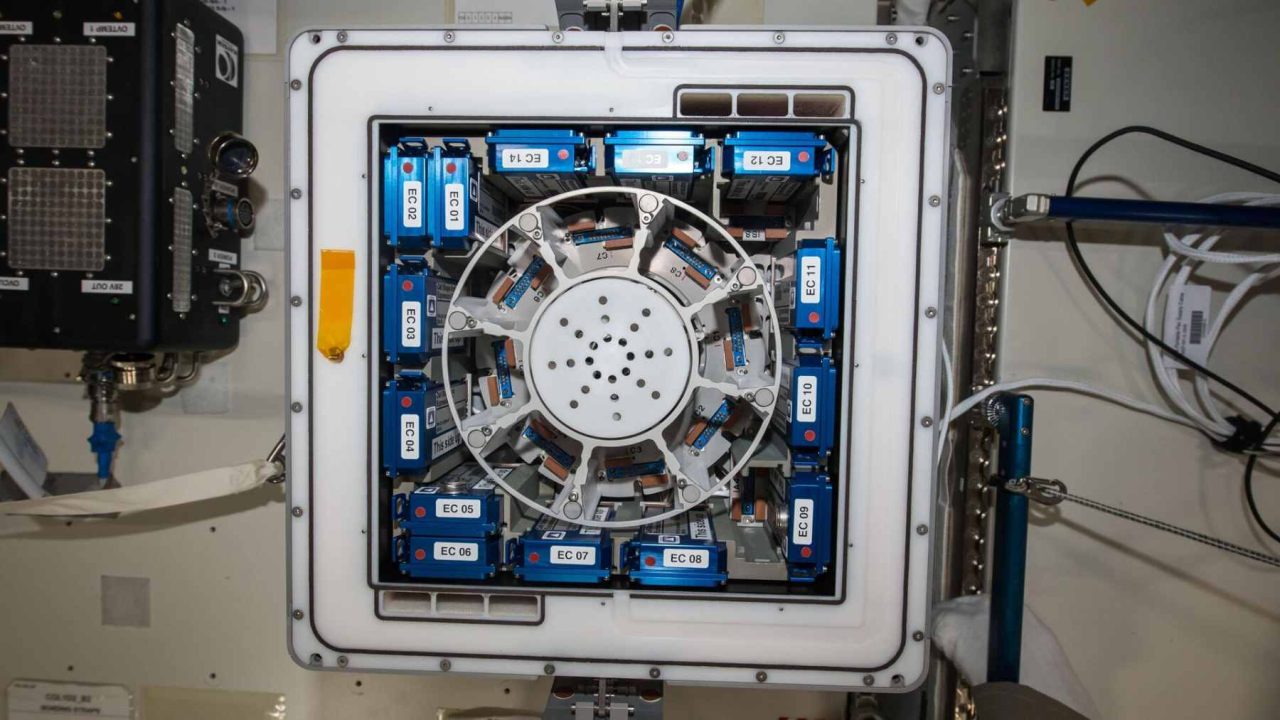
The BioAsteroid experiment was designed by research teams at Cornell University and the University of Edinburgh. It ran on the International Space Station at the end of 2020, with NASA astronaut Michael Scott Hopkins performing the in-orbit steps. The core question was deceptively simple: can microorganisms extract useful metals from asteroid material while floating in microgravity?
The answer, it turns out, is yes. Researchers tested two organisms: the bacterium Sphingomonas desiccabilis and the fungus Penicillium simplicissimum. Both were exposed to fragments of an L-chondrite meteorite, a common type of stony meteorite found on Earth that closely resembles the material making up many near-Earth asteroids. Scientists tracked 44 chemical elements across the experiment. Of those, 18 were biologically extracted by the microbes.
KEY TAKEAWAY
Living microbes successfully extracted 18 out of 44 tracked elements from a real meteorite fragment aboard the International Space Station, marking what lead researcher Rosa Santomartino called “probably the first experiment of its kind on the International Space Station on meteorite.”
Lead author Rosa Santomartino described it as “probably the first experiment of its kind on the International Space Station on meteorite.” That phrasing is careful and precise, the language of a scientist who knows exactly how significant a claim she is making. This was not a simulation. It was not a lab approximation. It happened in real microgravity, on real extraterrestrial rock, in actual orbit around Earth.
The Metals Worth Chasing Across the Solar System
To understand why anyone would bother sending microbes into space to nibble on rocks, you need to understand what those rocks contain. Asteroids and meteorites are not just inert rubble. Many are extraordinarily rich in platinum-group metals, rare earth elements, and other materials that are both economically critical and geologically scarce on Earth.
418,900 lbs
Global palladium mine production in 2025, equivalent to roughly 190,000 kilograms
374,800 lbs
Global platinum mine production in 2025, roughly 170,000 kilograms worldwide
Those numbers sound large until you consider that global demand for these metals continues to climb, driven by catalytic converters, hydrogen fuel cells, electronics, and medical devices. In 2025, about 308,600 pounds (140,000 kilograms) of palladium and platinum combined were recovered globally from scrap recycling. Supply is tight. Prices are volatile. And the geological deposits on Earth are concentrated in just a handful of countries, creating serious geopolitical vulnerabilities.
A single metallic asteroid one kilometer across could contain more platinum-group metals than humanity has ever mined in its entire history. The challenge has never been finding the material. It has been figuring out how to get it out without spending more energy and money than the metals are worth.
Approach
Mass Required
Energy Cost
Technology Readiness
Mechanical drilling rigs
Very high (tons)
Extremely high
Conceptual / early prototype
Laser ablation systems
High
Very high
Laboratory stage
Biomining (microbes)
Very low (grams)
Low (biological)
Demonstrated in orbit (2020)
Chemical leaching
Moderate
Moderate to high
Terrestrial only
How Microbes Actually Mine Metal From Rock
Biomining is not a new concept on Earth. Bacteria have been used in terrestrial mining operations for decades, particularly for extracting copper and gold from low-grade ores. Certain microorganisms produce organic acids and chelating compounds that chemically loosen metal ions from rock matrices, essentially dissolving the bonds that keep metals locked inside minerals.
Global Platinum-Group Metal Supply (2025)
Interactive data visualization
Palladium (2025)
418,900
154,300
Platinum (2025)
374,800
154,300
Combined PGM Scrap Recovery
308,600
308,600
Mine Production (lbs)
Scrap Recovery (lbs)
Source: Industry production estimates, 2025
“Probably the first experiment of its kind on the International Space Station on meteorite.”
— Rosa Santomartino, Lead Author, BioAsteroid Study
Sphingomonas desiccabilis is particularly well suited to harsh environments. It was originally isolated from desert biological soil crusts, places where UV radiation is intense, water is scarce, and conditions swing between extremes. The organism produces exopolysaccharides, sticky biological compounds that help it adhere to surfaces and concentrate metal ions. In the BioAsteroid experiment, it performed this function on meteorite fragments in microgravity.
Space Biomining Readiness Index
4.2/10
BioAsteroid demonstrated biological metal extraction in real microgravity, a critical milestone. However, scaling from a Tupperware-sized reactor to operational asteroid processing, developing in-situ metal separation, and engineering closed-loop life support for microbes in deep space remain unsolved. The technology is real but early-stage.
Penicillium simplicissimum is a fungus with a well-documented ability to solubilize insoluble metal compounds through the production of citric acid and other organic acids. On Earth, it has been studied for recovering metals from electronic waste. In orbit, it demonstrated that its chemistry works even when gravity is essentially absent.
The BioAsteroid hardware itself was compact by design. The experiment used small biomining reactors, each containing meteorite fragments, liquid growth medium, and the test organism. The entire assembly fit within a standard research container small enough to carry onto the ISS as part of a routine cargo manifest. No special launch vehicle was needed. No dedicated mission was required.
IMPORTANT
The BioAsteroid experiment used fragments of an L-chondrite meteorite, one of the most common meteorite types on Earth and chemically similar to S-type near-Earth asteroids. This makes the results directly relevant to real asteroid mining targets, not just laboratory proxies.
What Microgravity Does to Biological Extraction
One of the central unknowns before BioAsteroid was whether microgravity would impair or alter microbial metabolism. On Earth, convection currents help distribute nutrients and remove waste products around microorganisms. In space, those currents disappear. Fluid behavior changes fundamentally. The concern was that microbes might starve, become dormant, or simply fail to interact with rock surfaces the way they do under normal gravity.
18 of 44
Elements successfully extracted by microbes from meteorite fragments in microgravity aboard the ISS
The BioAsteroid results complicated that picture in interesting ways. The microbes did not simply replicate their terrestrial performance in space. Some extraction rates differed between microgravity and simulated Mars gravity conditions also tested in the experiment. This suggests that gravity level is a genuine variable in biomining efficiency, not just a background condition. Understanding exactly how and why that relationship works will be critical for designing future systems.
Biomining (Microbes)
VS
Mechanical Drilling
Reactor mass measured in kilograms, not tons
Decades of terrestrial engineering precedent
Organisms self-replicate, reducing resupply needs
Predictable performance curves and failure modes
Proven in real microgravity on actual meteorite material
Does not depend on biological life support
Low energy requirements compared to mechanical systems
Can process material faster at high throughput
Adaptable to different mineral compositions
No sensitivity to radiation or temperature extremes
VERDICT: Biomining wins on mass efficiency and self-sustainability, the two factors that dominate deep-space economics. Mechanical drilling wins on throughput and engineering maturity. For early-stage asteroid operations, biomining’s mass advantage is decisive.
The finding also raises a tantalizing possibility. If researchers can identify which conditions optimize microbial extraction in low-gravity environments, it may be possible to engineer or select microbial strains specifically adapted for use in space. Synthetic biology tools that already exist on Earth could, in principle, be applied to this problem within the next decade.
⚡What Would You Do?
You are a space agency program director with a limited budget. A proposal lands on your desk: fund a scaled-up biomining reactor test on the ISS for $40 million, or redirect that money toward a conventional robotic drilling prototype. The biomining approach is lighter and cheaper to launch, but less proven at scale. The drilling prototype is heavier and costlier, but draws on decades of terrestrial engineering.
Bold Bet
You advance a low-mass, self-sustaining technology with a demonstrated proof of concept in real microgravity. Risk: extraction rates at scale are still unknown.
Conservative
You build on established engineering traditions with predictable performance curves. Risk: mass and energy requirements may make the system economically unviable in deep space.
High Risk
You hedge your bets and advance both technologies simultaneously. Risk: neither project receives enough funding to reach a meaningful milestone within the budget cycle.
The Road From Tupperware to Asteroid Belt Operations
It would be dishonest to suggest that a single small experiment on the ISS means humanity is weeks away from microbial mining operations in the asteroid belt. The distance between proof-of-concept and operational deployment in space is enormous, measured in funding cycles, engineering challenges, and regulatory frameworks that do not yet exist.
But the BioAsteroid experiment does something important. It eliminates one of the most fundamental uncertainties in the biomining-in-space hypothesis. The question was not whether microbes could theoretically extract metals from rock. We knew they could do that on Earth. The question was whether they could do it in the actual physical conditions of space. Now we have evidence that at least two organisms can, at least partially, at least under ISS conditions.
From Lab to Asteroid: The Biomining Development Path
Step 1: Proof of Concept (Completed 2020)
BioAsteroid experiment demonstrates microbial metal extraction from meteorite fragments aboard the ISS in real microgravity conditions.
Step 2: Optimization Studies (Ongoing)
Researchers investigate which gravity levels, microbial strains, and mineral types produce the most efficient extraction. Synthetic biology candidates enter testing.
Step 3: Scaled Reactor Design
Engineers develop closed-loop biomining reactors capable of processing larger volumes of asteroid material with minimal resupply from Earth.
Step 4: In-Situ Asteroid Demonstration
A dedicated mission places a biomining payload directly on or near a target asteroid, testing extraction at the actual source rather than aboard a space station.
The next logical steps involve scaling the reactor design, testing a wider range of asteroid-analog materials, and understanding how microbial communities rather than single species might work together to improve extraction efficiency. On Earth, industrial biomining operations almost always use complex microbial consortia rather than pure cultures. The same principle likely applies in space.
Space Mining Vision: Then vs. Now
CONVENTIONAL VISION
Massive robotic drilling rigs weighing tons, nuclear power systems, laser ablation arrays, and billion-dollar dedicated missions. The assumption: space mining requires industrial-scale hardware launched from Earth at enormous cost.
POST-BIOASTEROID VISION
A kilogram-scale closed bioreactor seeded with engineered microbes, attached to an asteroid surface. Self-sustaining, self-replicating, powered by chemical energy in the rock itself. The assumption: biology has already solved the hard part.
There is also the question of what happens to the extracted metals. Biomining produces a metal-rich leachate solution. In a terrestrial mine, that solution feeds into conventional processing equipment. In space, the processing chain would need to be entirely reimagined, potentially using electrochemical separation or other low-energy methods that work in microgravity. The biology is only one piece of a much larger engineering puzzle.
What makes the biomining approach genuinely compelling, compared to mechanical alternatives, is the mass equation. Every kilogram launched from Earth to deep space costs thousands of dollars in propulsion. A mechanical drilling rig capable of processing asteroid material at scale would weigh tons. A biomining reactor capable of the same task might weigh kilograms. In the economics of spaceflight, that difference is not incremental. It is transformational.
The organisms themselves, once established in a self-sustaining culture, require only minimal nutrients and energy to continue operating. They reproduce. They adapt. In a resource-limited environment like a spacecraft or a future space habitat, a system that generates its own workforce from a small seed culture has obvious advantages over one that requires constant mechanical maintenance and spare parts shipped from Earth.
The asteroid belt contains an estimated 700 quintillion dollars worth of mineral resources, by some calculations. Whether that number is ever realized depends entirely on whether humanity can develop extraction methods that are economically viable in the conditions of deep space. The answer might not come from the engineering traditions of the Industrial Revolution. It might come from the evolutionary traditions of microbiology, refined over billions of years on a planet that, it turns out, was already practicing space mining chemistry all along.
Frequently Asked Questions
What was the BioAsteroid experiment?▶
BioAsteroid was an experiment designed by Cornell University and the University of Edinburgh that ran on the International Space Station in late 2020. It tested whether microbes could extract metals from meteorite fragments in microgravity. Results published in 2026 in npj Microgravity confirmed that 18 of 44 tracked elements were biologically extracted.
Which microbes were used in the BioAsteroid space mining experiment?▶
Researchers tested the bacterium Sphingomonas desiccabilis, originally isolated from desert soils, and the fungus Penicillium simplicissimum, known for producing metal-solubilizing organic acids. Both were exposed to fragments of an L-chondrite meteorite aboard the ISS.
Why does microgravity matter for biomining?▶
In microgravity, convection currents that normally distribute nutrients and remove waste around microbes disappear. The BioAsteroid experiment found that gravity level affects extraction rates, meaning future space biomining systems will need to account for the specific gravitational environment of their target location.
How does biological space mining compare to mechanical approaches?▶
Biomining reactors can weigh kilograms rather than the tons required by mechanical drilling systems. Since launch costs run thousands of dollars per kilogram, the mass savings from a biological approach could make asteroid mining economically viable in ways that mechanical systems currently cannot achieve.
What metals are most valuable in asteroids?▶
Asteroids are particularly rich in platinum-group metals including platinum and palladium. Global mine production of palladium in 2025 was about 418,900 pounds and platinum about 374,800 pounds worldwide, with supply concentrated in just a few countries. A single large metallic asteroid could contain more of these metals than humanity has ever mined.
⚡What Would You Do?
You are a space agency program director with a limited budget. A proposal lands on your desk: fund a scaled-up biomining reactor test on the ISS for $40 million, or redirect that money toward a conventional robotic drilling prototype. The biomining approach is lighter and cheaper to launch, but less proven at scale. The drilling prototype is heavier and costlier, but draws on decades of terrestrial engineering.
Bold Bet
You advance a low-mass, self-sustaining technology with a demonstrated proof of concept in real microgravity. Risk: extraction rates at scale are still unknown.
Conservative
You build on established engineering traditions with predictable performance curves. Risk: mass and energy requirements may make the system economically unviable in deep space.
High Risk
You hedge your bets and advance both technologies simultaneously. Risk: neither project receives enough funding to reach a meaningful milestone within the budget cycle.
This is an illustrative scenario — not financial or professional advice. Consult a qualified professional for your situation.
Frequently Asked Questions
What was the BioAsteroid experiment?▶
BioAsteroid was an experiment designed by Cornell University and the University of Edinburgh that ran on the International Space Station in late 2020. It tested whether microbes could extract metals from meteorite fragments in microgravity. Results published in 2026 in npj Microgravity confirmed that 18 of 44 tracked elements were biologically extracted.
Which microbes were used in the BioAsteroid space mining experiment?▶
Researchers tested the bacterium Sphingomonas desiccabilis, originally isolated from desert soils, and the fungus Penicillium simplicissimum, known for producing metal-solubilizing organic acids. Both were exposed to fragments of an L-chondrite meteorite aboard the ISS.
Why does microgravity matter for biomining?▶
In microgravity, convection currents that normally distribute nutrients and remove waste around microbes disappear. The BioAsteroid experiment found that gravity level affects extraction rates, meaning future space biomining systems will need to account for the specific gravitational environment of their target location.
How does biological space mining compare to mechanical approaches?▶
Biomining reactors can weigh kilograms rather than the tons required by mechanical drilling systems. Since launch costs run thousands of dollars per kilogram, the mass savings from a biological approach could make asteroid mining economically viable in ways that mechanical systems currently cannot achieve.
What metals are most valuable in asteroids?▶
Asteroids are particularly rich in platinum-group metals including platinum and palladium. Global mine production of palladium in 2025 was about 418,900 pounds and platinum about 374,800 pounds worldwide, with supply concentrated in just a few countries. A single large metallic asteroid could contain more of these metals than humanity has ever mined.
The Editorial Team is the named, credentialed group responsible for every article on this site. Each piece is researched by a section editor, reviewed by a credentialed practitioner where the topic warrants it, and signed off by the Editor in Chief before publication. The corrections process is public; named editors are accountable.



Leave a Reply