The Golden Fossil Lie: Jurassic Rocks Fooled Scientists for Decades
A 183-million-year-old Jurassic fossil's golden sheen wasn't pyrite at all. Scientists cracked open the truth — and it changes how we read ancient life.
The Golden Fossil Lie: Jurassic Rocks Fooled Scientists for Decades
Audio Briefing~1:03
Click play to listen to key points
▶ Read transcript
Here’s what you need to know about a discovery that just rewrote the textbook on fossil preservation.
For decades, scientists looked at golden-shimmering fossils from a 183-million-year-old rock formation in Germany and assumed they were seeing pyrite, also known as fool’s gold. It seemed obvious. The environment was right, the color matched, and nobody questioned it. Then a doctoral researcher named Sinjini Sinha did something deceptively simple — she counted microscopic crystals. She found 800 pyrite clusters in the surrounding rock, but only three or four on the actual fossils themselves. That’s not a small discrepancy. That’s the assumption collapsing entirely.
The golden sheen turned out to be phosphate minerals, not pyrite at all. This process, called phosphatization, can preserve soft tissue at stunning resolution — skin, organs, even muscle outlines.
Your takeaway: if you follow paleontology, watch for studies revisiting old fossil collections with new elemental analysis. Decades of conclusions may be due for a second look.
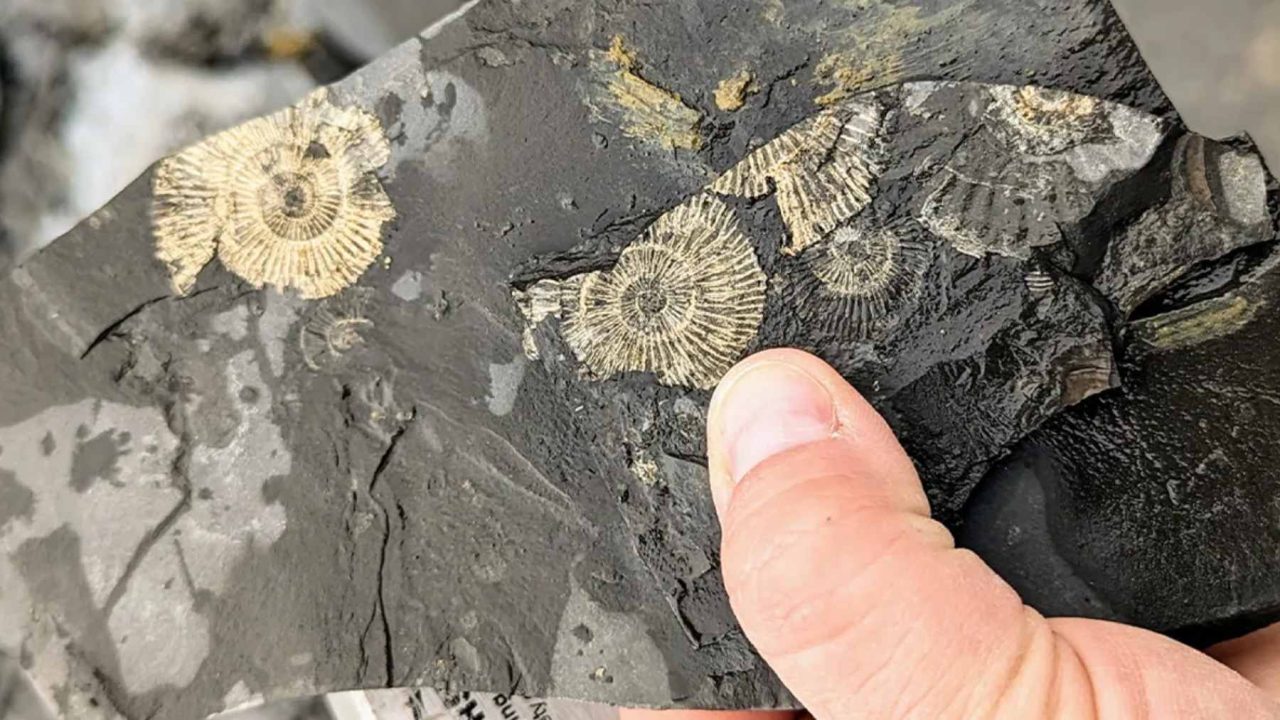
The rock sat in a museum drawer, black and unremarkable on the outside. Then a researcher cracked it open, and the inside blazed gold. For decades, scientists assumed they knew exactly what caused that shimmer. They were wrong.
This is the story of a 183-million-year-old deception, a microscopic counting experiment, and a discovery that forces paleontologists to rethink how ancient creatures are preserved. It is also, quietly, one of the most important fossil stories of the last several years.
Five Reasons the Posidonia Shale Has Always Been Special
Before we get to the revelation itself, it helps to understand why the Posidonia Shale of southwestern Germany attracts scientists from around the world. This formation is not just old. It is extraordinary in ways that stack up like a countdown of geological luck.
The Posidonia Shale: A Timeline of Significance
183 Million Years Ago
Marine creatures die and sink into oxygen-poor sediment in what is now Germany, beginning an extraordinary preservation process.
Early 20th Century
Fossil hunters begin systematically recovering ichthyosaurs, plesiosaurs, and ammonites from the black shale, many with soft tissue intact.
World War II
Some specimens, including the plesiosaur Plesiopterys wildi, were buried underground to protect them from bombing — and remained hidden for 80 years.
2025
A University of Texas at Austin team publishes findings in Earth-Science Reviews revealing the golden sheen in these fossils is not pyrite at all.
The formation preserves soft tissue at a rate that makes other fossil sites look impoverished by comparison. Skin, organs, outlines of muscle — all locked inside black rock for nearly two centuries of geological time. That preservation is precisely why the new findings matter so much.
Now, the countdown. Here are the five most surprising layers of this discovery, building toward the revelation that overturned decades of assumption.
Five: The Golden Appearance That Started Every Assumption
Crack open a piece of Posidonia Shale and you often find fossils that glow with a warm, metallic gold. Ammonites, in particular, seem to be gilded from the inside. The color is striking enough to make non-scientists gasp and trained paleontologists nod knowingly.
That knowing nod was the problem. For decades, the consensus explanation was simple: pyrite. Iron sulfide, also called fool’s gold, forms in oxygen-depleted sediments when bacteria break down organic matter. It produces that distinctive golden luster. The Posidonia Shale is exactly the kind of anoxic environment where pyrite thrives. The assumption seemed airtight.
IMPORTANT
Pyrite, or iron sulfide (FeS2), forms in low-oxygen sediments and is one of the most common minerals associated with fossil preservation worldwide. Its golden color has led to countless misidentifications — not just in Germany, but across fossil sites globally.
Nobody tested the assumption rigorously. The fossils looked golden. Pyrite looks golden. Case closed. Except it was not closed at all.
Four: The Raspberry Crystals That Should Have Been Everywhere
Pyrite does not just create a smooth golden surface. It often forms in distinctive microscopic clusters called framboids — tiny, raspberry-shaped groupings of iron sulfide crystals. Under a scanning electron microscope, they are unmistakable. And in pyrite-rich fossil sites, they are everywhere.
800
Framboids counted on the surrounding rock matrix by doctoral researcher Sinjini Sinha
3–4
Framboids found directly on the fossil specimens themselves — even the most golden-looking ones
Doctoral researcher Sinjini Sinha, working with the University of Texas at Austin team, did something painstaking and methodical. She counted framboids. Eight hundred of them on the surrounding rock matrix. Three or four on the actual fossils.
Framboid Distribution: Matrix vs. Fossil Specimens
Interactive data visualization
Surrounding Rock Matrix
800
20
Golden-Appearing Fossil Specimens
4
95
Non-Fossil Shale Control Samples
650
15
Framboids Counted
Phosphate Signal
Source: University of Texas at Austin / Earth-Science Reviews, 2025
That gap is not a rounding error. It is a complete reversal of what you would expect if pyrite were responsible for the golden color. If pyrite caused the sheen, framboids should cluster on the fossils, not avoid them.
How Scientists Read the Posidonia Shale Fossils
BEFORE 2025
Golden sheen interpreted as pyrite (fool’s gold). Preservation assumed to be iron sulfide-based. Soft tissue detail considered incidental. Decades of papers built on unverified visual identification.
AFTER 2025
Golden sheen confirmed as phosphate minerals. Preservation identified as phosphatization — one of the finest-resolution processes known. Skin texture and dual skin types on Plesiopterys wildi confirmed. Prior interpretations flagged for re-examination.
Three: The Mineral That Actually Preserved These Creatures
So if not pyrite, then what? The University of Texas team ran elemental analysis on the golden fossils and found the answer waiting in plain sight. Every single specimen was primarily composed of phosphate minerals.
The process is called phosphatization, and it is one of paleontology’s most powerful preservation mechanisms. When an organism dies in the right chemical conditions, phosphate ions from the surrounding water or sediment infiltrate soft tissues before they decay. The result is a mineral cast that can preserve structures at extraordinary resolution — skin texture, cell outlines, sometimes even internal organs.
“They discovered that every single fossil was primarily made up of phosphate minerals. So, not pyrite, but the fossils’ outer layer of black shale had been hiding something far more chemically complex than anyone realized.”
— IFLScience, reporting on the Earth-Science Reviews study
Phosphatization is known to occur in marine environments with specific bacterial activity and pH conditions. The Posidonia Shale, it turns out, was not just an anoxic grave. It was a chemical laboratory perfectly tuned to replace biology with geology, one molecule at a time.
Two: What the Plesiosaur Skin Revealed Once Scientists Knew Where to Look
Understanding that phosphatization was the dominant preservation process changed what researchers could extract from these fossils. The plesiosaur Plesiopterys wildi, recovered from the same formation and hidden underground during World War II for protection from bombing, became a key specimen.
Once scientists understood the true chemistry at work, they could interpret the preserved tissues with new precision. The results were remarkable. Plesiopterys wildi had both smooth skin and scaly skin on different parts of its body. The smooth sections likely helped it move efficiently through open water. The scaly sections may have protected it when navigating rough seabeds.
Feature
Old Assumption (Pyrite)
New Finding (Phosphatization)
Preservation mineral
Iron sulfide (pyrite)
Calcium phosphate
Framboid count on fossils
Expected: high
Actual: 3–4 per specimen
Soft tissue preservation
Incidental
Core mechanism of phosphatization
Skin detail readable?
Uncertain
Yes — smooth and scaly regions identified
Published in
Decades of assumption
Earth-Science Reviews, 2025
This is what happens when you correct a foundational misidentification. The data does not just shift slightly. It opens entirely new biological questions about how Jurassic marine reptiles actually lived and moved.
Pyrite Preservation
VS
Phosphatization
Forms in low-oxygen, sulfur-rich sediments
Phosphate ions replace organic tissue before decay
Creates golden framboid clusters visible under microscope
Can preserve skin, cells, and internal structures
Common in marine black shales worldwide
Produces golden/amber color that mimics pyrite visually
Preserves gross morphology but limited soft tissue detail
Framboids nearly absent on phosphatized specimens
Was the assumed mechanism for 50+ years in Posidonia Shale
Confirmed as the actual mechanism by University of Texas team
VERDICT: Phosphatization wins as the true preservation mechanism — and offers far richer biological data than pyrite ever could.
One: Why Misidentifying a Mineral for 50 Years Actually Matters
Here is the number one revelation, and it goes well beyond a single fossil site in Germany.
⚡What Would You Do?
You are a paleontologist examining a newly excavated fossil from a black shale formation. It has a vivid golden sheen. Your senior colleague says it is obviously pyrite and moves on. Do you accept that or investigate further?
Assumption Risk
You save time but risk building interpretations on a false chemical foundation, potentially misreading the preservation quality and biological detail available.
Best Practice
You spend extra time but confirm the actual mineral composition, opening the possibility of finding phosphate preservation and far richer biological data.
Missed Opportunity
The assumption persists in the published record. Another researcher may catch the error decades later — or may not.
Paleontologists worldwide use mineral identification as a guide to understanding preservation quality. If a fossil is preserved in pyrite, researchers draw certain conclusions about the burial environment, the chemistry of decay, and which biological structures might survive. If it is preserved in phosphate, the interpretive framework changes entirely.
KEY TAKEAWAY
The golden color of Posidonia Shale fossils was never pyrite. It was phosphate minerals all along — and that distinction means decades of interpretations about these Jurassic creatures may need to be revisited with fresh analytical eyes.
The Posidonia Shale has been studied intensively for well over a century. Researchers have published thousands of papers on its fossils. Many of those papers made assumptions about preservation chemistry that were based on visual identification alone. The golden color said pyrite. Nobody looked harder.
183,000,000
Years these fossils waited for the correct chemical identification
Sinjini Sinha’s framboid count is the kind of work that seems almost comically simple in retrospect. Count the crystals. See where they cluster. Follow the data. But science often works this way: the decisive insight is not the most complex one. It is the one someone actually bothered to check.
The implications ripple outward. Other fossil sites with similar visual characteristics may have been misidentified the same way. Phosphatization may be more common in Jurassic marine deposits than current literature acknowledges. And the biological information locked inside phosphate-preserved specimens — the skin textures, the tissue outlines, the structural details — may be far more readable than researchers previously assumed, because phosphate preserves at finer resolution than pyrite.
Posidonia Shale Preservation Quality Index
9.2/10
Now that phosphatization is confirmed as the dominant mechanism, the Posidonia Shale ranks among the highest-quality soft tissue preservation sites on Earth. Its combination of anoxic burial, phosphate-rich chemistry, and fine-grained sediment creates near-ideal conditions for biological detail retention across 183 million years.
For Plesiopterys wildi specifically, the corrected chemistry helped confirm something that would have seemed speculative under the old framework: that a single animal could have two distinct skin types serving two different functions. That is a biological insight with real consequences for understanding how plesiosaurs occupied their ecological niche 183 million years ago.
IMPORTANT
Phosphatization can preserve soft tissues at cellular resolution — far finer than most other fossilization processes. This means specimens previously dismissed as having limited biological information may actually contain extraordinary detail, waiting for the right analytical approach.
What This Means for Every Fossil With a Golden Sheen
The takeaway from the Posidonia Shale study is not just about one formation or one research team. It is a reminder that visual identification in paleontology carries real risk. Color is not chemistry. Appearance is not composition.
The study, published in Earth-Science Reviews, calls for re-examination of other fossil sites where pyrite has been assumed rather than confirmed. That is a significant ask. It means going back to specimens in museum collections around the world and running the kind of elemental analysis that Sinha’s team applied in Germany.
Some of those re-examinations will confirm pyrite. Others may find the same phosphate signal hiding behind the same golden glow. And each corrected identification could unlock biological data that has been sitting unread in a museum drawer for a century.
The black rock from the Posidonia Shale was not hiding fool’s gold. It was hiding something far more valuable: proof that the past is never as well understood as we think, and that the most important scientific discoveries sometimes begin with someone deciding to count raspberry-shaped crystals one by one.
Frequently Asked Questions
What mineral was actually responsible for the golden color in the Posidonia Shale fossils?▶
Phosphate minerals, not pyrite (fool’s gold) as previously believed. A University of Texas at Austin team found that every fossil examined was primarily composed of calcium phosphate, with almost no pyrite framboids present on the specimens themselves.
What are framboids and why did counting them matter?▶
Framboids are microscopic, raspberry-shaped clusters of pyrite crystals that form in low-oxygen sediments. Doctoral researcher Sinjini Sinha counted 800 framboids on the surrounding rock matrix but only 3 to 4 on the actual fossils — a distribution that directly contradicted the pyrite hypothesis.
What is phosphatization and why is it significant for fossil preservation?▶
Phosphatization is a process where phosphate ions infiltrate organic tissues before decay, creating a mineral cast that can preserve soft tissue structures at very fine resolution. It can capture skin texture, cell outlines, and sometimes internal anatomy — making it one of the most information-rich preservation processes known.
What did the corrected mineral identification reveal about Plesiopterys wildi?▶
Understanding that phosphatization was the preservation mechanism allowed researchers to confirm that Plesiopterys wildi had two distinct skin types: smooth skin for efficient swimming in open water and scaly skin likely used for protection near rough seabeds.
Where were these fossils found and how old are they?▶
The fossils were found in the Posidonia Shale formation in southwestern Germany. They are approximately 183 million years old, dating to the Early Jurassic period. The findings were published in the journal Earth-Science Reviews.
⚡What Would You Do?
You are a paleontologist examining a newly excavated fossil from a black shale formation. It has a vivid golden sheen. Your senior colleague says it is obviously pyrite and moves on. Do you accept that or investigate further?
Assumption Risk
You save time but risk building interpretations on a false chemical foundation, potentially misreading the preservation quality and biological detail available.
Best Practice
You spend extra time but confirm the actual mineral composition, opening the possibility of finding phosphate preservation and far richer biological data.
Missed Opportunity
The assumption persists in the published record. Another researcher may catch the error decades later — or may not.
This is an illustrative scenario — not financial or professional advice. Consult a qualified professional for your situation.
Frequently Asked Questions
What mineral was actually responsible for the golden color in the Posidonia Shale fossils?▶
Phosphate minerals, not pyrite (fool’s gold) as previously believed. A University of Texas at Austin team found that every fossil examined was primarily composed of calcium phosphate, with almost no pyrite framboids present on the specimens themselves.
What are framboids and why did counting them matter?▶
Framboids are microscopic, raspberry-shaped clusters of pyrite crystals that form in low-oxygen sediments. Doctoral researcher Sinjini Sinha counted 800 framboids on the surrounding rock matrix but only 3 to 4 on the actual fossils — a distribution that directly contradicted the pyrite hypothesis.
What is phosphatization and why is it significant for fossil preservation?▶
Phosphatization is a process where phosphate ions infiltrate organic tissues before decay, creating a mineral cast that can preserve soft tissue structures at very fine resolution. It can capture skin texture, cell outlines, and sometimes internal anatomy — making it one of the most information-rich preservation processes known.
What did the corrected mineral identification reveal about Plesiopterys wildi?▶
Understanding that phosphatization was the preservation mechanism allowed researchers to confirm that Plesiopterys wildi had two distinct skin types: smooth skin for efficient swimming in open water and scaly skin likely used for protection near rough seabeds.
Where were these fossils found and how old are they?▶
The fossils were found in the Posidonia Shale formation in southwestern Germany. They are approximately 183 million years old, dating to the Early Jurassic period. The findings were published in the journal Earth-Science Reviews.
The Editorial Team is the named, credentialed group responsible for every article on this site. Each piece is researched by a section editor, reviewed by a credentialed practitioner where the topic warrants it, and signed off by the Editor in Chief before publication. The corrections process is public; named editors are accountable.




Leave a Reply