
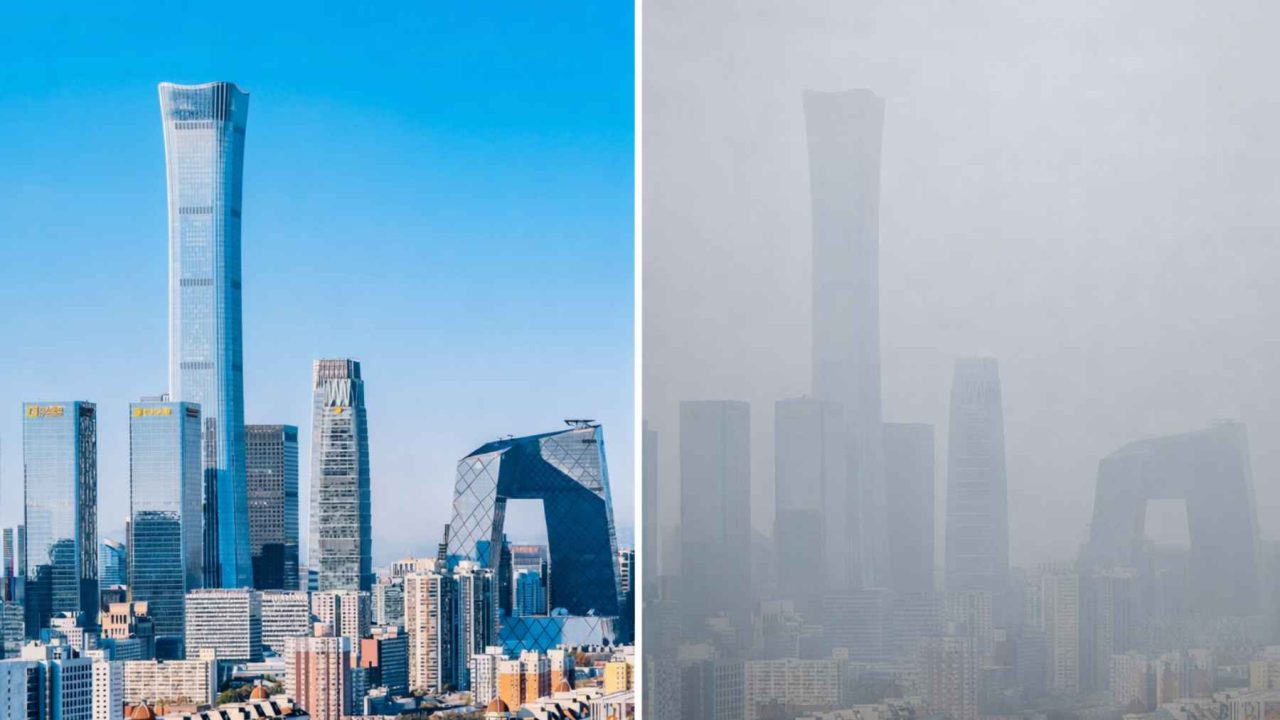
What would it take for you to believe that one of the world’s most famously polluted cities had quietly become a global model for clean air? Not a small improvement. Not a hopeful trend line. A full, verifiable, record-shattering transformation in just over a decade.
That is exactly what Beijing delivered in 2025. And the numbers behind it are hard to fully absorb on first read.
From 89.5 to 27: The Most Dramatic Urban Air Cleanup on Record
In 2013, Beijing’s annual average concentration of PM2.5 — the fine particulate matter most dangerous to human lungs — sat at 89.5 micrograms per cubic meter. That figure represented a city choking on its own growth. Visibility collapsed on bad days to a few hundred meters. Schools kept children indoors. Face masks became a daily accessory years before anyone had heard of COVID-19.
By 2025, that number had fallen to 27 µg/m³, the lowest annual average since China began systematic air quality monitoring. The city also logged just one day of heavy pollution in the entire year, and recorded 311 days of good or moderate air quality.
That 70 percent decline over roughly twelve years is not just an impressive statistic. Environmental scientists who study urban air quality say it represents the fastest large-city PM2.5 reduction ever documented at this scale.
The milestone also carries a specific bureaucratic weight. For the first time, Beijing crossed below the 30 µg/m³ threshold used in China’s own national air quality standards. That threshold had long looked unreachable for a megacity of 22 million people running one of the planet’s busiest economies.
| Standard / City | Annual PM2.5 Target (µg/m³) |
|---|---|
| WHO 2021 Guideline | 5 |
| United States EPA Standard | 9 |
| China National Standard | 30 |
| Beijing 2025 Actual | 27 |
| Beijing 2013 Actual | 89.5 |
The Four Levers Beijing Pulled to Rewire a City’s Air
The transformation did not happen by accident or natural weather shift. It came from a coordinated, sometimes brutal, policy push that began after 2013, when China’s leadership publicly acknowledged the pollution crisis could no longer be managed with propaganda.
The first lever was coal. Beijing undertook one of the largest urban clean-heating transitions in history, upgrading and retiring 28,000 megawatts of coal-fired boilers across the city and surrounding regions. Millions of residential coal heaters were replaced with electric or natural gas systems. The shift fundamentally changed Beijing’s winter energy profile, which had historically been its worst season for air quality.
The second lever was vehicles. Beijing phased in emissions standards comparable to Euro 6, some of the strictest vehicle pollution rules anywhere in the world. The city also aggressively expanded its electric vehicle fleet and public transit network, removing older, dirtier engines from its roads faster than almost any comparable city.
The third lever was industry relocation. Heavily polluting factories were either shut down or pushed outside the Beijing-Tianjin-Hebei corridor. This was economically painful and politically contentious. Workers lost jobs. Communities were displaced. But the regional air quality data shows the strategy worked.
The fourth lever was enforcement. China’s environmental regulators gained expanded authority after 2015, with powers to fine, shutter, and prosecute polluters in ways that had previously been blocked by local economic interests. Inspections became more frequent, more transparent, and harder to bribe away.
What 27 µg/m³ Actually Means — and What It Still Doesn’t
Context matters enormously here. Crossing China’s own 30 µg/m³ threshold is a genuine, meaningful achievement. But the World Health Organization’s 2021 guideline recommends an annual PM2.5 target of just 5 µg/m³. The United States EPA standard sits at 9 µg/m³. At 27, Beijing still has a long road ahead by those measures.
Beijing’s 2025 ecological report also flagged that while PM2.5, PM10, and nitrogen dioxide all declined broadly, ozone remains a seasonal problem. Ozone pollution tends to increase as cities reduce the other pollutants, a stubborn chemical paradox that has challenged Los Angeles and Tokyo as well.
“London, San Francisco and Beijing are among 19 global cities that have achieved remarkable reductions in air pollution, having slashed levels of two airway-aggravating pollutants by more than 20% since 2010.”
— Analysis cited in research from March 2026
So the story is not one of a solved problem. It is the story of a city proving that a solved problem is actually possible. Beijing in 2013 looked like a cautionary tale about the inevitable cost of rapid industrialization. Beijing in 2025 looks like evidence that the cost is not, in fact, inevitable.
Why This Record Has Implications Far Beyond China
The cities watching Beijing most closely are not in Europe or North America. They are in South Asia and Sub-Saharan Africa, where rapid urbanization is following a trajectory that looks uncomfortably similar to China’s early 2000s industrial surge.
Delhi’s annual PM2.5 concentrations regularly exceed 90 µg/m³, roughly where Beijing was in 2013. Dhaka, Lahore, and Kampala face similar trajectories. For those cities, Beijing’s record is not just an environmental story. It is a policy blueprint with a verified outcome attached to it.
The blueprint is not without costs or controversies. The pace of China’s coal boiler replacement required central government funding and authority that many democracies would struggle to replicate. The relocation of polluting industries moved some of the emissions burden to less politically visible regions. A complete accounting of the transformation includes those complications.
But the air quality numbers are not complicated. A city of 22 million people cut its most dangerous air pollutant by 70 percent in twelve years while its economy continued to grow. That combination had widely been considered impossible before Beijing demonstrated otherwise.
The WHO target of 5 µg/m³ is still more than five times stricter than where Beijing stands today. Ozone remains unresolved. The political model is not directly exportable to every country that needs it. These are real limits, and they deserve honest acknowledgment.
But perhaps the most important shift in 2025 is not the number itself. It is what the number does to the argument that cleaning up a city’s air requires choosing between environment and economic ambition. That argument is now measurably harder to make.
The smog that once defined Beijing on every international front page has not simply been filtered out. It has been engineered out, policy by policy, boiler by boiler, emission standard by emission standard. The question now is which city will be the next to prove it was not a one-time miracle.
Frequently Asked Questions

You Might Also Like

Your Brain Shifts Gears at Four Ages — One Will Surprise You
A 2025 Cambridge study of 4,216 MRI scans found the brain changes course at ages…

Red Sprites: The Pilot Legend That Turned Out to Be Real
Astronauts on the ISS photographed red sprites and gigantic jets above storms at 89 km…
The Skull Inside a Tree Stump That Upended 307 Million Years of Fossil History
A 307-million-year-old soccer-ball-sized skull found in a fossilized tree stump in Nova Scotia is rewriting…
Leave a Reply