
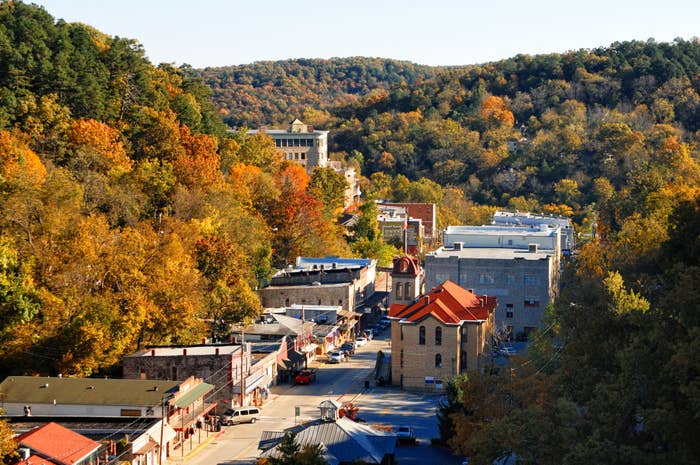
When did you last pull off the highway for a town with no billboard? If your answer is “never,” you are leaving behind the best version of America — the one that doesn’t need a marketing budget. From Virginia’s hidden harbors to Pennsylvania’s deep countryside, small towns where slow travel actually works are hiding in plain sight, with zero crowds and real human connections waiting. This is your ranked guide to fifteen of them — built for the traveler brave enough to take the exit.
America’s most rewarding towns share one trait: they were bypassed by the interstate era. Populations under 10,000. Average nightly hotel rates under $195. Distance from a major airport: 45–120 miles. That friction is the point — it keeps them real.
Why Hidden America Matters More in 2026
Read more: Forgotten Small Towns Under $150/Night: 18 Gems Across America
Route 66’s centennial and America’s 250th anniversary make 2026 the single best year for authentic road travel. The crowds are surging toward the obvious — Yellowstone, Charleston, Napa. That means the towns on this list are emptier and better than ever. California alone hides dozens of underrated destinations offering everything from serious wine culture to coastal solitude, all invisible to the average itinerary. The timing has never been more perfect to go the other direction.
Positions 15–11: Towns Hiding in Crowded States
Read more: $675/Month Rent: The 5 Cheapest States to Live in America
#15 — Senoia, Georgia (Coweta County, pop. ~4,200)
Fifty miles south of Atlanta, Senoia still has its 1860s commercial district intact. It doubled as Woodbury in The Walking Dead. A night at the Veranda Inn runs about $159. Most visitors drive straight through on U.S. 16 heading to Callaway Gardens without ever stopping.
#14 — Wellsboro, Pennsylvania (Tioga County, pop. ~3,200)
Pennsylvania’s countryside hides some of the country’s most compelling slow-travel infrastructure. Wellsboro lights its Main Street with actual gas lamps every night. It sits 27 miles from the Pennsylvania Grand Canyon — yes, that’s a real place, 800 feet deep — and charges $105/night at the Penn Wells Hotel.
#13 — Seligman, Arizona (Yavapai County, pop. ~456)
Route 66’s centennial in 2026 makes Seligman more relevant than it has been in decades. The town that saved Route 66 from erasure in 1987 still looks like it’s 1962. Snow Cap Drive-In is open. A motel room costs $79. Almost every car doing the Grand Canyon loop blows past on I-40 five miles north.
#12 — Apalachicola, Florida (Franklin County, pop. ~2,250)
Florida has better oysters here than anywhere on the Gulf Coast — or did, before habitat pressures cut harvests. Gibson Inn, built in 1907, charges $145/night. The nearest tourist crowd is 80 miles east in Panama City Beach. Apalachicola gets roughly 60,000 annual visitors. Panama City gets 7 million.
#11 — Jefferson, Texas (Marion County, pop. ~1,900)
Jefferson was Texas’s most important inland port in the 1870s. It flatly
refused Jay Gould’s railroad in 1882. He reportedly scrawled a curse in the Excelsior House hotel ledger. The town’s population collapsed from 30,000 to under 2,000 within a decade. That ledger sits behind glass in the Excelsior House today — rooms start at $125/night. Shreveport is 60 miles west and gets 10 times the visitors.
#10 — Wytheville, Virginia (Wythe County, pop. ~8,200)
Every southbound driver on I-81 stops here for gas. Almost none stay. That is a mistake. Wytheville sits at 2,274 feet in the Blue Ridge highlands, surrounded by the Mount Rogers National Recreation Area. The historic district runs along Main Street with buildings dating to the 1840s. A motel room runs $89/night. The Sinkland Farm cornmaze draws regional visitors in October but the town itself stays quiet. Roanoke is 60 miles northeast.
#9 — Natchitoches, Louisiana (Natchitoches Parish, pop. ~17,400)
Founded in , Natchitoches is the oldest permanent settlement in the Louisiana Purchase territory — older than New Orleans by four years. The Front Street brick district runs along Cane River Lake. Meat pies are the local obsession: Lasyone’s Meat Pie Restaurant has been selling them since 1959 for under $8. A bed-and-breakfast along Cane River averages $135/night. Most Louisiana tourists never leave the New Orleans-to-Baton Rouge corridor, 200 miles southeast.
#8 — Mineral Point, Wisconsin (Iowa County, pop. ~2,500)
Cornish miners arrived here in the 1830s for lead and zinc. They built limestone cottages that still stand on Shake Rag Street — arguably the most intact pre–Civil War streetscape in the Midwest. The town has more working artists per capita than almost anywhere in Wisconsin. Gallery-hopping is the main activity. A room at the Hill Street Inn runs around $149/night. Madison is 50 miles east. Almost no one makes the detour.
#7 — Harpers Ferry, West Virginia (Jefferson County, pop. ~286)
The town proper has fewer than 300 residents — one of the smallest incorporated towns on this list. It sits at the exact confluence of the Shenandoah and Potomac rivers, a geographic drama that Thomas Jefferson called worth crossing the Atlantic to see. John Brown raided the federal armory here in . The National Historical Park charges $20 per vehicle. A room at the Angler’s Inn B&B starts at $165. Washington D.C. is 65 miles east. Day-trippers exist but almost nobody stays the night.
#6 — Astoria, Oregon (Clatsop County, pop. ~10,100)
The oldest American settlement west of the Rockies, founded by John Jacob Astor’s Pacific Fur Company. The Columbia River here is four miles wide. Victorian houses climb the hillside above the waterfront in layers. The Astoria Column, built in 1926, gives a 360-degree view of where the river meets the Pacific. The Hotel Elliott charges $179/night. Portland is 96 miles southeast. Cannon Beach, 23 miles south, gets five times the visitors despite offering a fraction of the history.
#5 — Bisbee, Arizona (Cochise County, pop. ~5,000)
Bisbee sits at 5,300 feet in the Mule Mountains — cool even in July when Tucson bakes at 105°F. The Copper Queen Mine produced $8 billion worth of copper between 1880 and 1975. Underground mine tours run $20 per adult. The Copper Queen Hotel, built in 1902, charges $129/night and claims several documented ghost encounters (make of that what you will). Tombstone, 24 miles north, pulls ten times the tourists on the strength of a single gunfight. Bisbee had an entire industrial civilization.
#4 — Galena, Illinois (Jo Daviess County, pop. ~3,200)
Ulysses S. Grant lived here before the Civil War. His restored home on Bouthillier Street charges no admission and still has original furnishings. In 1845, Galena generated more than 80 percent of the nation’s lead supply. The Main Street commercial district has 85 buildings on the National Register of Historic Places. A weekend room at the DeSoto House Hotel — open since — runs $169. Chicago is 165 miles southeast. Most Chicagoans have never heard of it.
#3 — Port Townsend, Washington (Jefferson County, pop. ~10,100)
Port Townsend was supposed to become the great metropolis of Puget Sound. Land speculators in the 1880s bet heavily on it. The railroad never arrived. The boom collapsed in 1893. The consequence: 70 Victorian-era commercial buildings frozen in amber, now the largest intact Victorian seaport on the West Coast. The Palace Hotel charges $139/night. The annual Wooden Boat Festival draws 15,000 visitors in September. Seattle is 50 miles southeast by ferry and highway. The ferry alone makes the trip worth it.
#2 — Truth or Consequences, New Mexico (Sierra County, pop. ~6,000)
In the NBC radio show Truth or Consequences offered to broadcast from the first town that renamed itself after the program. Hot Springs, New Mexico took the deal. The natural geothermal hot springs still flow at 107°F along the Rio Grande. A private soak at Riverbend Hot Springs runs $20/hour. A motel room averages $89/night. Albuquerque is 150 miles north. Spaceport America — where Virgin Galactic launches — is 25 miles south. Most people drive straight to Santa Fe and never look at a map.
#1 — Medora, North Dakota (Billings County, pop. ~132)
One hundred and thirty-two permanent residents. Theodore Roosevelt came here in 1883, ranched the Badlands, and credited this landscape with making him the man who would become president. Theodore Roosevelt National Park surrounds the town. The Badlands at sunset are a genuine geological shock — striped buttes of burgundy, ochite, and gray dropping into the Little Missouri River. The Rough Riders Hotel charges $189/night. Billings, Montana is 220 miles west. Bismarck is 135 miles east. Most Americans will never visit North Dakota at all. That is precisely the point — and precisely why this is number one.


Leave a Reply