
Sarah Kimball stood in her backyard in Broken Arrow, Oklahoma last August, calculating that her $1,140 mortgage payment was less than her old Denver parking and utility bills combined. She had moved from Colorado in early 2025 and hadn’t looked back — not once.
Millions of Americans are running the same math right now. Half of America’s states show annual household expenditures of roughly $75,000 or less, while the other half stretch from $76,000 to well over six figures. The gap between affordable and expensive America has never been wider — and 2026 is the year that gap is changing migration patterns permanently.
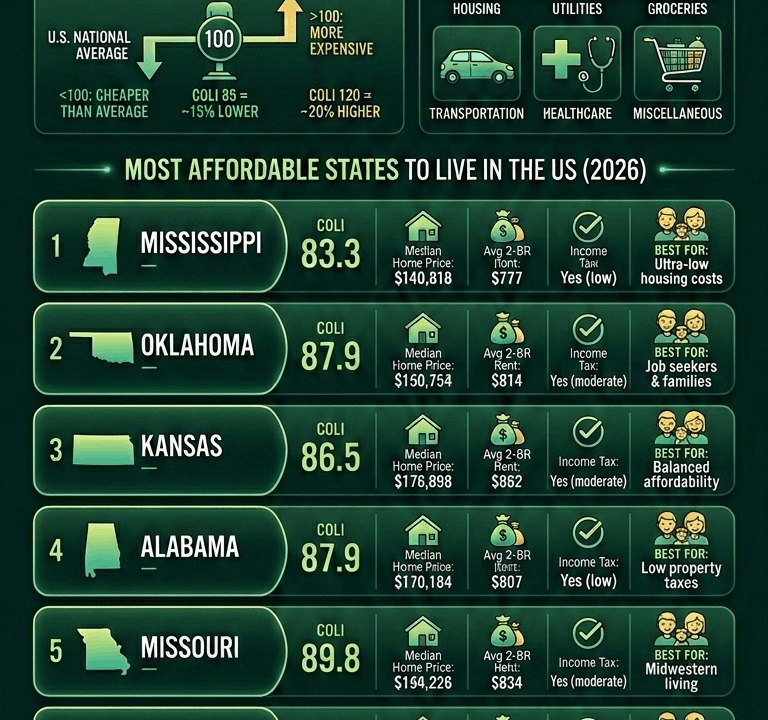
Oklahoma leads every major affordability index in 2026 with a cost-of-living index of 85.5, followed by Mississippi, Alabama, Missouri, and West Virginia. A household living comfortably on $4,800/month in Tulsa would need roughly $8,200/month to match that lifestyle in San Jose, California.
Why Millions Are Leaving Expensive States for the Affordable South and Midwest
Read more: Cheapest States to Live in America
When deciding where to live, income tax savings are just part of the equation. Housing, everyday expenses, and other levies determine your actual take-home purchasing power. Someone earning $70,000 remotely in Gulfport, Mississippi lives materially better than a $95,000 earner in Austin, Texas — once rent, groceries, and insurance are factored in.
The driver isn’t just housing. It’s the compound effect of cheaper groceries, lower car insurance premiums, smaller utility bills, and reduced state tax burdens. In Tulsa, Oklahoma, a family of four can realistically budget $4,200 to $5,100 per month — full stop.
(100 = U.S. average)
Q4 2025 (Motley Fool)
63% below U.S. median
Family of 4, Tulsa OK
Real Monthly Cost Breakdown: The Top 5 Cheapest States Head to Head
The U.S. median home price hit $405,300 in Q4 2025. Every state in this top five sits well beneath that ceiling — some dramatically so. Here’s how real monthly budgets break down for a single renter and a homeowning couple in each state’s most livable midsize city.
| State / City | COL Index | 1-BR Rent | Median Home Price | Est. Solo Monthly Cost | Top Income Tax |
|---|---|---|---|---|---|
| Oklahoma — Tulsa | 85.5 | ~$850 | ~$192,000 | ~$2,050/mo | 4.75% |
| Mississippi — Hattiesburg | 86.1 | ~$780 | ~$172,000 | ~$1,920/mo | 4.7% |
| Alabama — Huntsville | 87.3 | ~$970 | ~$218,000 | ~$2,210/mo | 5.0% |
| Missouri — Springfield | 87.9 | ~$820 | ~$208,000 | ~$2,080/mo | 4.7% |
| West Virginia — Morgantown | 88.6 | ~$760 | ~$148,000 | ~$1,870/mo | 5.12% |
Sources: C2ER Cost of Living Index, Zillow Research, state revenue department tax schedules. Monthly estimates include housing, groceries, utilities, transportation, and basic insurance for a single adult. All figures approximate for early 2026.
That $1,920/month in Hattiesburg, Mississippi is striking context. A comparable lifestyle in
That $1,920/month in Hattiesburg, Mississippi is striking context. A comparable lifestyle in San Jose, California runs closer to $4,400/month — more than double, for roughly the same square footage and grocery cart. That gap is not abstract. It is the difference between financial stress and actual savings.
What “Cost of Living” Actually Measures — and What It Misses
Most cost-of-living indexes, including the C2ER COLI, benchmark against a national average of 100. A score of 88.6 means everyday expenses run about 11.4% below that average. But the index has blind spots worth naming.
- Healthcare quality varies wildly. Rural Mississippi has far fewer specialists than suburban Tennessee. Cheap premiums can mask expensive access gaps.
- Income matters as much as expenses. If wages in a cheap state are proportionally lower, the real-dollar advantage shrinks fast.
- Property taxes compound over time. Texas has no income tax but median property tax bills in Travis County now top $7,200/year — erasing much of the income-tax savings for homeowners.
- Climate costs are rising. Homeowners insurance in Gulf Coast Louisiana has surged past $4,000/year in many zip codes, a cost not fully reflected in older indexes.
None of this disqualifies the cheap states. It just means you need the full picture, not just the headline number.
🏆 #1 Mississippi — COLI: 85.2 | Est. Monthly Cost: ~$1,870
Mississippi has ranked cheapest in the nation for six consecutive years. The anchor city for value is Hattiesburg (pop. ~48,000), home to the University of Southern Mississippi and a surprisingly active arts scene. A three-bedroom house in the Oak Grove corridor sells for a median of $148,000 as of early 2026. Groceries run about 14% below the national average per USDA food cost data.
The state income tax rate dropped to 4.7% in 2025 under HB 1733 and is scheduled to phase down to 4.0% by 2026. There is no tax on Social Security income — critical for retirees. Groceries are taxed at 7%, which is a real hit for low-income households.
Median household income: ~$46,600 (U.S. Census Bureau ACS 2023). Utility costs in Hattiesburg average ~$148/month per EIA data.
#2 Oklahoma — COLI: 86.1 | Est. Monthly Cost: ~$1,920
Tulsa quietly became one of the most cost-effective mid-sized cities in America. The Tulsa Remote program, which offered $10,000 to relocate, ended in 2023 — but the affordability that attracted participants never left. Median home prices in Broken Arrow, Tulsa’s largest suburb, sit near $224,000. In the city proper, you can find solid three-bedrooms in the Brady Arts District fringe for $160,000–$185,000.
Oklahoma’s top income tax rate is 4.75% on income over $7,200 (single filers). Gas is consistently among the cheapest in the nation — $2.79/gallon average in early 2026 per AAA. That matters in a state where driving 30+ miles to work is routine.
Sources: Oklahoma Tax Commission, AAA Fuel Gauge Report, Zillow Research 2026.
#3 Arkansas — COLI: 86.9 | Est. Monthly Cost: ~$1,950
Arkansas is the sleeper pick of this list. Fayetteville, home to the University of Arkansas and a booming startup culture anchored by the Walmart and Tyson Foods ecosystems, offers median home prices near $295,000 — elevated by its own success, but still far below comparably dynamic metros. Go 45 minutes south to Fort Smith and the median drops to roughly $165,000.
Arkansas cut its top income tax rate to 3.9% in 2024, one of the sharpest reductions in recent state tax history. The state also exempts the first $6,000 of retirement income. Sales tax, however, hits 6.5% at the state level with county add-ons pushing some areas to 11.5% — the highest combined rate in the nation in certain counties.
Sources: Arkansas Department of Finance and Administration, Zillow, Tax Foundation 2026 State Tax Data.
#4 Missouri — COLI: 87.3 | Est. Monthly Cost: ~$1,980
St. Joseph, a city of about 72,000 in the northwest corner of Missouri, may be the most underrated cheap city in the Midwest. Median home prices hover near $138,000. Kansas City’s western suburbs — Independence and Lee’s Summit — offer metro amenities at prices well below the national median, with homes averaging $230,000–$260,000.
Missouri’s top income tax rate dropped to 4.8% in 2023 and will continue declining under existing legislation. Social Security benefits are fully exempt for residents earning under $85,000/year. Property taxes in Jackson County average roughly 1.1% of assessed value — moderate by Midwest standards.
Sources: Missouri Department of Revenue, Tax Foundation, Zillow Research.
#5 Alabama — COLI: 87.9 | Est. Monthly Cost: ~$1,990
Huntsville has outgrown its reputation as a sleepy rocket-science town. It is now one of the fastest-growing metros in the Southeast, with a median household income over $60,000 — high for Alabama — yet home prices still average just $268,000. For retirees on fixed income, Decatur (40 miles west of Huntsville) offers waterfront homes on the Tennessee River for $180,000–$220,000.
Alabama’s income tax tops out at 5% on income over $3,000 (single). But here’s the hidden gem: Alabama does not tax Social Security or most pension income. Property taxes are the lowest in the nation — a $200,000 home in Morgan County generates roughly $450–$600/year in property tax.
Sources: Alabama Department of Revenue, Tax Foundation, U.S. Census Bureau, Zillow 2026.
#6 Kansas — COLI: 88.0 | Est. Monthly Cost: ~$2,010
Wichita — the largest city in Kansas at around 400,000 — delivers an honest Midwest value proposition. Median home price: $195,000. Monthly utilities average $142. The metro has a genuine manufacturing economy (Spirit AeroSystems, Koch Industries) that stabilizes employment without inflating housing the way tech booms do.
Kansas’s income tax structure simplified in 2024 to two brackets: 5.2% on income over $30,000 and 3.1% below. Social Security became fully exempt from Kansas state income tax as of . That single change made Kansas significantly more attractive for retirees in Sedgwick County and beyond.
Sources: Kansas Department of Revenue, EIA Residential Energy Data, Zillow Research.
#7 Iowa — COLI: 88.3 | Est. Monthly Cost: ~$2,020
Iowa is in the middle of one of the most aggressive tax cuts in its history. The state is on a path to a flat 3.9% income tax rate by 2026, down from a top rate that once hit 8.98%. Cedar Rapids — Iowa’s second city at ~140,000 — has median home prices of $192,000 and a cost of living meaningfully below its peer Midwest metros.
Iowa also fully exempts retirement income — including pensions, 401(k) distributions, and IRAs
Frequently Asked Questions

You Might Also Like

West Virginia 2026: Full Life Under $2,100/Month in Charleston
West Virginia's cost of living index sits at 83.2 — 17% below the U.S. average.…

Austin’s $5,400 Monthly Burn: What a Cost of Living Index Really Measures
Austin hit $5,400/month. Here's what a cost of living index actually measures — 6 weighted…

8 Affordable US Cities Under $300K That Beat Austin and Denver
Tulsa's median home is $185K. The national median is $407,500. Eight cities like it offer…
Leave a Reply