

If 47% of Americans say cost of living is their single biggest financial obstacle, why are millions still paying $2,800 a month for a one-bedroom apartment in cities that give them nothing extra in return? The answer usually isn’t ignorance — it’s inertia. But the math on relocation has rarely looked more compelling than it does heading into .
This guide breaks down the actual monthly cost of living — housing, groceries, utilities, transportation, healthcare — in the states where your dollar stretches furthest. Every number is anchored to a real place, because “affordable” means nothing without a ZIP code attached to it.
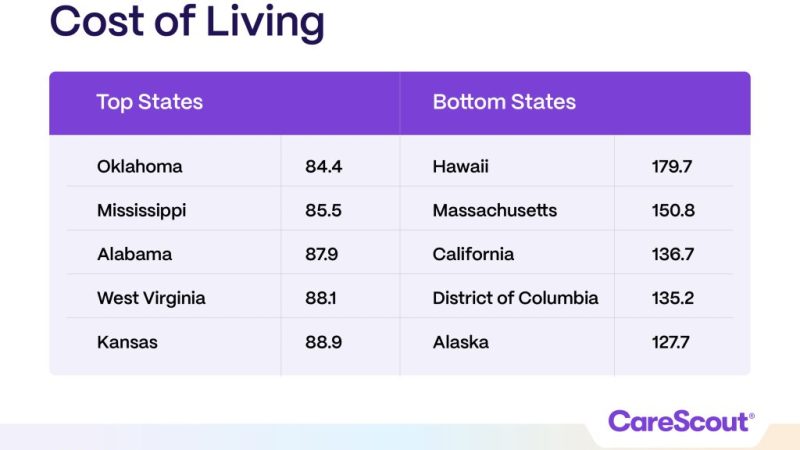
A single adult can cover all essential expenses in West Virginia for roughly $2,187/month — compared to $4,820/month in Hawaii. That $2,633 monthly gap compounds into $31,596 per year without any lifestyle sacrifice. The seven cheapest states all share a cost-of-living index below 90 on the national baseline of 100.
By the Numbers: Cheapest States at a Glance
Read more: Cheapest States to Live in America
(national avg = 100)
groceries + utilities below avg
Morgantown WV area
same essential lifestyle
Full Monthly Cost Breakdown: 7 Cheapest States vs. National Average
All figures represent estimated monthly costs for a single adult covering housing (1BR rental), groceries, utilities, transportation, and healthcare. Basic needs costs vary sharply by congressional district, not just state.
| State | COL Index | Housing/mo | Groceries/mo | Utilities/mo | Transport/mo | Total Est./mo |
|---|---|---|---|---|---|---|
| 🏆 West Virginia | 83.3 | $720 | $310 | $145 | $390 | $2,187 |
| Oklahoma | 85.3 | $760 | $315 | $140 | $400 | $2,240 |
| Alabama | 86.9 | $790 | $320 | $150 | $405 | $2,290 |
| Kansas | 86.5 | $775 | $318 | $148 | $395 | $2,260 |
| Iowa | 89.9 | $830 | $325 | $155 | $410 | $2,355 |
| Missouri | 87.1 | $800 | $320 | $148 | $400 | $2,300 |
| Georgia | 88.8 | $850 | $330 | $152 | $415 | $2,390 |
| National Average | 100 | $1,280 | $400 | $185 | $520 | $3,050 |
Sources: Missouri Economic Research and Information Center (MERIC) Q1 2026; U.S. Census Bureau American Community Survey 2024.
Why Mississippi Still Leads — and What That Costs You in Reality
Hattiesburg, Mississippi — population 46,000 in Forrest County — is the clearest argument for the state’s affordability dominance. A three-bedroom house rents for $820/month on average. The same unit in Columbus, Ohio runs $1,490. That $670 monthly gap is $8,040 per year — real money.
Mississippi’s state income tax dropped to a flat 4.7% in , down from 5% in prior years, under House Bill 1733. Groceries carry a 7% sales tax — the highest in the nation on food — which partially offsets housing savings for low-income households.
The honest trade-off: Mississippi ranks last or near-last in healthcare access, public school funding, and broadband coverage according to the Kaiser Family Foundation and FCC Broadband Data Collection. Cheap isn’t always cheap when a ER visit means driving 60 miles to Meridian Regional Medical Center.
Oklahoma: The Underrated Contender in Tulsa County
Broken Arrow, Oklahoma — Tulsa County’s largest suburb at 117,000 residents — delivers a cost index of 85.3 against the national average of 100. Median household income here sits at $72,400 annually, per the U.S. Census Bureau’s 2024 ACS, while average monthly rent for a two-bedroom is just $950.
Oklahoma’s income tax tops out at 4.75% and the state has no estate tax. Utility costs average $152/month for a standard apartment — well below the national figure of $185 — largely because of access to cheap natural gas through Oklahoma’s own production infrastructure.
For remote workers, Tulsa Remote — a program offering $10,000 grants to qualifying relocators — is still active through . Details are available at tulsaremote.com. The catch: you must earn income outside Oklahoma and commit to 12 months of residency.
Kansas: Wichita’s $2,390/Month Life — What That Actually Looks Like
Read more: West Virginia 2026: Full Life Under $2,100/Month in Charleston
Wichita, in Sedgwick County, is Kansas’s largest city at 397,000 people. It was founded in as a cattle-trade hub. Today it’s a quietly affordable metro with a Boeing and Textron Aviation manufacturing base that keeps middle-income wages stable.
A realistic monthly budget in Wichita for a single adult in : rent at $880 (one-bedroom, East Side), groceries at $310, utilities at $148, transportation at $390 (car ownership, no meaningful transit), and healthcare at $280 with a mid-tier ACA silver plan. Total: approximately $2,390/month — matching the MERIC-based estimate.
Kansas charges a 6.5% state sales tax — plus local add-ons reaching 10% in some Wichita districts. That’s a meaningful bite on everyday purchases. The state income tax rate is 5.7% at the top bracket for earnings over $30,000.
The Hidden Costs These Rankings Miss
Cost-of-living indexes typically exclude four major expense categories that hit low-cost-state residents hard.
💬 Frequently Asked Questions
- 🚗 Car Dependency: Arkansas, Mississippi, and Oklahoma have virtually no urban rail. Owning two cars in Fayetteville, Arkansas runs $780–$950/month when insurance, gas, and payments are totaled — per AAA’s 2025 driving cost data.
- 🏥 Healthcare Access Gaps: Rural Mississippi has 15 counties with no OB-GYN, per the Mississippi State Department of Health. Medical tourism inside the U.S. — driving to Memphis or Mobile — adds real out-of-pocket cost.
- ❄️ Climate Risk Insurance: Tornado Alley states — Kansas, Oklahoma, Arkansas — face homeowner’s insurance premiums averaging $2,400–$3,100/year in 2026, roughly double the national median, per the Insurance Information Institute.
- 📡 Broadband Costs: In rural Ozark County, Missouri, 35% of residents lack access to 25 Mbps broadband as of the FCC’s 2024 data. Satellite internet via Starlink costs $120/month — a premium that urban residents never factor in.
✅ Good Fit
- Remote workers earning $60,000+ from coastal employers
- Retirees with fixed Social Security income
- Small business owners in service trades
- Families buying (not renting) their first home
⚠️ Proceed Carefully
- Healthcare workers needing specialized facilities nearby
- Households relying on public transit
- Those in industries with thin local job markets
- People in climate-risk-sensitive financial positions
Sources & Methodology
- Missouri Economic Research and Information Center (MERIC) — Cost of Living Index, Q1 — meric.mo.gov
- U.S. Census Bureau — American Community Survey 5-Year Estimates, 2024 — census.gov
- Bureau of Labor Statistics — Consumer Expenditure Survey 2025 — bls.gov/cex
- Kaiser Family Foundation — State Health Facts, Healthcare Access 2025 — kff.org
- Federal Communications Commission — Broadband Data Collection, 2024 — fcc.gov
- Insurance Information Institute — Homeowners Insurance Premium Report, 2025 — iii.org
- AAA — Your Driving Costs Study, 2025 — exchange.aaa.com
- Mississippi State Department of Health — Physician Workforce Report, 2025 — msdh.ms.gov
What is the single cheapest state to live in during 2026?

You Might Also Like

I Ran the Tulsa Numbers on a Napkin — and Saved $13,200 a Year
Oklahoma's cost index hits 85.5 in 2026 — a retired couple spending $4K/month in California…
$675/Month Rent: The 5 Cheapest States to Live in America
A Chicagoan rented a 2-bedroom in Evansville, IN for $675/month. These 5 states offer the…

Knox County, Maine Costs $2,840/Month Before Retirees Snap It Up
Maine dock prices fell from $6.29 to $1.75/lb since 2021. Now lobstermen are cashing out…
Leave a Reply