
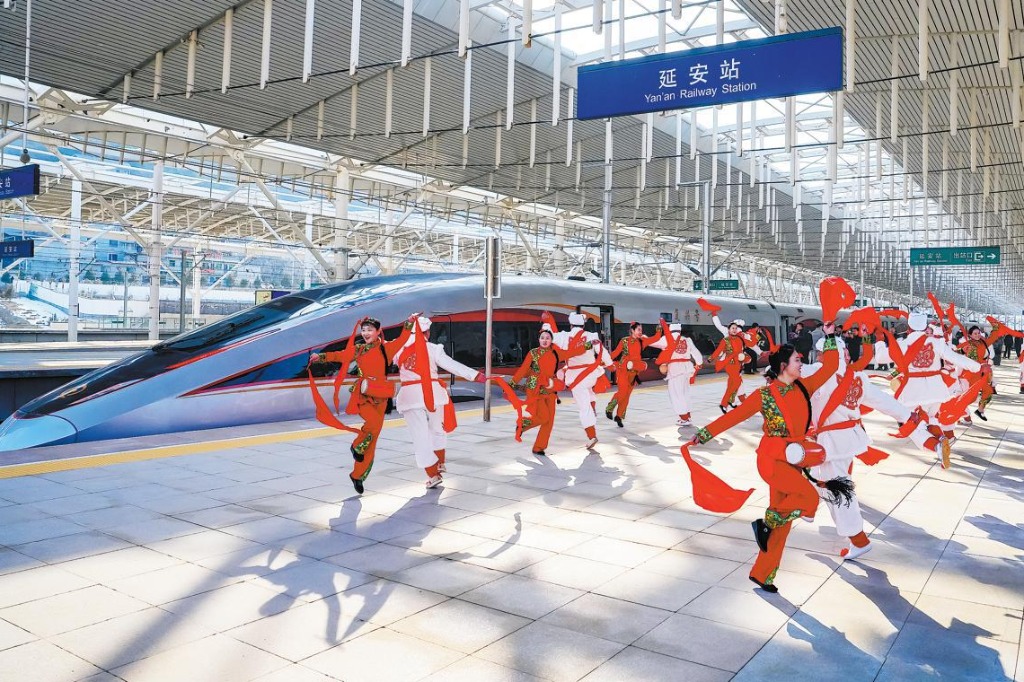
China’s high-speed rail network has officially crossed 50,000 kilometres of operational track — a figure so large it dwarfs every other high-speed rail system on the planet combined. That milestone, confirmed by China State Railway Group and State Council sources following the commissioning of new lines in late 2025, marks a turning point not just for infrastructure, but for how hundreds of millions of people move, work, and connect across one of the world’s largest countries.
The number didn’t arrive quietly. It came with the opening of a specific new line — the Xi’an–Yan’an high-speed railway in Shaanxi Province — that pushed the national total past the threshold and cut travel time significantly between two major regional hubs. For the communities along that corridor, the change is immediate and practical. For China’s broader economic and transport ambitions, it’s another brick in a decades-long construction project that has fundamentally reshaped domestic travel.
What’s striking isn’t just the scale. It’s the speed at which this network was built, and what it signals about where China’s infrastructure strategy is heading next.
(function(){var wrp=document.getElementById(“paap_stat_69cb0a48a1b4f3.84905947”);if(!wrp)return;var ids=[“paap_stat_69cb0a48a1b4f3.84905947_c0″,”paap_stat_69cb0a48a1b4f3.84905947_c1”];var dur=1800;function ease(t){return 1-Math.pow(1-t,3);}function anim(){ids.forEach(function(id){var el=document.getElementById(id);if(!el)return;var tgt=parseFloat(el.getAttribute(“data-target”))||0;var pfx=el.getAttribute(“data-prefix”)||””;var sfx=el.getAttribute(“data-suffix”)||””;var dec=parseInt(el.getAttribute(“data-decimals”))||0;var st=null;function step(ts){if(!st)st=ts;var p=Math.min((ts-st)/dur,1);var v=ease(p)*tgt;el.textContent=pfx+v.toFixed(dec)+sfx;if(p<1)requestAnimationFrame(step);}requestAnimationFrame(step);});}if("IntersectionObserver" in window){var obs=new IntersectionObserver(function(e){e.forEach(function(en){if(en.isIntersecting){anim();obs.disconnect();}});},{threshold:0.2});obs.observe(wrp);}else{anim();}})();
How China’s High-Speed Rail Network Reached This Point
China’s high-speed rail expansion has been one of the defining infrastructure stories of the 21st century. What began as a handful of intercity corridors has grown, through sustained central planning and significant state investment, into a web of lines connecting major cities, regional centres, and previously isolated communities.
The 50,000 km milestone was reached following the opening of the Xi’an–Yan’an high-speed railway, a line that links two significant cities in Shaanxi Province and dramatically reduces journey times along that route. The line’s commissioning was acknowledged publicly by China State Railway Group and confirmed through State Council sources, with the milestone framed as a direct result of national transport and development strategies set under central planning targets.
Officials have noted that the expansion reflects not just a desire for connectivity, but a deliberate economic development tool — bringing faster access to regions that previously relied on slower, older rail infrastructure or road transport.
The Numbers Behind the Network
To understand what 50,000 kilometres actually means, it helps to put the figure in context. The scale of China’s high-speed rail infrastructure is genuinely without precedent in global transport history.
| Metric | Detail |
|---|---|
| Total HSR network length | Over 50,000 km of operational track |
| Milestone trigger line | Xi’an–Yan’an high-speed railway, Shaanxi Province |
| Milestone confirmed by | China State Railway Group and State Council sources |
| Timeline of milestone | New lines commissioned in late 2025 |
| Global ranking | Largest high-speed rail network in the world |
The key detail here is consistency. China has not reached this point through a single burst of construction, but through steady, planned expansion over many years — with each phase of development building on the last and deepening the network’s reach into new regions.
What This Means for Travellers and Communities
For ordinary travellers inside China, the expansion of the high-speed rail network translates into something very tangible: faster journeys, more frequent services, and access to cities and towns that were previously difficult to reach efficiently.
The Xi’an–Yan’an line is a clear example. Shaanxi Province is home to Xi’an, one of China’s most historically significant cities and a major tourism and economic hub. Yan’an, further north, has its own cultural and political significance. Cutting travel time between the two doesn’t just benefit commuters — it opens up tourism flows, supports business travel, and connects labour markets that were previously separated by distance.
Supporters of the expansion point to evidence suggesting that high-speed rail connectivity consistently drives regional economic growth, increases property values near stations, and reduces pressure on road and air transport networks. The argument is that infrastructure at this scale doesn’t just serve existing demand — it creates new economic activity that wouldn’t otherwise exist.
What Happens Next for China’s Rail Ambitions
Reaching 50,000 kilometres is a milestone, but it’s unlikely to be a stopping point. The expansion has been driven by national transport strategies and central planning targets that have consistently set ambitious long-term goals for rail connectivity across the country.
The pattern established over the past two decades suggests continued investment in lines connecting regional cities, improving frequency on existing corridors, and extending the network into areas where high-speed rail has not yet reached. Officials have framed the 50,000 km milestone as a reflection of sustained implementation rather than a finished project.
For international observers, the trajectory raises questions about what this scale of domestic infrastructure investment means for China’s broader economic competitiveness — and whether the model of state-led, long-term infrastructure planning at this scale offers lessons or contrasts for other countries grappling with their own transport challenges.
What’s clear is that for the hundreds of millions of people who use China’s rail network every year, the story is less about geopolitical symbolism and more about a train that gets them where they’re going — faster, more reliably, and to more places than ever before.
Frequently Asked Questions
How long is China’s high-speed rail network?
China’s high-speed rail network has surpassed 50,000 kilometres of operational track, making it the largest high-speed rail system in the world.
Which new railway line pushed China past the 50,000 km milestone?
The Xi’an–Yan’an high-speed railway in Shaanxi Province was the line whose commissioning pushed the national total past the 50,000 km threshold.
When did China reach the 50,000 km milestone?
The milestone was reached following the commissioning of new lines in late 2025, and was confirmed publicly by China State Railway Group and State Council sources.
What does the Xi’an–Yan’an railway actually do?
The line connects two major hubs in Shaanxi Province and significantly cuts travel time between Xi’an and Yan’an, improving regional connectivity for commuters, tourists, and businesses.
Is China planning to expand its high-speed rail network further?
Based on confirmed national transport and development strategies, the 50,000 km milestone reflects ongoing implementation of central planning targets rather than a final endpoint, suggesting continued expansion is expected.
Who confirmed the 50,000 km milestone?
The milestone was confirmed by China State Railway Group and acknowledged through State Council sources following the opening of the Xi’an–Yan’an high-speed railway.




Leave a Reply