
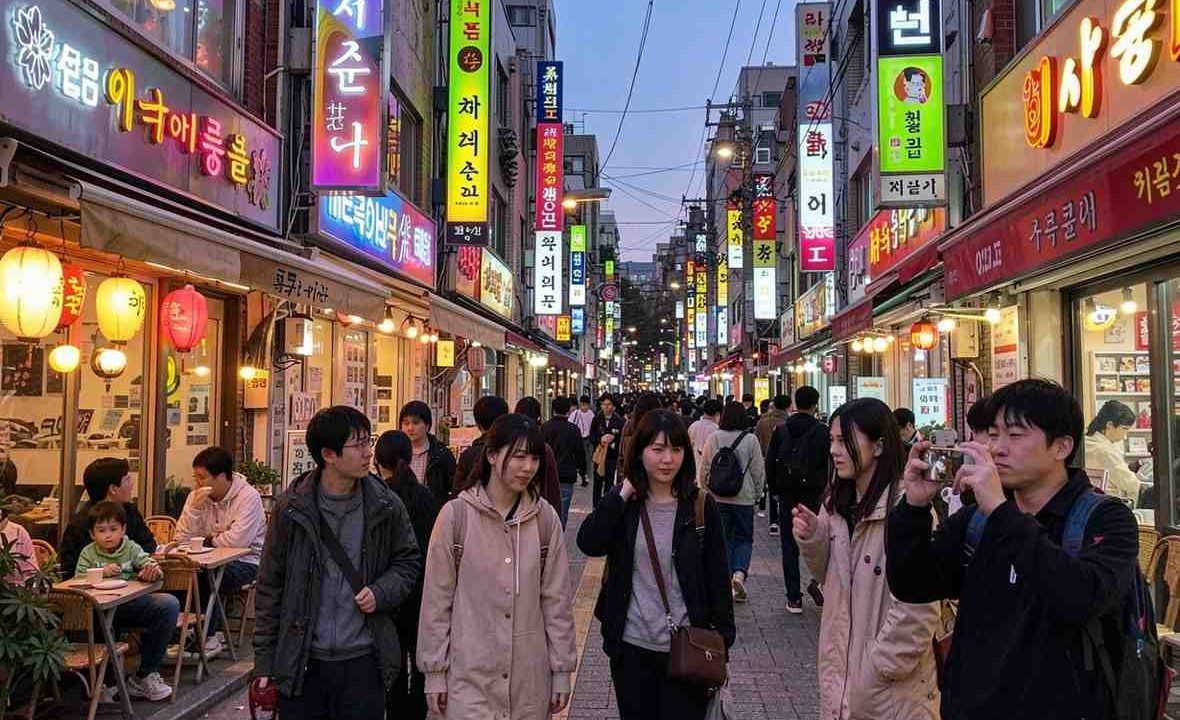
South Korea welcomed a record-breaking 18.94 million international visitors in 2025 — surpassing pre-pandemic levels and confirming what travel analysts have been watching build for years: the Korean Wave is no longer just a cultural phenomenon. It has become one of the most powerful forces reshaping global tourism.
Travelers from China, Japan, and the United States are now leading the charge, booking flights to Seoul and beyond not just for sightseeing, but to immerse themselves in the culture they have been consuming through screens for years. K-pop, television dramas, and fashion have quietly done what no marketing campaign could — they have made South Korea feel personal to millions of people who have never set foot there.
The numbers confirm the shift is real, significant, and still accelerating.
(function(){var wrp=document.getElementById(“paap_stat_69dee7cec08df9.20506347”);if(!wrp)return;var ids=[“paap_stat_69dee7cec08df9.20506347_c0″,”paap_stat_69dee7cec08df9.20506347_c1”];var dur=1800;function ease(t){return 1-Math.pow(1-t,3);}function anim(){ids.forEach(function(id){var el=document.getElementById(id);if(!el)return;var tgt=parseFloat(el.getAttribute(“data-target”))||0;var pfx=el.getAttribute(“data-prefix”)||””;var sfx=el.getAttribute(“data-suffix”)||””;var dec=parseInt(el.getAttribute(“data-decimals”))||0;var st=null;function step(ts){if(!st)st=ts;var p=Math.min((ts-st)/dur,1);var v=ease(p)*tgt;el.textContent=pfx+v.toFixed(dec)+sfx;if(p<1)requestAnimationFrame(step);}requestAnimationFrame(step);});}if("IntersectionObserver" in window){var obs=new IntersectionObserver(function(e){e.forEach(function(en){if(en.isIntersecting){anim();obs.disconnect();}});},{threshold:0.2});obs.observe(wrp);}else{anim();}})();
How K-Pop and Korean Dramas Turned Fans Into Travelers
The global dominance of K-pop acts like BTS and BLACKPINK has done something remarkable: it has inspired an entire generation of fans to treat South Korea as a destination tied to personal identity, not just leisure. Visiting Seoul’s music venues, filming locations from beloved dramas, and shopping the streets made famous by Korean fashion influencers has become a form of cultural pilgrimage.
This is a different kind of tourism. It is driven by emotional connection rather than bucket-list logic. Fans want to stand where their favorite idols stood, eat what the characters ate, and wear what the style icons wore. That emotional pull is proving extraordinarily durable — and it is drawing visitors from wildly different parts of the world simultaneously.
The reach of Korean pop culture has made South Korea genuinely competitive with established powerhouses like France, Japan, and Italy as a top-tier global travel destination. And unlike those destinations, South Korea’s tourism moment feels like it still has significant room to grow.
Who Is Actually Making the Trip — and Where They Are Coming From
Three countries are standing out as the dominant sources of inbound tourism to South Korea right now.
| Country | Role in South Korea Tourism | Primary Cultural Driver |
|---|---|---|
| Japan | Leading source market | K-pop, fashion, food culture |
| China | Rapidly growing visitor base | K-dramas, beauty trends, shopping |
| United States | Major long-haul market | BTS, BLACKPINK, Korean drama fandom |
Japan’s proximity has always made it a natural source of visitors, but the cultural dimension has deepened that relationship considerably. Chinese travelers, returning after years of reduced international movement, are arriving with specific itineraries shaped by drama filming locations and K-beauty destinations. American visitors, many of them younger travelers who grew up with Korean entertainment, are making South Korea a first or second international trip rather than an afterthought on a broader Asia itinerary.
What unites all three groups is that they are not passive tourists. They arrive with research already done — they know which neighborhoods, which restaurants, and which specific spots they want to experience. South Korea’s tourism industry is meeting a highly informed, highly motivated visitor base.
What This Tourism Boom Means for South Korea — and for Travelers
Crossing the 18.94 million visitor mark in 2025 is more than a statistical milestone. It signals that South Korea has permanently repositioned itself on the global tourism map. Before the pandemic, the country was a rising destination. Now, it is an established one — with the visitor numbers to prove it.
For travelers considering the trip, the boom carries practical implications. Popular neighborhoods like Hongdae, Myeongdong, and Gangnam — already well-known to Korean culture fans — are seeing heavier foot traffic. Demand for accommodations tied to cultural experiences, such as stays near concert venues or drama filming locations, has grown alongside general hotel demand.
The fashion dimension is also worth noting. Korean streetwear and beauty trends have global reach, and many visitors are specifically combining travel with shopping — treating Seoul as a style capital on par with Tokyo or Milan. That spending behavior is reshaping what South Korea’s retail and hospitality sectors prioritize for international guests.
Where South Korea’s Cultural Tourism Moment Goes From Here
The trajectory suggests the momentum is not slowing down. The global fanbase for K-pop and Korean entertainment continues to expand, particularly in markets across Southeast Asia, Europe, and Latin America — regions that could represent the next wave of significant visitor growth beyond the current top three.
South Korea’s tourism authorities and private sector operators are in a strong position to capitalize on this, provided infrastructure and visitor experience keep pace with demand. The cultural pull is already there. The challenge — and opportunity — is converting first-time visitors into repeat travelers who return for new experiences beyond the ones that originally drew them.
For the travel industry more broadly, South Korea’s rise offers a clear lesson: cultural exports are not separate from tourism strategy. They are, increasingly, the most effective tourism strategy there is.
Frequently Asked Questions
How many international visitors did South Korea receive in 2025?
South Korea welcomed a record 18.94 million international visitors in 2025, surpassing pre-pandemic figures.
Which countries are sending the most tourists to South Korea?
China, Japan, and the United States are currently identified as the leading source markets driving South Korea’s tourism boom.
What is driving tourists to visit South Korea specifically?
The global popularity of K-pop acts like BTS and BLACKPINK, Korean television dramas, and Korean fashion trends are the primary cultural drivers bringing international visitors to the country.
Has South Korea’s tourism recovered to pre-pandemic levels?
Yes. The 18.94 million visitors recorded in 2025 confirms that South Korea has surpassed its pre-pandemic visitor numbers.
Is South Korea now considered a top global travel destination?
Based on visitor numbers and the breadth of international interest, South Korea has established itself as a major global travel destination, driven significantly by its cultural exports.
Are American tourists a significant part of South Korea’s visitor growth?
Yes. The United States is identified as one of the three leading source markets, with American travelers drawn largely by Korean pop culture and entertainment fandoms.



Leave a Reply