
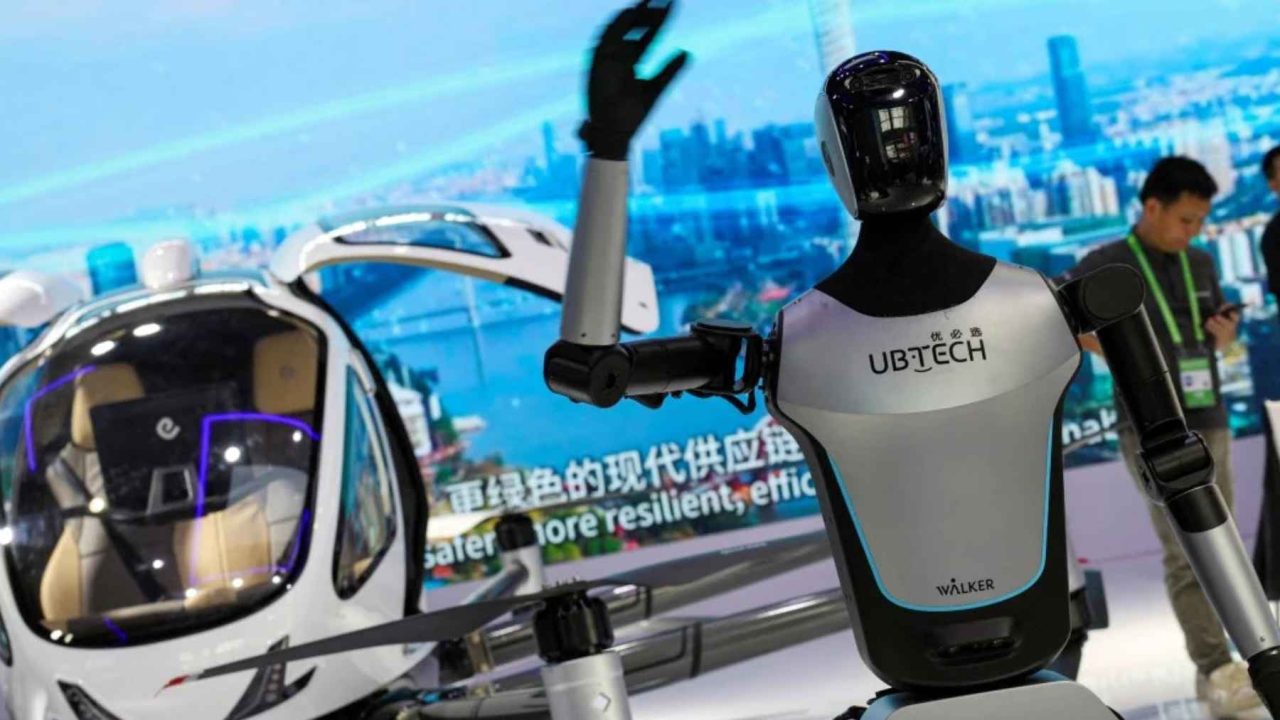
More than 5,500 humanoid robots shipped from a single Chinese company last year alone. That number, remarkable on its own, becomes genuinely unsettling when you learn where some of those machines are now stationed: at live international border crossings, interacting with real travelers, conducting inspections, and supporting armed human guards.
This is not a concept video. It is not a trade show demonstration. Along a stretch of frontier where China meets Vietnam, the future of border enforcement has already clocked in for its first shift.
The Walker S2 and the $37 Million Border Initiative
The robot at the center of this story is the UBTECH Walker S2, a full-sized humanoid built by Shenzhen-based UBTECH Robotics. Standing roughly at human height, the Walker S2 is designed to move through environments built for people, which makes it unusually well-suited for the chaotic, crowd-heavy reality of an international checkpoint.
A Chinese city on the Vietnamese frontier has deployed a fleet of these machines under a program valued at approximately $37 million. The robots are being tested for three core tasks: guiding travelers through the crossing process, conducting visual inspections, and supporting logistics operations behind the scenes.
The choice of a Vietnam border crossing is deliberate. The Sino-Vietnamese frontier handles enormous volumes of trade and foot traffic, particularly through crossings like Friendship Pass and Mong Cai. These are busy, multilingual, high-pressure environments. If a humanoid robot can function reliably here, it can likely function almost anywhere.
UBTECH’s Nearly $400 Million War Chest and What It Signals
The border deployment did not happen in a financial vacuum. In late 2025, UBTECH Robotics completed a significant share placement on the Hong Kong Stock Exchange, raising approximately HK$3.06 billion, equivalent to roughly $389 to $394 million USD.
The placement closed on December 2, 2025, with 31,468,000 new H shares sold at HK$98.80 each. That price represented an 11.39% discount to the prior closing price and an 18.56% discount to the average over the previous five trading days. Shares were distributed among at least six investors, none of whom crossed the threshold to become a major shareholder.
Placing agents included Guotai Junan Securities (Hong Kong) Limited, CLSA Limited, and TradeGo Markets Limited. The capital allocation tells its own story: 75% of net proceeds are planned for supply chain investments, acquisitions, or joint ventures over two years. Another 15% covers business operations and working capital. The remaining 10% repays existing credit facilities.
This is not the spending profile of a company running a publicity stunt. It is the balance sheet of an organization preparing to scale.
| Use of Proceeds | Allocation | Purpose |
|---|---|---|
| Supply chain, acquisitions, joint ventures | 75% | Scale manufacturing and partnerships over 2 years |
| Business operations and working capital | 15% | Day-to-day development and deployment costs |
| Credit facility repayment | 10% | Reduce existing debt obligations |
Why China’s Industrial Machine Moves Faster Than Anyone Else
To understand why China can field humanoid robots at a border crossing while most countries are still debating regulatory frameworks, you need to understand the underlying manufacturing ecosystem.
China’s position in robotics reflects an industrial dynamic building for decades. The country’s manufacturing system, anchored by dense and highly coordinated supply chains, means it can move quickly in robotics, a field also known as embodied AI. When a company like UBTECH needs a new actuator, sensor array, or control board, the supplier is often within a few hours’ drive.
“People often talk about solving global poverty — how do we give everyone a very high standard of living? The only way to do this is AI and robotics.”
— Elon Musk, on the long-term economic potential of robotics
That supply chain density does not just reduce cost. It compresses the feedback loop between prototype and production. A design flaw discovered on a Monday can be corrected with new components by Thursday. Western robotics firms, often dependent on globally distributed suppliers, simply cannot iterate at the same pace.
The result is that China shipped more humanoid robots last year than any other country, with Unitree alone accounting for over 5,500 units. UBTECH operates in a different market segment, targeting enterprise and government deployments rather than research labs, but the underlying advantage is the same.
What the Walker S2 Actually Does at the Border
Specifics matter here, because the gap between what people imagine a border robot does and what it actually does is significant.
The Walker S2 is not carrying a weapon. It is not making detention decisions. According to available reporting, its current role at the China-Vietnam crossing involves three functions. First, it guides travelers through the crossing process, providing directions and answering basic questions. Second, it conducts visual inspections, scanning for anomalies that a tired human guard might miss after an eight-hour shift. Third, it handles logistics support behind the scenes, moving documents or equipment between stations.
This is a meaningful distinction, but it may also be a temporary one. Test programs have a way of expanding when they produce acceptable results. The question is not whether humanoid robots will take on more border security functions. The question is how quickly, and under what oversight framework.
The Surveillance and Sovereignty Questions Nobody Is Answering
Here is where the story gets genuinely complicated. A humanoid robot conducting inspections at a border crossing is also, by definition, a data collection platform. The Walker S2’s sensors, cameras, and processing systems generate enormous amounts of information about every traveler it encounters.
Who owns that data? How long is it retained? Can it be cross-referenced with other government databases? These questions have no publicly available answers for the China-Vietnam deployment. China’s domestic data governance framework gives the state broad access to information collected by Chinese technology companies, which UBTECH is.
Vietnam, for its part, has been navigating a delicate balancing act with its northern neighbor for decades. The two countries share a 1,300-kilometer border, significant trade flows, and a complicated history. How Hanoi views the presence of Chinese AI systems at shared crossing points is not a question that has been answered publicly.
A Timeline Accelerating Faster Than Policy Can Follow
The speed of this progression is the point. From concept to live border deployment, the timeline has been measured in years, not decades. Other nations are watching, and some are beginning to ask whether they need their own programs, or whether they are already too far behind to catch up.
The Walker S2 standing at a crossing point between China and Vietnam is not just a machine doing a job. It is a proof of concept for an entirely different theory of what a border is, who guards it, and what authority looks like when it wears a humanoid face.
The border has always been a place where nations perform their sovereignty. What happens when one nation’s performance includes robots, and the other’s does not?



Leave a Reply