
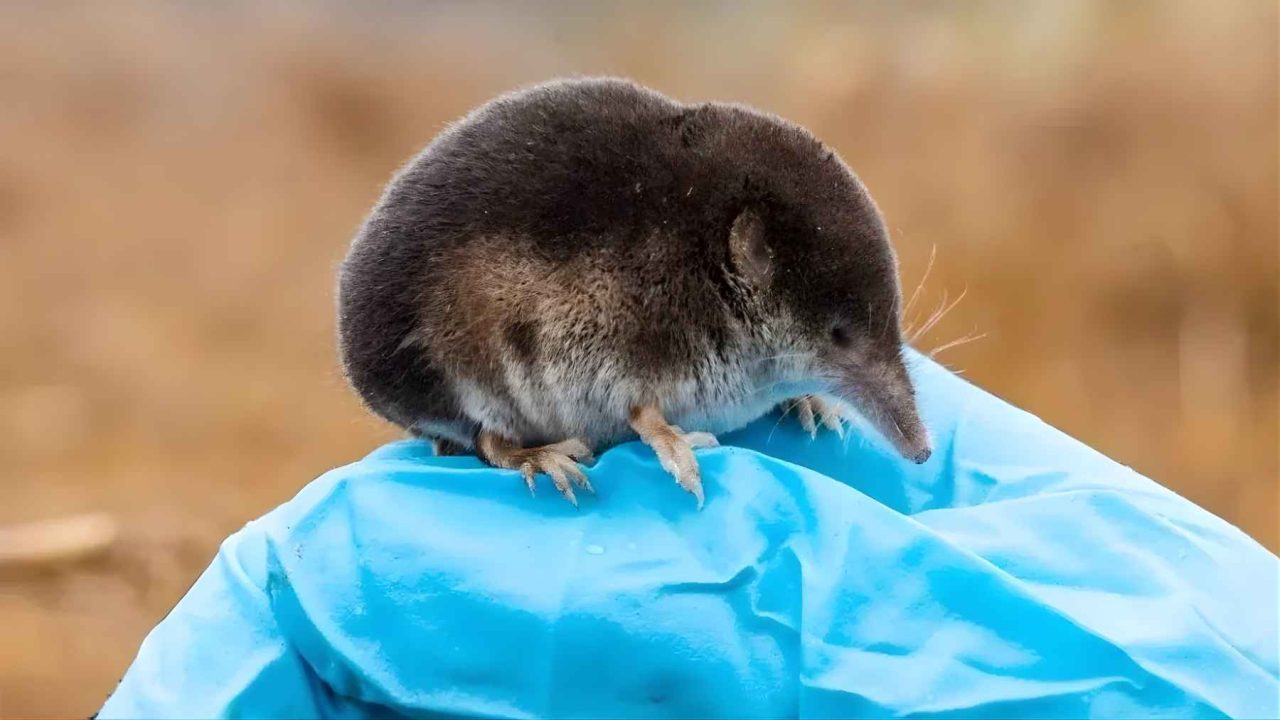
The pitfall trap had been sitting undisturbed overnight in the tall grasses of Mount Damota, perched more than 2.5 kilometers above sea level in southern Ethiopia. Researcher Yonas Meheretu pulled it open in 2023 and found something small enough to sit on a fingertip. Gray-brown fur. A slightly flattened head. A stubby, hairy tail. It weighed roughly 3 grams — about as much as a sugar cube.
Meheretu knew immediately this was something unusual. What he didn’t know yet was that the creature in his hand had been waiting nearly a decade to be named.
What Scientists Assumed About Dwarf Shrews
For most of modern biology, the assumption has been that Africa’s shrew diversity was well-catalogued. Shrews are small, yes — but they are also extraordinarily numerous and well-studied compared to many mammal groups. The genus Crocidura alone contains over 200 recognized species, making it one of the largest mammal genera on Earth.
Most researchers working in the Ethiopian Highlands assumed specimens collected there were variants of already-known species. Small size differences, slight fur color changes, a marginally different tail — these could all be chalked up to individual variation, elevation stress, or regional morphology. No one expected a genuinely new species to be hiding in a trap.
The Ethiopian Highlands are remote, rugged, and biodiversity-rich. But “new mammal species” isn’t a phrase researchers throw around lightly. It requires rigorous morphological analysis, genetic sequencing, and comparisons against specimen collections from around the world.
The Specimen That Started Everything — and the Loss Behind It
The story of Crocidura stanleyi doesn’t actually begin in 2023. It begins in 2015, in the Simien Mountains of northern Ethiopia.
That year, mammalogist Bill Stanley of the Field Museum of Natural History caught a specimen of what appeared to be an unusually small, distinctly featured shrew. Stanley was experienced, careful, and meticulous. He recognized this might be significant.
Then, just a few days after catching the specimen, Bill Stanley died suddenly while still in the field.
“The species is named in his honor — a reminder that behind every scientific name is a human story, often one of sacrifice and devotion to the natural world.”
— Context from the research on Crocidura stanleyi
The specimen Stanley collected sat in institutional archives for years. It was a clue without a conclusion. It took a new generation of researchers, updated genetic tools, and Meheretu’s 2023 discovery to finally close the loop.
Why the Old Assumption Was Wrong
Lead author Evan W. Craig, who recently completed his doctorate at the University of Massachusetts Boston, assembled a team that examined more than one hundred dwarf shrew specimens from multiple institutions around the world. The research was conducted in association with the Swedish University of Agricultural Sciences.
What Craig’s team found dismantled the assumption that these specimens were just regional variants. Morphologically, Crocidura stanleyi has a combination of traits that don’t appear together in any known species. The head is noticeably flattened. The tail is unusually short and densely hairy. The body length sits around 5 centimeters, with the tail adding roughly 3 more.
Genetically, the separation was definitive. These weren’t quirky individuals from a known population. They were a distinct lineage, isolated by the extreme elevation and rugged terrain of the Ethiopian Highlands. Evolution had been quietly shaping them apart from their relatives for a long time.
| Feature | Crocidura stanleyi | Typical Crocidura Species |
|---|---|---|
| Body weight | ~3 grams | 3–30+ grams (varies widely) |
| Body length | ~5 cm | 4–15 cm |
| Tail character | Short, densely hairy | Usually longer, lightly haired |
| Head shape | Noticeably flattened | Typically tapered, not flat |
| Habitat | Ethiopian Highlands, 2,500m+ | Diverse; many lowland species |
What This Discovery Actually Tells Us
The formal naming of Crocidura stanleyi is more than a taxonomic housekeeping exercise. It represents something biologists have been saying for years but the public rarely hears: the planet’s species inventory is nowhere near complete.
#pvv_bar_chart_1775663836470_x88t03 {
font-family: -apple-system, BlinkMacSystemFont, ‘Segoe UI’, Roboto, sans-serif;
margin: 2rem 0;
border-radius: 12px;
box-shadow: 0 4px 24px rgba(0,0,0,0.08);
background: #fff;
overflow: hidden;
}
#pvv_bar_chart_1775663836470_x88t03 .pvv-bc-header {
background: linear-gradient(135deg, #2d3436 0%, #636e72 100%);
color: #fff;
padding: 1.25rem 1.5rem;
font-size: 1.15rem;
font-weight: 700;
}
#pvv_bar_chart_1775663836470_x88t03 .pvv-bc-body { padding: 1.5rem; }
#pvv_bar_chart_1775663836470_x88t03 .pvv-bc-row {
display: flex;
align-items: center;
margin-bottom: 0.75rem;
}
#pvv_bar_chart_1775663836470_x88t03 .pvv-bc-label {
width: 120px;
flex-shrink: 0;
font-size: 0.85rem;
font-weight: 600;
color: #2d3748;
text-align: right;
padding-right: 1rem;
white-space: nowrap;
overflow: hidden;
text-overflow: ellipsis;
}
#pvv_bar_chart_1775663836470_x88t03 .pvv-bc-track {
flex: 1;
height: 32px;
background: #f7fafc;
border-radius: 6px;
overflow: hidden;
}
#pvv_bar_chart_1775663836470_x88t03 .pvv-bc-bar {
height: 100%;
border-radius: 6px;
display: flex;
align-items: center;
justify-content: flex-end;
padding-right: 8px;
min-width: 40px;
}
#pvv_bar_chart_1775663836470_x88t03 .pvv-bc-value {
font-size: 0.75rem;
font-weight: 700;
color: #fff;
white-space: nowrap;
text-shadow: 0 1px 2px rgba(0,0,0,0.2);
}
#pvv_bar_chart_1775663836470_x88t03 .pvv-bc-vertical {
display: flex;
align-items: flex-end;
justify-content: space-around;
height: 250px;
padding: 0 1rem;
border-bottom: 2px solid #e2e8f0;
}
#pvv_bar_chart_1775663836470_x88t03 .pvv-bc-vcol {
display: flex;
flex-direction: column;
align-items: center;
flex: 1;
max-width: 60px;
height: 100%;
justify-content: flex-end;
}
#pvv_bar_chart_1775663836470_x88t03 .pvv-bc-vbar {
width: 70%;
border-radius: 6px 6px 0 0;
min-width: 24px;
min-height: 4px;
}
#pvv_bar_chart_1775663836470_x88t03 .pvv-bc-vlabel {
margin-top: 0.5rem;
font-size: 0.72rem;
font-weight: 600;
color: #4a5568;
text-align: center;
word-break: break-word;
}
#pvv_bar_chart_1775663836470_x88t03 .pvv-bc-vvalue {
font-size: 0.7rem;
font-weight: 700;
color: #718096;
margin-top: 0.2rem;
}
@media (max-width: 640px) {
#pvv_bar_chart_1775663836470_x88t03 .pvv-bc-label { width: 80px; font-size: 0.75rem; }
#pvv_bar_chart_1775663836470_x88t03 .pvv-bc-track { height: 26px; }
#pvv_bar_chart_1775663836470_x88t03 .pvv-bc-header { font-size: 1rem; padding: 1rem; }
#pvv_bar_chart_1775663836470_x88t03 .pvv-bc-vertical { height: 180px; }
}
We tend to assume that if something is small and lives in a remote place, it either doesn’t matter or has already been catalogued. Both assumptions are wrong. Shrews like this one play critical ecological roles — insect control, soil aeration through burrowing, and serving as prey for highland raptors and snakes. Losing a species before it’s named means losing it before anyone even knew to protect it.
The Ethiopian Highlands are considered a global biodiversity hotspot, but infrastructure for systematic surveying is limited. Pitfall traps, the low-tech method Meheretu used in 2023, remain one of the most effective tools for capturing small mammals that might otherwise go undetected for decades.
Craig’s team noted that the extreme elevation where the species lives creates natural isolation. Mountains act like islands. Species evolve separately, cut off from lowland relatives by altitude and climate. The Simien Mountains in the north and Mount Damota in the south are separated by hundreds of kilometers — yet both held specimens of the same previously unrecognized species.
A Name Carries Weight
Naming a species after Bill Stanley ensures that a scientist who died in service of discovery doesn’t disappear from the scientific record. It’s a quiet form of legacy, embedded into Latin nomenclature and preserved in every paper that cites the species going forward.
That kind of continuity matters. Science is often presented as a series of clean breakthroughs, but the reality is messier and more human. Specimens sit in drawers for years. Researchers die before their work is done. Graduate students pick up threads left by others. Crocidura stanleyi is the product of all of that.
What This Means Beyond the Lab
The confirmation of Crocidura stanleyi arrives at a moment when global biodiversity loss is accelerating. The Ethiopian Highlands face increasing agricultural pressure, climate-driven vegetation shifts, and habitat fragmentation. A species that lives only above 2,500 meters elevation has nowhere to go if its habitat degrades.
We can’t protect what we haven’t named. And we can’t name what we haven’t found. The cycle that produced this discovery — field collection, institutional preservation, decades-later genetic analysis — is exactly the kind of long-game science that conservation depends on, and exactly the kind that often loses funding battles to more visible, charismatic research.
A 3-gram shrew with a flat head and a hairy tail doesn’t make headlines the way a new big cat would. But its existence, and the rigor required to confirm it, says something important about the scale of what we still don’t know. Every pitfall trap left overnight on a remote hillside is, in a sense, a question mark waiting to be answered.
The question is whether we’re willing to keep asking.
.pvv-faq-section details summary::-webkit-details-marker{display:none}.pvv-faq-section details summary::marker{display:none;content:””}.pvv-faq-section details[open] summary .pvv-faq-arrow{transform:rotate(90deg)}
Frequently Asked Questions

You Might Also Like

5 Ways DART Proved Humanity Can Move an Asteroid
NASA's DART mission didn't just nudge an asteroid moon. It shifted a celestial body's orbit…

Raindrops as Power: The Science Debate Soaking Energy Research
Scientists at Nanjing University built a floating generator that turns raindrops into electrical pulses. Is…

Dead Mice Found in Jumbo Frozen Green Beans Spark Recall
Jumbo recalls 14oz and 28oz frozen green beans after dead mice found in sealed bags.…
Leave a Reply