
▶ Read transcript
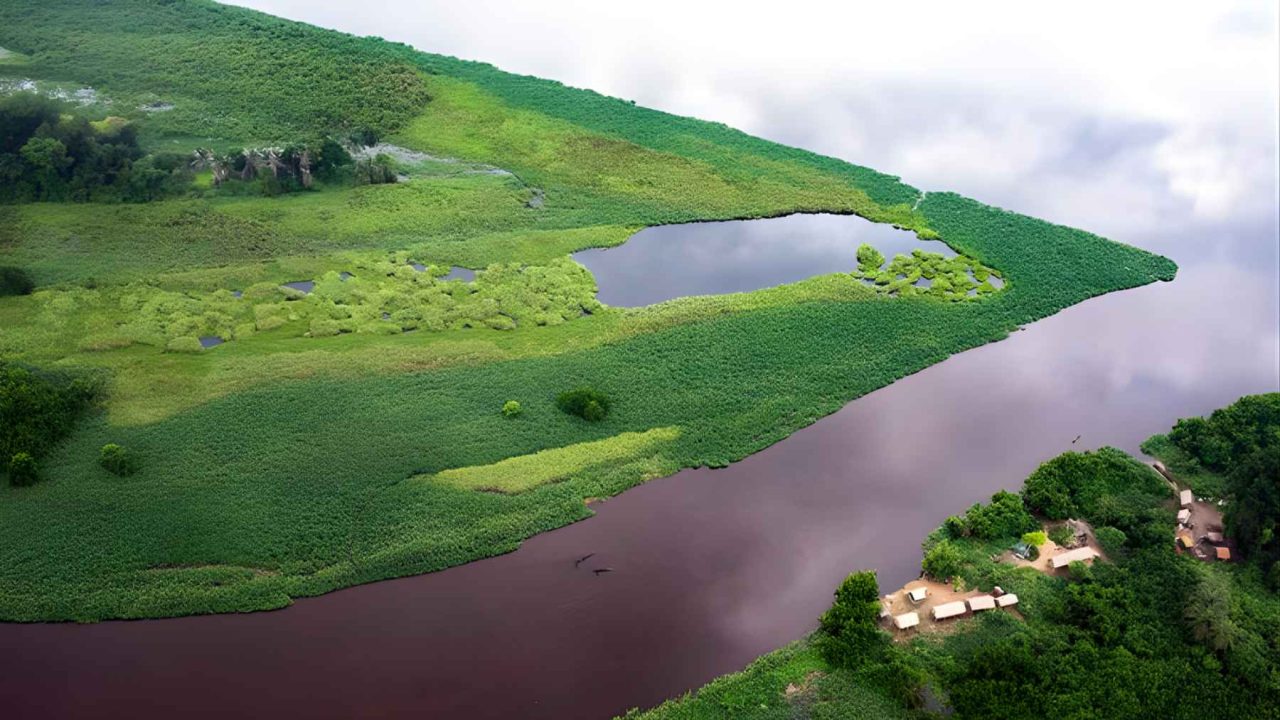
Here’s what you need to know about the Congo Basin’s peatlands and why scientists are worried. Deep in central Africa sits one of Earth’s most important carbon stores — a vast region of swamp forests and waterlogged peatlands holding carbon that has been building up for thousands of years. Researchers estimate these peatlands alone store the equivalent of three years of total global fossil fuel emissions. The problem is that this carbon is preserved by wet, low-oxygen conditions, not by freezing temperatures like permafrost. Any shift in regional hydrology — from drought, warming, or land use change — can start releasing that carbon. A warning sign is already visible: lakes in the basin have turned dark from dissolved organic carbon leaching out of surrounding soils. And in 2023, extreme heat and drought caused land ecosystems worldwide to nearly stop absorbing carbon altogether. The takeaway here is simple — pay attention to climate coverage that goes beyond the Amazon and the oceans. The Congo Basin deserves a place in that conversation.
Jean-Pierre Mbadu had fished the same stretch of the Congo’s flooded forest for thirty years. But in recent seasons, the water had changed color, turning darker, almost black, carrying a faint sulfurous edge that hadn’t been there before. He couldn’t name what was happening. Scientists, it turns out, are only beginning to.
What Most People Assume About Carbon Sinks
Ask most people where Earth stores its excess carbon, and they’ll point to the ocean or the Amazon rainforest. The ocean is, by volume, the largest single carbon sink on the planet, absorbing excess heat and energy released from rising greenhouse gas emissions, according to NOAA. Forests come a close second in the public imagination.
The Congo Basin rarely enters that conversation. It sits in central Africa, largely out of the global spotlight, and its swamp forests and peatlands don’t generate the same headlines as the Amazon. Yet this region is one of Earth’s great natural climate buffers, holding carbon that has been accumulating for thousands of years beneath layers of waterlogged organic matter.
The assumption, widely shared even among educated observers, is that these sinks are stable. That they passively absorb carbon year after year, acting as a permanent geological savings account. That assumption is now under serious pressure.
The Dark Lakes That First Raised the Alarm
Researchers studying two lakes in the Congo Basin noticed something unusual in their water chemistry. The lakes had turned distinctly dark, stained by dissolved organic carbon leaching out of the surrounding peatlands and swamp soils. This kind of darkening, known scientifically as brownification, is a known signal in other parts of the world that ancient organic material is breaking down and moving.
In Siberia and northern Canada, similar darkening has been documented in lakes sitting atop thawing permafrost. There, the process is well understood: warming temperatures destabilize frozen ground, releasing carbon that had been locked away for millennia. The Congo situation is different in its mechanism but troublingly similar in its implication.
The Congo Basin’s peatlands don’t freeze. They stay wet. Their carbon is preserved not by cold but by waterlogged, oxygen-poor conditions that slow decomposition almost to a halt. When those conditions change, even slightly, the carbon begins to move.
Why the Stability of the Congo Basin Has Been Overestimated
For years, global climate models treated terrestrial carbon sinks as relatively predictable. Research from Stanford has challenged that view directly, finding that one of Earth’s biggest carbon sinks has been overestimated. The models assumed a consistency that real-world conditions don’t support.
The Congo Basin covers roughly 3.7 million square kilometers. Its peatlands alone are estimated to store the equivalent of three years of global fossil fuel emissions. That number sounds reassuring until you consider that it represents carbon accumulated over thousands of years, not a renewable resource that regenerates on human timescales.
The year 2023 was a turning point that few outside the scientific community registered. Extreme heat, drought, and wildfires caused forests and other land ecosystems to emit almost as much carbon dioxide as they removed from the atmosphere, according to New Scientist. The land sink, in effect, nearly collapsed for an entire calendar year.
Congo Basin Peatlands
Amazon Rainforest
World's Oceans
| Metric | Congo Basin Peatlands | Amazon Rainforest | World's Oceans |
|---|---|---|---|
| Carbon Density |
95 |
80 |
88 |
| Stability Over Time |
72 |
68 |
85 |
| Climate Vulnerability |
78 |
82 |
70 |
| Human Disturbance Risk |
65 |
80 |
45 |
| Scientific Monitoring |
38 |
74 |
80 |
| Public Awareness |
22 |
88 |
76 |
| Absorption Rate |
55 |
72 |
90 |
The Congo Basin escaped the worst of that particular crisis. But the event demonstrated a principle that scientists had long warned about: carbon sinks are not switches locked in the “on” position. They are dynamic systems that can flip.
| Carbon Sink | Primary Storage Mechanism | Vulnerability |
|---|---|---|
| Ocean | Dissolved CO2, marine organisms | Acidification, warming reduces absorption |
| Amazon Rainforest | Living biomass, soil organic matter | Deforestation, drought, fire |
| Congo Basin Peatlands | Waterlogged organic matter, millennia of accumulation | Hydrological disruption, warming, drainage |
| Northern Permafrost | Frozen soil locking ancient carbon | Thaw from rising Arctic temperatures |
What Is Actually Happening Beneath the Congo’s Surface
Soil is a critical but underappreciated carbon storage medium. As Wikipedia’s carbon sink overview notes, much of the organic carbon retained in terrestrial systems sits in soil, not in the living trees above it. In peatlands, this is especially true. The trees are almost incidental. The real archive is underground.
Peat forms when plant material accumulates faster than it can decompose. In the Congo Basin, this process has been running for thousands of years, layer upon layer of partially decayed vegetation pressed into a dense, carbon-rich substrate. The two dark lakes now showing signs of carbon release sit within or adjacent to this system.
When dissolved organic carbon appears in lake water at elevated concentrations, it tells researchers that the surrounding peat is breaking down. The carbon is moving from solid storage into liquid form, and from there, into the atmosphere as CO2 and methane. Methane is particularly significant: it is roughly 80 times more potent than CO2 as a greenhouse gas over a 20-year period.
“The world’s land plays a key role in the climate system as an essential carbon sink that regulates the planet’s temperature and absorbs its carbon emissions.”
— United Nations, on the role of land-based carbon storage
The United Nations has identified land-based carbon storage as essential to climate regulation. When that storage begins to reverse, it doesn’t just stop helping. It starts actively making things worse.
The Feedback Loop Scientists Fear Most
Here is the scenario that keeps climate scientists awake. The Congo Basin begins releasing carbon. That carbon warms the atmosphere further. Warmer temperatures accelerate the breakdown of peat. More carbon escapes. The cycle accelerates beyond any human intervention.
This is not a theoretical worst case. It is the same feedback loop already documented in Siberian permafrost regions, where thawing ground is releasing carbon that in turn accelerates thaw. The Congo version would operate through different physics but arrive at the same destination.
What makes the Congo situation particularly difficult is geography and politics. The basin spans multiple nations, including the Democratic Republic of Congo, the Republic of Congo, and Cameroon. Coordinated conservation at the scale needed is logistically and diplomatically complex. Meanwhile, the pressures driving hydrological change, including agricultural expansion, logging, and regional climate shifts, are intensifying.
What This Means Beyond the Congo
The implications reach far beyond central Africa. Global climate projections are built on assumptions about how much carbon land ecosystems will continue to absorb. If the Congo Basin shifts from sink to source, those projections underestimate future warming. Every climate target, every net-zero commitment, every temperature threshold becomes harder to meet.
There is also a deeper lesson about how humans have understood natural systems. The Congo’s peatlands were treated as a given, a permanent feature of the climate balance sheet. The dark lakes suggest they were always more fragile than the models assumed.
For the fishermen and farmers who live alongside these waters, the change is not abstract. It is the color of the water they drink, the smell of the air above the swamp, the slow disappearance of species that once defined their world. Science is only now catching up to what some of them have been noticing for years.
The question is no longer whether the Congo Basin’s carbon stores are vulnerable. The question is how much time remains before a slow leak becomes something much harder to stop.
Frequently Asked Questions
Frequently Asked Questions

You Might Also Like
India’s Red Road Uses Psychology to Slow Drivers in Tiger Country
India's first red road on NH-45 uses a 5mm thermoplastic surface and 25 animal underpasses…
The Aluminum Breakthrough That Could End Our Addiction to Rare Metals
Scientists at King's College London created cyclotrialumane, a new aluminum form that could replace platinum…

Your Brain Shifts Gears at Four Ages — One Will Surprise You
A 2025 Cambridge study of 4,216 MRI scans found the brain changes course at ages…
Leave a Reply