
▶ Read transcript
Here’s what you need to know about a chemistry breakthrough that could reshape how we make everything from medicines to clean energy technology.
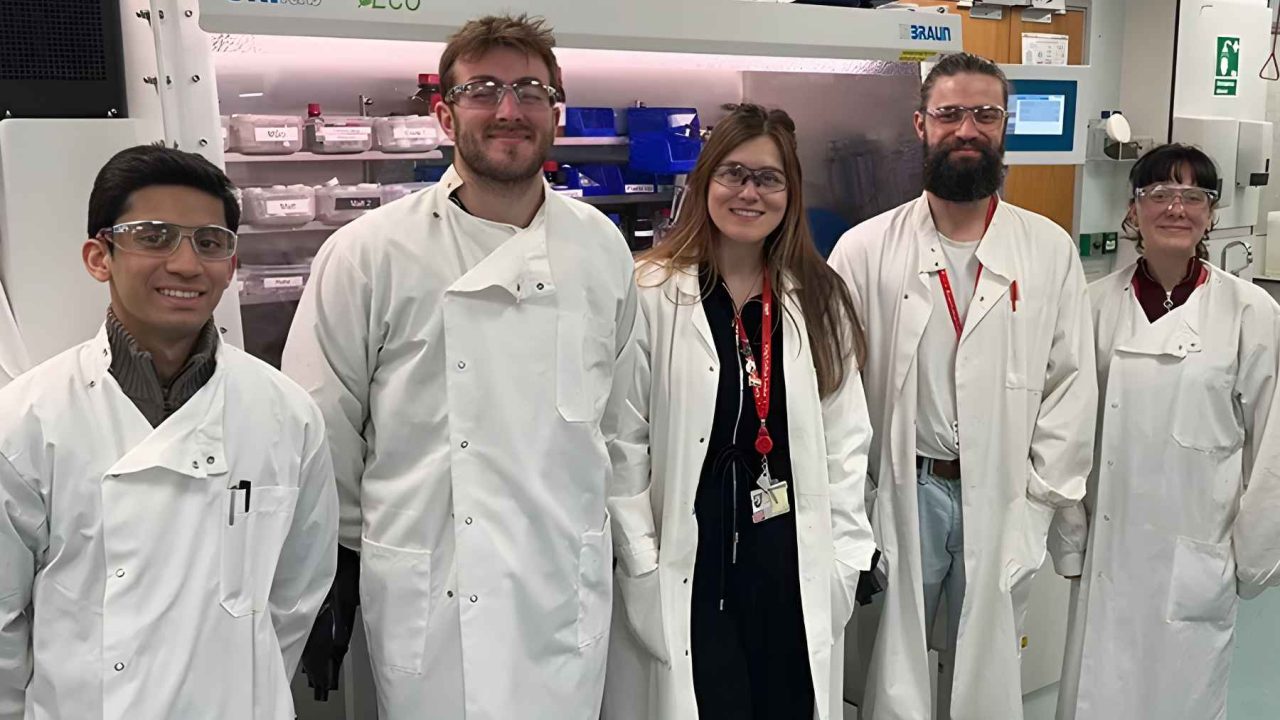
Researchers at King’s College London have created something called a cyclotrialumane — a stable three-atom ring of aluminum that behaves in ways aluminum simply wasn’t supposed to be able to. The findings were published in Nature Communications in April 2026.
Here’s why that matters. Industrial chemistry has long depended on rare precious metals like platinum and palladium to drive critical reactions. Those metals are expensive, geopolitically fragile, and largely controlled by a handful of countries. Aluminum costs roughly 20,000 times less and is one of the most abundant elements on Earth.
The key breakthrough is that this new aluminum compound stays stable in liquid solution, which is essential for real-world chemical reactions. It’s still early-stage research, but the potential to replace precious metals in catalysis is genuinely significant.
Keep an eye on this one — it’s worth following King’s College London’s next publications as they move toward testing this at larger scales.
A chemist stares at a vial of silvery liquid under a fume hood in London. The material inside is aluminum, the same element found in soda cans and kitchen foil. But this aluminum does something aluminum has never done before. It holds together in a perfect three-atom ring and refuses to fall apart, even in solution.
That moment, replicated carefully across dozens of experiments at King’s College London, may represent one of the most consequential chemistry breakthroughs in recent memory. Not because it is flashy, but because it quietly dismantles an assumption that has shaped industrial chemistry for decades.
What the World Has Always Assumed About Aluminum
Most people think of aluminum as a humble, workaday metal. Cheap, abundant, lightweight. It wraps your leftovers and frames your windows. It is emphatically not the kind of material that powers cutting-edge chemical reactions.
That role has always belonged to precious metals like platinum and palladium. These elements sit at the heart of catalytic converters, pharmaceutical manufacturing, and fuel cell technology. They are extraordinary at facilitating chemical reactions without being consumed in the process.
The problem is that they are extraordinarily expensive and geopolitically fragile. Platinum and palladium are mined in only a handful of countries, and supply chains can be disrupted by conflict, policy shifts, or export controls. Industry has accepted this dependency as an unavoidable cost of doing business.
The assumption, deeply embedded in chemistry textbooks and industrial procurement departments alike, is that only certain rare, expensive metals can do this catalytic work. Aluminum, the reasoning goes, simply does not have the right electronic properties. It is too reactive in some ways, too inert in others.
That assumption just cracked open.
The Three-Atom Ring That Defies Aluminum’s Known Chemistry
Chemists at King’s College London have synthesized a compound called a cyclotrialumane: a neutral aluminum(I) trimer made of a three-atom ring of aluminum atoms. The research was published in Nature Communications in April 2026.
Aluminum(I) compounds, where aluminum carries a single positive charge rather than its usual three, are notoriously unstable. They tend to decompose or rearrange almost instantly. Getting three aluminum(I) atoms to lock together in a stable ring and stay that way, even when dissolved in solution, was considered essentially impossible.
What makes the discovery especially significant is that the compound retains its trimeric form in solution. That is not a minor technical detail. It means the structure remains available for a broader set of chemical reactions, rather than collapsing the moment it leaves a solid state. For catalysis, solution stability is everything.
Researcher Bakewell and the King’s College team demonstrated that this new aluminum form can activate small molecules in ways that previously required platinum-group metals. The electronic behavior of the three-atom ring mimics, at least partially, the reactive properties that make precious metals so useful in industrial chemistry.
Why the Rare-Earth Crisis Makes This Discovery Urgent
To understand why this matters beyond a chemistry journal, you need to look at the global supply chain for critical metals. The situation is more precarious than most people realize.
Global rare-earth mine production in 2024 was estimated at approximately 430,000 short tons of rare-earth-oxide equivalent. China alone produced about 298,000 short tons of that total, roughly 69 percent of global supply. China also controls an estimated 99 percent of the world’s capacity to process heavy rare earth elements, according to Reuters analysis.
| Country / Region | 2024 REO Production (short tons) | Share of Global Total |
|---|---|---|
| China | ~298,000 | ~69% |
| United States | ~49,600 | ~12% |
| Rest of World | ~82,400 | ~19% |
| Global Total | ~430,000 | 100% |
The United States produced about 49,600 short tons of rare-earth-oxide equivalent in mineral concentrates in 2024, valued at $260 million. Catalysts were the leading domestic end use of rare earths in the country. That means the very industrial processes that American manufacturing depends on are built on a foundation of materials that are largely processed abroad.
Prices are rising, too. Neodymium-praseodymium oxide, one of the most critical rare-earth compounds for magnets used in electric vehicles and wind turbines, rose from about $29 per pound to roughly $40 per pound between 2024 and 2025. That is a 38 percent increase in a single year.
At current extraction rates, humans will exhaust known rare-earth reserves within 60 to 100 years. We have mined roughly 4.5 million metric tons so far. Only 90.9 million metric tons of known deposits remain. The math is uncomfortable.
Efforts are underway to ease the pressure. Researchers at Idaho National Laboratory have developed an electrochemical membrane reactor that recovers critical materials from spent lithium-ion battery leachates. Separate analyses suggest the United States already has significant quantities of critical minerals sitting in mining waste, effectively discarded during previous extraction operations. But recycling and recovery, while promising, cannot fully substitute for finding alternative materials.
“Aluminum is approximately 20,000 times less expensive than precious metals such as platinum and palladium.”
— Researcher Bakewell, King’s College London
That is where cyclotrialumane enters the picture with unusual force. Aluminum is the third most abundant element in Earth’s crust. It is not subject to the same geopolitical chokepoints. It does not require deep-sea mining or conflict-zone extraction. And it costs a fraction of a fraction of what platinum-group metals cost.
You manage procurement for a mid-sized pharmaceutical company. Your palladium supplier just announced a 40 percent price increase, citing supply disruptions. A research partner offers you early access to an experimental aluminum-based catalyst that has shown promise in lab settings but has not yet been validated at industrial scale. Do you wait for proven technology or take the risk?
What Cyclotrialumane Could Mean for Industry and Everyday Life
The practical implications stretch across several industries, though it is important to be clear: this is foundational research. Cyclotrialumane is not going into catalytic converters next year. The path from a laboratory synthesis to industrial deployment involves years of further study, scale-up challenges, and engineering work.
But the direction it points is significant. Pharmaceutical manufacturing relies heavily on palladium-catalyzed reactions to build complex organic molecules. If aluminum-based catalysts can replicate even a subset of those reactions, the cost reduction would be dramatic. Drug manufacturing costs could fall. Supply chain vulnerabilities would shrink.
Beyond pharmaceuticals, the implications extend to clean energy. Fuel cells, which convert hydrogen into electricity using platinum catalysts, are central to many decarbonization strategies. A cheaper, more abundant aluminum-based alternative could accelerate the economics of hydrogen power in ways that subsidies alone cannot achieve.
Green chemistry as a discipline has long sought what researchers call “earth-abundant” catalysts: materials made from elements that are common, cheap, and ethically sourced. Iron, cobalt, and nickel have all been explored. Aluminum has largely been overlooked, precisely because its chemistry seemed too limited. The cyclotrialumane discovery reopens that conversation entirely.
There is also a broader geopolitical dimension. Nations that currently depend on China for rare-earth processing have spent years searching for alternatives, from deep-sea nodule mining to asteroid resource proposals. A material as common and domestically available as aluminum, reimagined through new chemistry, sidesteps the entire supply chain problem rather than trying to solve it at the extraction end.
The energy transition already demands enormous quantities of critical minerals. Electric vehicles, wind turbines, and grid-scale batteries all require rare earths and precious metals at scales that current supply chains were not designed to handle. Every industrial process that can be shifted to aluminum-based chemistry reduces that pressure, even marginally.
Marginal reductions, multiplied across thousands of industrial processes and billions of units of manufactured goods, stop being marginal very quickly.
A three-atom ring of aluminum, stable in a London laboratory vial, may not look like the future of manufacturing. But the history of chemistry is full of small, strange molecules that quietly rewrote what industry believed was possible. This one is worth watching closely.




Leave a Reply