
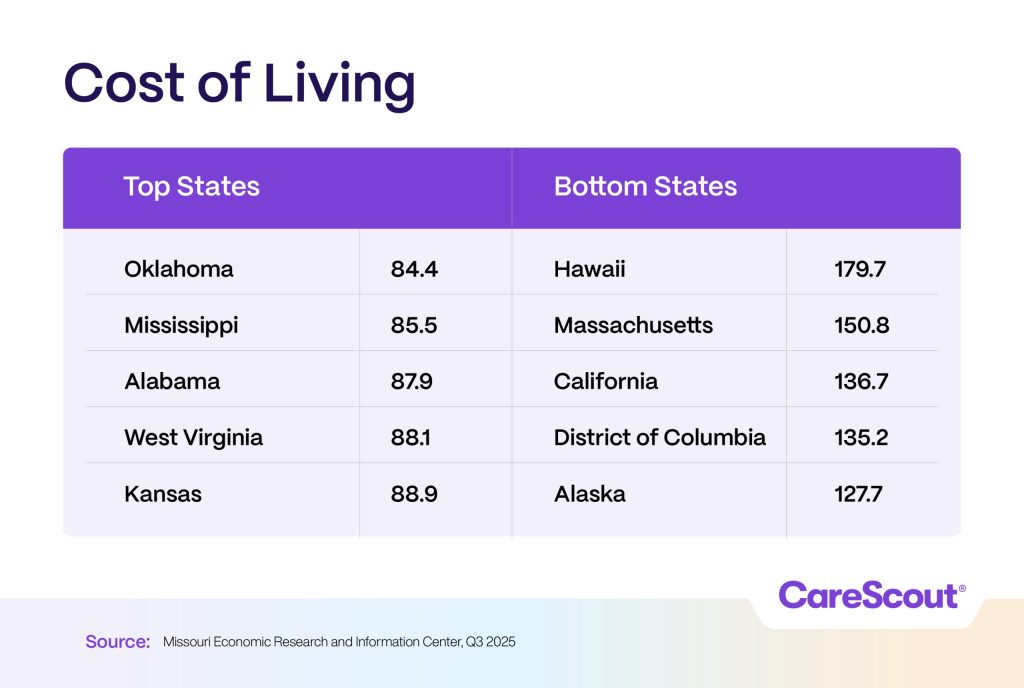
The Cost of Living Index gives Meadville, Pennsylvania a composite score of 82.4 — meaning everyday expenses run roughly 18% below the U.S. average of 100. That sounds like clarity. It isn’t. One composite number cannot capture the 44-mile drive to Erie’s Hamot Medical Center for specialist care, the silent erosion of a fixed income when
property tax assessments jump 12% in a single reassessment cycle, or the compounding cost of owning two vehicles because Crawford County has zero public transit routes.
The index was never designed to answer the question most families actually ask: “Can I actually afford to live here, well, for the long term?” That is a fundamentally different question from “Is this place cheap on paper?”
How the Index Is Actually Built
Read more: Cheapest States to Live in America
The most widely cited benchmark is the Council for Community and Economic Research (C2ER) Cost of Living Index. It surveys prices in roughly 300 urban and suburban markets each quarter. Researchers collect prices on a defined basket of goods — groceries, housing, utilities, transportation, health care, and miscellaneous goods and services.
Here is the first structural problem: participation is voluntary and dominated by chambers of commerce. Meadville participates. But nearby Titusville, Pennsylvania — population 5,200, Venango County — does not. Neither does Clarion or Oil City. Dozens of genuinely rural communities are simply invisible to the index.
The basket itself is weighted toward urban consumption patterns. It prices a 6-ounce can of tuna, a half-gallon of milk, a movie ticket, and a doctor’s office visit. It does not price a cord of firewood, a 500-gallon propane fill-up, a septic system pump-out, or a used pickup truck — all of which are routine expenses in places like Elk County, Pennsylvania or Osceola County, Michigan.
By the numbers: C2ER weights housing at 28% of the composite score. In a rural county where the median home sells for $89,000 — as in Crawford County, PA — that weight crushes the composite score downward. It makes the place look dramatically affordable. But housing is already cheap. The hidden costs live in the other 72% that the index partially captures.
The Six Costs Small-Town Indexes Routinely Miss
Read more: 9 States With No Income Tax in 2026 — and the Hidden Costs
1. The Transportation Tax Nobody Names
In Meadville, the nearest Costco is in Erie — 44 miles north on Route 19. The nearest IKEA is in Pittsburgh — 115 miles south. There is no Trader Joe’s, no Whole Foods, no Target within Crawford County limits. The index prices a grocery basket at local stores. It does not account for the monthly trip to Erie that most Meadville households make for bulk goods, specialty items, or simply more competitive pricing.
The American Automobile Association pegs the total cost of operating a mid-size sedan in 2025 at roughly $0.67 per mile. A monthly Erie run — call it 90 miles round-trip — costs approximately $60 in pure vehicle cost, before tolls. That’s $720 per year that does not appear in any cost-of-living composite for Meadville.
Now multiply that across a two-car household — the statistical norm in rural America, not the exception. The index captures neither vehicle ownership rates nor fuel costs with adequate rural granularity.
2. Health Care Access vs. Health Care Price
The C2ER index prices a routine doctor’s office visit. In Meadville, that visit might cost $142 — below the national average. Score one for the index. But Meadville Regional Medical Center does not employ a full-time oncologist, a pediatric cardiologist, or a movement disorder neurologist. Patients needing those specialists travel to UPMC Hamot in Erie or UPMC Presbyterian in Pittsburgh.
A cancer patient driving from Meadville to Pittsburgh for weekly infusions logs roughly 230 miles round-trip. Over a 12-week treatment cycle, that’s 2,760 miles — a transportation burden of roughly $1,849 at AAA’s 2025 rate, unaccounted for in any composite score. The index prices health care. It doesn’t price the geography of health care.
3. Energy Costs in Older Rural Housing Stock
Crawford County’s median housing unit was built in . Many homes in Meadville’s older neighborhoods — particularly around Arch Street and the Diamond — are pre-1940 wood-frame construction with minimal insulation. The index uses a standardized utility cost based on a metered monthly bill.
But a family heating a drafty 1,800-square-foot Victorian in a Pennsylvania winter at average Crawford County propane prices — roughly $2.89 per gallon in winter 2025 — can easily spend $3,200 annually on heating alone. A comparable household in a well-insulated 2010 build in suburban Columbus, Ohio might spend $1,100. Both appear as “utilities” in their respective city indexes, but the underlying reality diverges by thousands of dollars.
4. Property Tax Volatility and Reassessment Cycles
Pennsylvania is notorious for infrequent property reassessments. Crawford County went decades without a countywide reassessment. When reassessment finally hits, long-term homeowners on fixed incomes absorb sudden, compounding increases with no warning and limited appeals infrastructure. The index captures current property tax rates. It cannot capture the latent reassessment risk embedded in a county that hasn’t updated values since .
A retiree who bought a Meadville home for $95,000 in 2005 and saw it reassessed at $178,000 in 2023 faced a tax bill shock their fixed income had no room to absorb — regardless of what the composite index said about affordability.
5. Income Opportunity Cost — The Wage Side of the Equation
Cost of living is only half the personal finance equation. The other half is income. Crawford County’s median household income sits at approximately $47,800 annually, well below Pennsylvania’s statewide median of $72,627. A remote worker earning a Pittsburgh or Philadelphia salary while living in Meadville captures genuine arbitrage. But a locally employed worker — in retail, manufacturing, or education — earns a local wage against those costs.
The index never expresses affordability as a ratio of local wages to local costs. An 82.4 composite score means nothing to a Meadville teacher earning $38,000 competing against a Boulder, Colorado teacher earning $62,000. The costs are lower, yes. But so is the economic runway.
6. The Amenity Premium — What You Give Up
Cost of living indexes measure expenditure. They don’t measure substitution. In Meadville, there are no sushi restaurants, no concert venues with national acts, no professional sports franchises, no major art museums within the county. Residents either go without, drive, or pay for subscriptions and streaming services as proxies. None of that shows up in a composite score as a meaningful category.
This isn’t a criticism of Meadville — it’s a genuinely livable, historically rich city founded in , home to Allegheny College since . But a composite number that says “18% cheaper” doesn’t tell a prospective resident which 18% they’re trading away in quality of life.
What a Better Small-Town Affordability Score Would Include
Read more: 15 Hidden American Towns Most Road-Trippers Never Find
Researchers at the Economic Innovation Group and the Urban Institute have argued for composite indexes that incorporate wage-adjusted costs, transportation access scores, health care proximity metrics, and broadband availability. Some state-level models are emerging. The Pennsylvania Economy League has pushed for county-level fiscal health dashboards that go beyond price baskets.
Until those tools become standardized, the honest framework for evaluating a small-town move looks something like this:
- Calculate your actual local income or remote income after state and local taxes
- Price out two-vehicle ownership costs including insurance in that specific county
- Call the county assessor’s office and ask when the last reassessment occurred
- Drive the routes to the nearest Level II trauma center and specialty medical hub
- Request 12 months of utility bills from a seller — not national averages
- Price propane or heating oil locally, not from a national benchmark
- Check broadband availability by address, not by county or zip code aggregates
None of these steps are glamorous. But they are the difference between a composite score and a real decision. Meadville may still win on every single metric. Or the calculation may surprise you. Either way, you’ll know something the index never told you.




Leave a Reply