
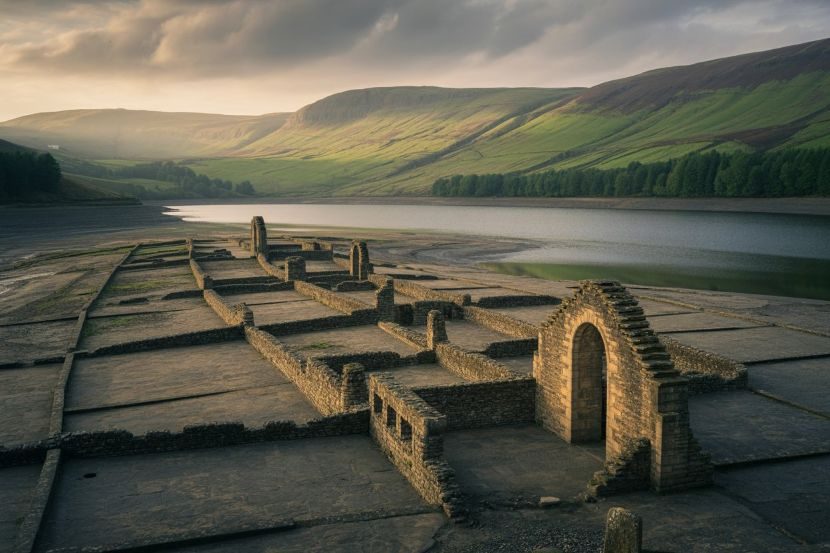
Beneath the dark surface of Ladybower Reservoir in Derbyshire’s Peak District, an entire village has been waiting for over eighty years. In 2025, unusually low water levels finally brought it back — and what emerged from the depths has drawn visitors from across Britain to witness one of the most extraordinary intersections of nature and history the region has seen in decades.
The submerged village of Derwent, along with its neighboring settlement of Ashopton, was deliberately flooded in the 1940s to make way for Ladybower Reservoir. Stone foundations, pathways, and the skeletal outlines of what was once a living rural community have resurfaced, offering a rare and sobering glimpse into a chapter of British history that most people never expected to see with their own eyes.
The response has been immediate. Tourists have been flooding — quite literally — into the Peak District to stand at the water’s edge and look down at a village that time, and water, was supposed to have swallowed permanently.
The Village That Was Sacrificed for a Reservoir
Ladybower Reservoir was constructed between 1935 and 1945, making it one of the largest engineering projects undertaken in the English Midlands during that era. The reservoir was designed to serve as a major water storage source for much of central England — a practical necessity that came with an enormous human cost.
Two villages, Derwent and Ashopton, stood in the path of the rising water. The decision was made to flood them entirely. Residents were relocated, buildings were demolished, and the communities that had existed there for generations were erased from the landscape. Even a church — the kind of structure that typically anchors a rural English village for centuries — was submerged beneath the reservoir’s growing surface.
The structures were largely demolished before the water rose, but the foundations remained. Roads, pathways, and the stone bones of homes settled into the silt at the bottom of what became one of Derbyshire’s most recognizable landmarks. And there they stayed, mostly invisible, for the better part of eight decades.
What the Retreating Water Has Revealed
The emergence of these ruins is not entirely without precedent. During past periods of drought or low rainfall, fragments of Derwent Village have briefly appeared before disappearing again as water levels recovered. But the low water conditions of 2025 have created an unusually extended and visible exposure of the site, drawing far greater attention than previous appearances.
What visitors are seeing are the physical remnants of the village — old stone foundations rising above the waterline, the outlines of paths that once connected homes to fields and churches, and the general shape of a settlement that was once very much alive. There are no standing walls, no intact buildings. But the scale and clarity of what is visible has been striking enough to trigger a significant surge in visitor numbers to the area.
| Key Fact | Detail |
|---|---|
| Reservoir construction period | 1935 to 1945 |
| Villages submerged | Derwent and Ashopton |
| Location | Peak District, Derbyshire |
| Purpose of reservoir | Major water storage for central England |
| Trigger for 2025 emergence | Unusually low water levels |
| Visible remains | Stone foundations, paths, community remnants |
Why This Moment Is Drawing So Many People
There is something genuinely unsettling — and compelling — about seeing a place that was meant to be gone forever. The story of Derwent and Ashopton carries a weight that goes beyond architectural curiosity. These were functioning communities. People were born there, grew up there, and were forced to leave so that a reservoir could be built. The water was supposed to be the final chapter.
For visitors arriving at Ladybower in 2025, the experience is less like visiting a ruin and more like watching a ghost materialize. The Peak District already draws millions of tourists annually for its landscapes and walking trails, but the reappearance of Derwent Village has added something different — a reason to visit that feels urgent and time-sensitive in a way that a mountain trail does not.
Observers have noted that the tourism response reflects a broader public appetite for what might be called “living history” — moments when the past becomes physically accessible rather than just readable in books or viewable in photographs. The ruins of Derwent Village are not behind glass in a museum. They are out in the open, subject to weather, water levels, and time.
What Happens When the Water Returns
The visibility of Derwent Village’s remains is entirely dependent on water levels, which fluctuate with rainfall patterns and seasonal conditions. When the reservoir refills — as it inevitably will — the foundations will disappear again beneath the surface. There is no permanent exhibition, no guaranteed viewing window, and no infrastructure built around the site specifically for tourists.
That impermanence is, in many ways, the point. The current moment is being treated as exactly that — a moment. Visitors who want to see the ruins are being encouraged to go now, while conditions allow it, because there is no certainty about how long the exposure will last or when a similar opportunity might arise again.
Local interest in preserving the memory of Derwent and Ashopton has always existed in the communities surrounding Ladybower Reservoir. The periodic reappearances of the ruins tend to reignite that interest sharply, prompting conversations about the history of the villages and the lives of the people who were displaced when the valley was flooded.
Visiting Ladybower Reservoir and the Derwent Ruins
The Peak District remains one of England’s most visited natural areas, and Ladybower Reservoir is already a well-established destination within it. The reservoir sits in the Upper Derwent Valley and is accessible by road, with walking trails and viewing points throughout the surrounding landscape.
The visibility of the ruins varies depending on where water levels stand at any given time. Visitors are advised to check current conditions before making a special trip specifically to see the submerged village remains, as the window of visibility can change quickly with rainfall. That said, the broader area offers significant natural and historical interest regardless of whether the ruins are above the waterline on any particular day.
Frequently Asked Questions
Which villages were submerged to create Ladybower Reservoir?
The two villages of Derwent and Ashopton were deliberately flooded during the construction of Ladybower Reservoir in the 1940s.
When was Ladybower Reservoir built?
Construction took place between 1935 and 1945.
What can visitors actually see at the site?
During the current low water conditions, visitors can see old stone foundations, paths, and the remnants of the former village layout that once made up Derwent.
Why did the ruins reappear in 2025?
Unusually low water levels in 2025 caused the water surface of Ladybower Reservoir to drop far enough to expose the submerged remains.
Will the ruins always be visible?
No — visibility depends entirely on water levels. When the reservoir refills following rainfall, the foundations will be submerged again and no longer visible from the surface.
Where is Ladybower Reservoir located?
It is located in the Peak District, Derbyshire, in the heart of central England, and serves as a major water storage source for the region.




Leave a Reply