
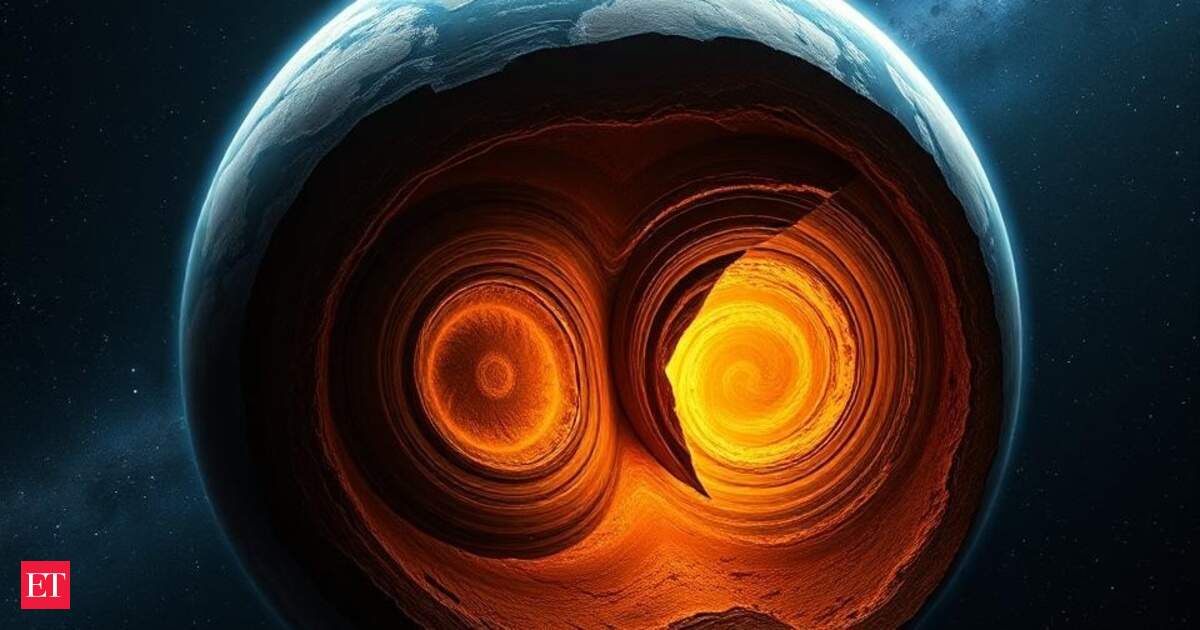
Here is a claim most geophysicists would have dismissed a decade ago: the thing keeping Earth’s magnetic field stable might not be the churning liquid iron of the outer core. It might be two enormous blobs of hot rock sitting at the bottom of the mantle, barely moving, doing almost nothing — and doing it perfectly.
That idea now has serious scientific weight behind it. A new study led by Andy Biggin at the University of Liverpool has linked two mysterious, continent-sized structures deep inside Earth to long-term patterns in the planet’s magnetic history. The implications stretch far beyond geology. They touch on why Earth remains habitable at all.
What Most People Assume About the Magnetic Field
Ask anyone with a basic science education where Earth’s magnetic field comes from, and they will tell you: the outer core. Specifically, the convection of liquid iron roughly 1,800 miles beneath your feet, spinning and churning as the planet rotates, generating the electromagnetic shield that deflects solar radiation and keeps the atmosphere intact.
That answer is correct, as far as it goes. But it carries a hidden assumption: that the outer core operates in relative isolation, a self-contained dynamo governed by its own internal physics. The mantle above it, in this picture, is just a passive bystander — a thick, slow-moving layer of rock that doesn’t have much to say about what happens below.
That assumption is now cracking open.
The Two Blobs Beneath Africa and the Pacific Ocean
The structures in question sit at the very base of the mantle, approximately 2,900 kilometers below Earth’s surface. That is where the mantle meets the liquid outer core, a boundary scientists call the core-mantle boundary. The two formations are located beneath Africa and the Pacific Ocean, and they are enormous — each one roughly the size of a continent.
They have been known to seismologists for decades, detected through the way earthquake waves slow down as they pass through them. But their significance was never fully understood. Were they ancient remnants of subducted tectonic plates? Primordial material left over from Earth’s molten beginnings? Something else entirely?
What the new research adds is a functional role. These structures appear hotter than the surrounding mantle. And that temperature difference matters enormously for what happens at the core-mantle boundary below them.
| Feature | Standard Mantle Region | Hot Blob Regions (Africa & Pacific) |
|---|---|---|
| Depth | Varies (35–2,890 km) | ~2,900 km (base of mantle) |
| Temperature relative to surroundings | Average | Significantly hotter |
| Heat flow to outer core | More efficient | Less efficient (heat retained) |
| Effect on magnetic field | Promotes instability | Produces long-lived stable structures |
| Known since | Standard model | Seismically detected for decades; function newly studied |
How 250 Million Years of Rock Memory Changed the Picture
Biggin’s team didn’t drill down to examine these structures directly. No one has come close. Humans have managed to drill only about 7 miles into Earth’s crust — a scratch compared to the 1,800-mile journey needed to reach the mantle blobs. Instead, the researchers used a different kind of archive: igneous rocks.
When volcanic rock cools and solidifies, it locks in a record of the magnetic field direction at that moment in time. By analyzing magnetic directions recorded in igneous rocks formed over roughly the last 250 million years, the team assembled a long-term picture of how Earth’s magnetic field has behaved across geological time.
The patterns they found were not random. Certain magnetic field structures persisted for extraordinarily long periods, far longer than standard models of core convection would predict. Something was stabilizing them. Something slow, massive, and fixed in place.
“Giant hidden structures deep inside Earth may be helping protect the planet’s magnetic field from instability.”
— Research summary, Ecoticias / University of Liverpool study
To test whether the mantle blobs could explain this, the team ran computer simulations. These models tracked the flow of liquid iron in the outer core over tens of millions of simulated years, incorporating the thermal influence of the two hot structures above.
The result was striking. Heat escaping less efficiently beneath the hot blobs produced long-lived magnetic field structures in the simulations. Those structures matched the patterns preserved in ancient rock records. The blobs weren’t passive. They were shaping the dynamo below them.
Why the Mantle’s Role Was Systematically Underestimated
The scientific community’s focus on the outer core as the sole driver of magnetic field behavior wasn’t irrational. The core is where the dynamo action happens. The mantle, by contrast, moves at a pace measured in millions of years. It seemed irrelevant on human timescales.
Outer Core (Liquid Iron)
Lower Mantle Blobs (LLSVPs)
Upper Mantle
| Metric | Outer Core (Liquid Iron) | Lower Mantle Blobs (LLSVPs) | Upper Mantle |
|---|---|---|---|
| Thermal Stability |
35 |
94 |
58 |
| Structural Permanence |
20 |
97 |
62 |
| Magnetic Influence |
92 |
78 |
22 |
| Convection Activity |
98 |
8 |
45 |
| Heat Transfer |
85 |
42 |
67 |
| Geological Longevity |
45 |
99 |
70 |
But that slowness is precisely the point. The magnetic field doesn’t just need energy — it needs structure. It needs something to organize the chaotic convection of liquid iron into patterns that persist. The mantle blobs, sitting motionless at the bottom of everything, provide exactly that kind of persistent thermal boundary condition.
Think of it less like a generator and more like a mold. The outer core generates the field. The mantle blobs shape what form that field takes over geological time. Researchers at Rutgers have separately linked these same anomalous structures to Earth’s molten beginnings, suggesting they may be primordial material that has survived billions of years of planetary evolution.
Additional research published in Science has shown that drilled rock samples from the oceanic mantle are revealing unexpected mineralogical complexity at depth. Separately, work published on SciTechDaily found that tiny defects in common mantle minerals produce unexpected movement patterns inside Earth’s interior. The picture emerging across multiple research fronts is the same: the mantle is far more active and consequential than the old models assumed.
What This Means for Earth’s Magnetic Future
Here is where the research becomes genuinely unsettling. If the two mantle blobs have been stabilizing the magnetic field for 250 million years, the obvious next question is: are they permanent? And the honest answer is no.
Mantle structures evolve. Tectonic processes, changes in heat flow, and the slow cooling of Earth’s interior all affect the deep mantle over geological timescales. If the blobs were to shift, shrink, or lose their thermal distinctiveness, the stabilizing influence they exert on the dynamo below could weaken or vanish.
Earth’s magnetic field has reversed polarity hundreds of times in its history. During reversals, the field weakens significantly before re-establishing in the opposite direction. These periods of weakness expose the surface to elevated radiation. The new research raises the possibility that the geometry and thermal state of the mantle blobs may influence not just the frequency of reversals, but the overall resilience of the field between them.
That has direct consequences for life. Earth’s magnetic field deflects the solar wind — the stream of charged particles constantly blasting outward from the Sun. Without it, or with a significantly weakened version of it, the upper atmosphere erodes faster. Satellites and power grids become vulnerable during even moderate solar storms. The ozone layer faces additional stress.
None of this is imminent. The timescales involved are millions of years, not centuries. But the research reframes what planetary habitability actually depends on. It isn’t just the right distance from the Sun, or liquid water, or a nitrogen-oxygen atmosphere. It’s also two enormous blobs of hot rock buried deeper than any drill has ever reached, quietly doing their job in the dark.
The unsettling part isn’t that they might fail. It’s that until very recently, we didn’t know they were working at all.
Frequently Asked Questions

You Might Also Like

The Loneliest Person in the Room Is Often the Strongest One
Psychology reveals the loneliest people aren't outcasts — they're the capable, always-available ones everyone values…

Mirror Bacteria: The Synthetic Threat That Could Upend All Life on Earth
Scientists warn synthetic mirror bacteria, built from opposite-handed molecules, could evade immune systems, resist antibiotics,…

The Sea With No Shore Is Quietly Warming — and the Ocean May Never Be the Same
The Sargasso Sea has no coastline, bordered only by ocean currents. It's warming fast —…
Leave a Reply