
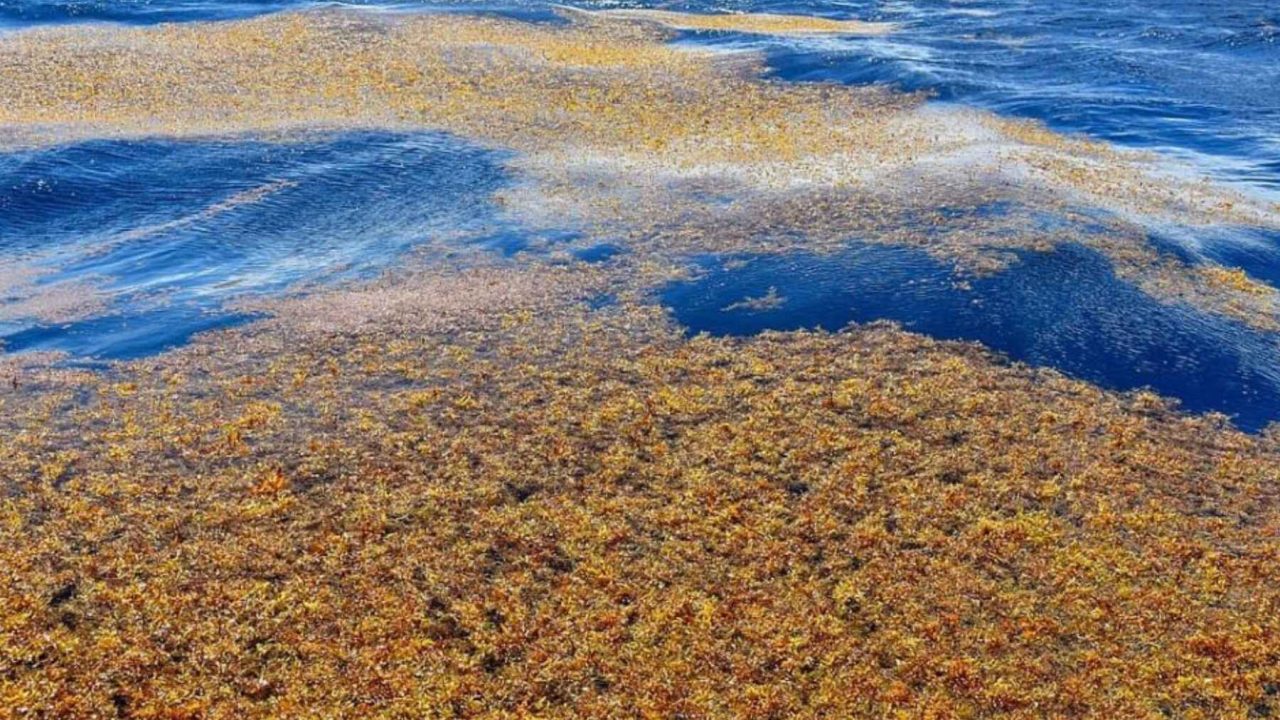
In the summer of 1492, sailors aboard Christopher Columbus’s fleet stared across miles of golden-brown mats of floating seaweed and fell silent with dread. The sargassum stretched to every horizon, thick and motionless, and the crew whispered among themselves that they might never again feel a breeze.
They were not wrong to feel unnerved. They had sailed into one of the strangest places on Earth — a sea with no shores, no beaches, no cliffs. A sea defined not by land, but by water itself.
The Only Sea on Earth Bounded Entirely by Ocean Currents
The Sargasso Sea sits roughly 590 miles east of Florida, in the western North Atlantic. Every other sea on Earth is shaped by at least one coastline. This one has none. Instead, it is enclosed by four powerful ocean currents: the North Atlantic Current to the north, the Canary Current to the east, the North Equatorial Current to the south, and the Antilles Current to the west.
Those currents act as invisible walls, spinning slowly clockwise, trapping warm water in the center. The result is a gyre — a vast, languid pool of blue-clear water sitting inside a ring of moving ocean. It is calm, warm, and deeply strange.
| Feature | Sargasso Sea | A Typical Sea |
|---|---|---|
| Borders | Four ocean currents only | At least one coastline |
| Defining feature | Floating Sargassum seaweed | Land geography |
| Summer surface temp | 82–86°F | Varies by region |
| Winter surface temp | 64–68°F | Varies by region |
| Temperature rise since 1980s | ~1.8°F | ~1.2°F global ocean avg |
That warmth, historically a gift to the life sheltering here, is now becoming a threat. Since the 1980s, the Sargasso Sea has warmed by approximately 1.8°F. That number sounds small. The consequences are not.
A Living Raft That Entire Species Depend On
The Sargassum itself is the story. Thick, buoyant mats of this brown seaweed float across the surface like a floating rainforest. Researchers have documented more than 100 invertebrate species living directly on the weed — shrimp, crabs, nudibranchs, and fish that have evolved over millennia to match its exact color and texture.
Young loggerhead sea turtles, fresh from Atlantic beaches, drift into the Sargasso and tuck themselves beneath the mats. The seaweed acts as camouflage and nursery at once, shielding hatchlings from predators during the most vulnerable months of their lives.
Then there are the eels. Both American eels and European eels begin and end their lives in the Sargasso Sea, traveling an estimated 3,000 miles through open ocean to spawn in these warm waters. After hatching, larvae drift on ocean currents toward freshwater rivers on two different continents. Years or decades later, the adult eels return to the Sargasso to reproduce and die.
Scientists still do not fully understand how they find their way back. The eels navigate across thousands of miles of open ocean with no map, no coastline, no visible landmark. They simply arrive.
“The Sargasso Sea is an ocean within an ocean — a place where biology, physics, and climate intersect in ways we are only beginning to understand.”
— Oceanographers studying the North Atlantic gyre system
What the Bermuda Data Reveals About Rapid Change
Bermuda sits inside the Sargasso Sea’s boundaries, making it one of the few inhabited outposts in this coastless expanse. For decades, researchers there have maintained some of the ocean’s most consistent long-term monitoring programs. What they have found is unsettling.
Alongside rising temperatures, data from Bermuda shows increasing ocean acidity and falling dissolved oxygen levels. These three shifts — warming, acidification, deoxygenation — form a triple pressure on the species that evolved for a more stable environment.
Warmer water holds less oxygen. As temperatures climb, the metabolic demands of marine life increase while the oxygen available to meet those demands shrinks. For species already adapted to live at the edge of survivable conditions, this gap can prove fatal.
Higher acidity threatens shell-forming organisms at the base of the food web. Pteropods, foraminifera, and other tiny calcifying creatures underpin the ocean’s carbon cycle. When their shells dissolve before sinking, carbon that would otherwise be locked away on the seafloor re-enters circulation.
The Sargasso Sea’s Hidden Role as a Carbon Sink
The Sargasso Sea is not just a biological treasure. It is a functioning carbon storage system. Plankton near the surface absorb carbon dioxide during photosynthesis. When they die, their shells and bodies sink into the deep ocean, carrying that carbon with them. Scientists call this the biological pump.
In a healthy, stable Sargasso Sea, this process reliably moves carbon from the atmosphere into the deep ocean, where it remains locked away for centuries. Disruption of the plankton community — through warming, acidification, or both — weakens the pump. Less carbon sinks. More stays in the atmosphere.
Sargasso Sea
Typical Sea
| Metric | Sargasso Sea | Typical Sea |
|---|---|---|
| Temperature Stability |
85 |
55 |
| Biodiversity Support |
78 |
70 |
| Current Boundary Strength |
95 |
30 |
| Warming Rate |
72 |
58 |
| Surface Clarity |
90 |
50 |
| Seaweed Density |
95 |
25 |
| Isolation Level |
98 |
20 |
This is the part of the story that tends to get lost in discussions about coral reefs and melting ice. Open ocean gyres are invisible to most people. They appear on no tourist maps. They generate no headlines when a heat wave strikes. But they perform quiet, enormous work that the entire planet depends on.
Why a Coastless Sea Is Especially Difficult to Protect
Every ocean jurisdiction on Earth is defined by proximity to land. Exclusive economic zones extend 200 nautical miles from coastlines. Marine protected areas cluster around islands and continental shelves. The Sargasso Sea, with no coast to anchor it legally, sits in a kind of governance vacuum.
The Sargasso Sea Commission was formed in 2014, bringing together governments including the United Kingdom, the United States, and several island nations with historical ties to the region. It represents a rare attempt at protecting open-ocean space without the leverage of national territory.
But cooperation is harder to enforce than legislation. And the currents keep turning, trapping more than seaweed inside their rotating walls. They concentrate plastic debris, too, gathering it from across the Atlantic into the same calm center where loggerhead turtles rest and eels return to die.
The same geographic quirk that makes the Sargasso Sea extraordinary — that closed-loop, current-bordered isolation — makes it a trap for everything the ocean carries. Including heat. Including human waste. Including consequences.
Columbus’s sailors feared they would never escape it. Five hundred years later, we may have made that a self-fulfilling prophecy for the creatures that call it home.
Frequently Asked Questions

You Might Also Like

Goodbye Toilet Paper: Cleaner, Cheaper Alternatives Are Here
Science is upending toilet paper's dominance. From bidet savings to bamboo's hidden carbon cost, here's…
Magnetic Cement Invented by 29-Year-Old Could End Nails and Screws Forever
Argentine inventor Marco Secchi created Ironplac, a magnetic cement that lets walls hold objects without…
5 Ways DART Proved Humanity Can Move an Asteroid
NASA's DART mission didn't just nudge an asteroid moon. It shifted a celestial body's orbit…
Leave a Reply