
Over 1,400 Embraer regional jets are currently in service across more than 70 countries, quietly connecting cities that larger widebody aircraft simply cannot reach. That number tells a story that rarely makes headlines: regional aviation is the circulatory system of global tourism, and when its key players shift direction, the effects ripple from Belgrade to Bangalore.
Embraer’s appointment of Felipe Santana as Chief Financial Officer is one such shift. It arrives precisely when three of the manufacturer’s key airline partners — Air India, LATAM, and Air Serbia — are executing some of the boldest expansion strategies in their recent histories. The timing is not coincidental. It’s a signal.
Why Embraer’s CFO Seat Matters to Passengers, Not Just Shareholders
Most travelers never think about who signs off on an aircraft manufacturer’s balance sheet. But the CFO of a company like Embraer controls decisions that directly shape which routes get launched and which cities gain air connectivity.
Embraer’s E-jet family — particularly the E175 and E195-E2 — serves routes where full-size narrowbodies would fly half-empty. These are the aircraft that make it economically viable for an airline to open a new secondary city connection, test a seasonal beach route, or link a growing tourism destination to a major hub.
Felipe Santana steps into the role at a moment when regional aircraft orders are under real financial pressure. Fuel prices remain elevated, supply chains for aircraft components are still recovering from post-pandemic disruption, and airlines are negotiating harder on fleet financing terms. A CFO who can structure competitive financing packages and manage production costs aggressively will directly influence how quickly airlines like Air Serbia and Air India can take delivery of new regional jets.
Air India and Air Serbia: Two Airlines, Two Expansion Strategies Converging
The contrast between Air India and Air Serbia’s current expansion approaches is instructive. One is a legacy carrier in the midst of a sweeping privatization-era reinvention. The other is a mid-sized Balkan carrier punching well above its geographic weight.
Air India recently announced a new codeshare partnership with airBaltic, Latvia’s flag carrier, opening up Baltic connectivity for Indian travelers. That deal is part of a larger pattern: Air India has entered four new partnerships that collectively add 16 destinations across six European countries to its network. This is European connectivity built through smart alliance-building rather than expensive new routes.
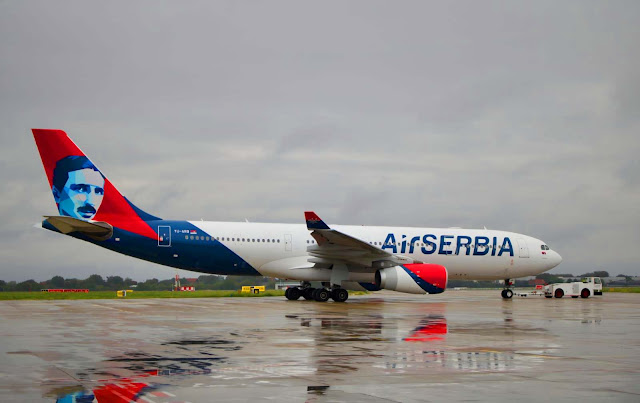
Air Serbia is taking a more direct approach. The carrier has committed to launching all nine of its new 2026 routes, refusing to scale back despite global uncertainty and rising fuel costs. One of the headline additions is a new seasonal direct service between Belgrade and Brač, opening the Adriatic island to Serbian travelers without a connection through Split or Dubrovnik.
| Airline | Key 2026 Move | Region Impacted | Embraer Relevance |
|---|---|---|---|
| Air India | 4 new codeshare partnerships, 16 European destinations added | India–Europe | Regional feeders for hub connections |
| Air Serbia | 9 new routes, Belgrade–Brač Adriatic launch | Southeast Europe | E-jets ideal for Balkan short-haul |
| LATAM | Expanding intra-South America connectivity | Brazil, Argentina, Chile | E195-E2 core to domestic operations |
Air Serbia also won the Global Traveler Award for Best Airline in Eastern Europe for the second consecutive year, a recognition that carries real commercial weight in travel agent communities. The award signals that the airline’s service quality is backing up its route ambitions.
“We’re not in a rush.”
— Air Serbia CEO Jiri Marek, on potential alliance membership, speaking to EX-YU Aviation News
That measured tone from Air Serbia’s CEO about alliance membership is revealing. The airline is building value independently before negotiating from a position of strength. More routes, more awards, more passengers — then alliance talks. Embraer’s ability to supply the right aircraft on favorable financial terms is central to that strategy working.
LATAM’s South American Network and the Regional Jet Economics That Bind It All
While Air India and Air Serbia dominate the European storyline, LATAM Airlines represents perhaps the most structurally significant relationship between Embraer and a single carrier. Brazil is Embraer’s home market. LATAM is South America’s largest airline group, connecting Brazil, Argentina, Chile, Colombia, Ecuador, and Peru.
The intra-South American routes that hold LATAM’s network together — city pairs like São Paulo to Florianópolis, or Buenos Aires to Mendoza — are precisely the distances and passenger volumes where Embraer’s E-jet family operates at peak efficiency. These are not routes where a Boeing 737 or Airbus A320 makes economic sense at current load factors.
Felipe Santana’s appointment as CFO therefore carries a specific implication for LATAM: how Embraer manages its cost base and capital allocation will determine how competitive its aircraft purchase and leasing terms remain. In an environment where Airbus and Boeing are both pushing hard into regional configurations, Embraer cannot afford financial instability at the top.
Tourism boards across Brazil and Argentina understand this implicitly. Secondary cities with growing tourism infrastructure — think Iguazú, Bariloche, or the northeastern Brazilian coast — depend on regular regional jet service to maintain traveler interest. Without those connections, even significant investment in accommodation and experience infrastructure goes underutilized.
What Felipe Santana’s CFO Appointment Signals for 2026 Fleet Deliveries
A CFO appointment at a major aircraft manufacturer is not a cosmetic event. It reflects where the board sees financial risk and where it wants strategic focus. Santana’s elevation suggests Embraer is prioritizing tighter financial discipline while continuing to invest in its E2 family and the newer turboprop concepts gaining traction in sustainability discussions.
For airlines like Air Serbia, which is simultaneously resisting alliance pressure, launching new routes, and managing fuel cost exposure, Embraer’s financial posture matters enormously. Delayed deliveries or revised financing terms can cascade quickly into route launch postponements.
Air India’s parallel strategy of codeshare expansion rather than pure organic fleet growth is partly a hedge against exactly this kind of supply uncertainty. By partnering with airBaltic and building out a codeshare network across six European countries, Air India gains connectivity without waiting on new aircraft deliveries. It is a smart workaround — but it still requires regional feeder capacity at both ends to function.
The Tourism Destinations That Stand to Gain Most
Strip away the corporate announcements and one question matters most for travelers: which destinations become more accessible as a result of all this activity?
In Southeast Europe, Brač island in Croatia is the most immediate winner from Air Serbia’s summer 2026 expansion. The Belgrade–Brač route removes a connection for Serbian holidaymakers and adds a new entry point for travelers routing through Belgrade from elsewhere in the Balkans. For a Croatian tourism industry that depends heavily on repeat visitors from neighboring countries, direct regional jet service is more valuable than a single long-haul flight from a distant market.
In South Asia, Air India’s 16-destination European expansion creates new itinerary possibilities for Indian travelers who previously faced awkward routings through major hubs. Baltic cities like Riga — now accessible through the airBaltic codeshare — represent genuinely new territory for Indian outbound tourism, a market that grew substantially in the post-pandemic years.
In South America, LATAM’s continued reliance on Embraer regional jets sustains the domestic tourism infrastructure that feeds into Argentina and Brazil’s international appeal. Travelers flying into Buenos Aires or São Paulo from Europe or North America depend on onward regional connections to reach the destinations that actually make those trips remarkable.
What Comes Next for Regional Aviation in 2026 and Beyond
Felipe Santana’s first priorities as CFO will likely center on managing Embraer’s order backlog, controlling production costs, and navigating currency volatility between Brazil’s real and the U.S. dollar — the denomination in which most aircraft are priced globally.
For Air Serbia, the immediate question is whether its nine new 2026 routes hold firm as fuel prices stay elevated. The carrier’s CEO has been explicit: no retreat. Air Serbia’s February 2026 promotional campaign — offering special travel benefits across its network — suggests the commercial confidence to back that commitment with early bookings stimulus.
For Air India, the codeshare expansion strategy will test whether partnership-driven connectivity can substitute for organic fleet growth in the short term. The airBaltic deal and four new European partnerships provide cover while the carrier continues its broader fleet and service modernization.
For LATAM, the calculus is simpler but the stakes are higher: Embraer aircraft are not a strategic option but a structural necessity for the intra-South American network that underpins the entire group’s profitability.
Regional aviation rarely gets the attention it deserves in travel media. The widebody long-haul flights capture the imagination; the 80-seat regional jets that connect island to mainland, secondary city to hub, emerging destination to global network — those are the flights that actually determine whether a tourism economy thrives or stalls. Felipe Santana’s in-tray contains decisions that will be felt in Croatian beach bars, Indian travel agencies, and Argentine Patagonia lodges long before they show up in any quarterly earnings report.
Frequently Asked Questions

You Might Also Like

France Now Leads All Nations as Morocco Tourism Crosses 1.3 Million
More than 1.3 million international visitors arrived in Morocco during January 2026 alone — and…

Norwegian Just Opened a Winter Sun Route Bergen Travelers Have Been Waiting For
For travelers living in western Norway, flying somewhere warm for the winter has long meant…

Nine Nations Are Now Fueling Greece Tourism in Ways Few Predicted
Nearly 1.1 million tourists arrived in Greece in January 2026 alone — a 33.3% jump…
Leave a Reply