
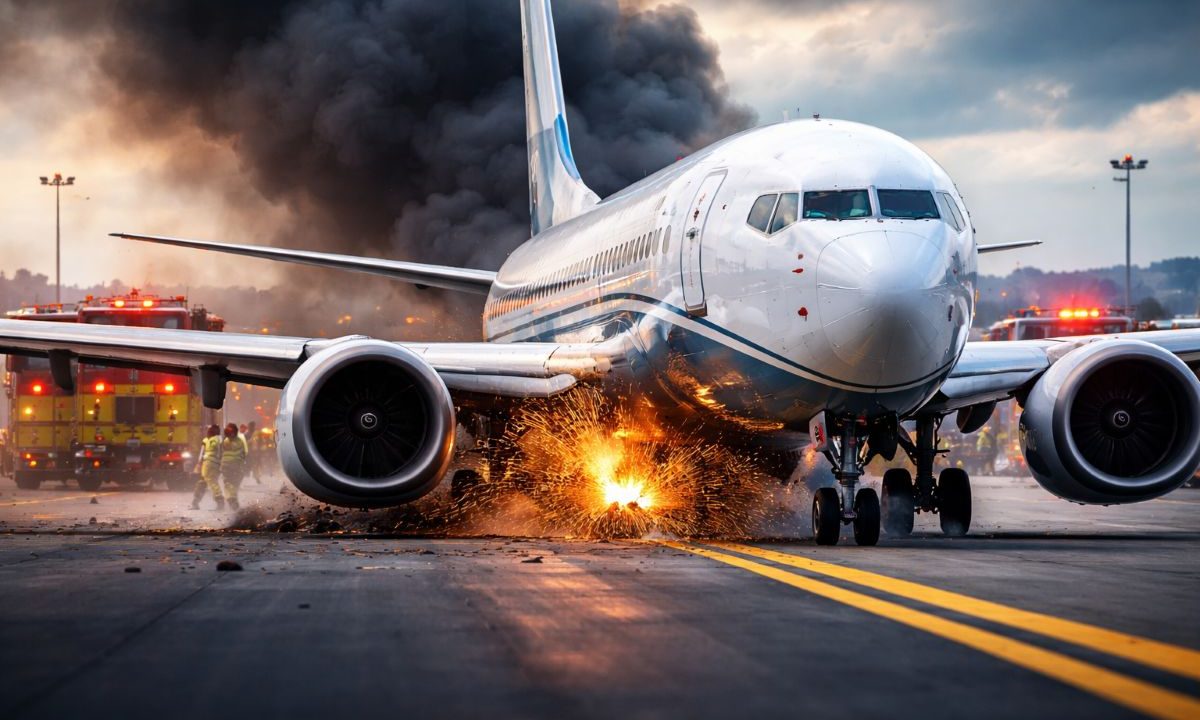
A routine Wednesday evening flight turned into an emergency response scenario at one of the country’s busiest airports — when a tire catastrophically failed on landing, triggering a full emergency deployment on the runway.
American Airlines Flight 1461, a Boeing 737 MAX operating the route from Charlotte Douglas International Airport (CLT) to Newark Liberty International Airport (EWR), suffered a nose-gear tire blowout as it touched down on the evening of Wednesday, March 25, 2026. The moment the aircraft rolled to a stop, emergency first responders flooded the runway, surrounding the plane as the acrid smell of burning rubber spread across the tarmac.
For everyone aboard, what had been a standard short-haul trip up the East Coast became something far more alarming — a reminder of just how quickly the ordinary can turn extraordinary at 30,000 feet.
What Happened Aboard American Airlines Flight 1461
The Boeing 737 MAX departed Charlotte Douglas International Airport on what was classified as a routine evening service. The flight covers a well-traveled corridor connecting North Carolina to the New York metropolitan area — a route operated multiple times daily by major carriers.
Somewhere in the sequence of landing at Newark Liberty International Airport, the nose-gear tire suffered what has been described as a catastrophic failure. Tire blowouts on aircraft, while rare, carry serious implications — particularly on nose gear, which plays a critical role in directional control during the landing roll. A failure at the wrong moment can compromise a pilot’s ability to steer the aircraft safely down the runway.
The flight crew managed to bring the aircraft to a stop, and emergency services were waiting. A massive deployment of first responders met the plane on the runway, standard protocol whenever an aircraft declares an emergency or arrives with known structural or mechanical issues. The runway was effectively locked down during the response.
Flight Details at a Glance
Here is what has been confirmed about the incident based on available information:
- Flight number: American Airlines Flight 1461
- Aircraft type: Boeing 737 MAX
- Departure airport: Charlotte Douglas International Airport (CLT), Charlotte, North Carolina
- Arrival airport: Newark Liberty International Airport (EWR), Newark, New Jersey
- Date of incident: Wednesday, March 25, 2026
- Nature of failure: Catastrophic nose-gear tire blowout on landing
- Emergency response: Full deployment of emergency first responders to the runway
| Detail | Confirmed Information |
|---|---|
| Flight | American Airlines Flight 1461 |
| Aircraft | Boeing 737 MAX |
| Route | Charlotte Douglas (CLT) to Newark Liberty (EWR) |
| Incident Date | March 25, 2026 |
| Failure Type | Catastrophic nose-gear tire blowout |
| Response | Massive emergency first responder deployment, runway lockdown |
Why a Nose-Gear Tire Failure Is Taken So Seriously
Not all tire failures are equal in aviation. A blowout on the main landing gear — the large wheels under the wings — is serious, but aircraft are designed with redundancy to handle it. The nose gear is different. Those front wheels guide the aircraft’s direction during the landing roll and are essential for keeping the plane tracking straight down the centerline of the runway.
When a nose-gear tire fails catastrophically, pilots can lose precise steering capability at exactly the moment they need it most — during the high-speed deceleration phase after touchdown. The risk of veering off the runway, though manageable by experienced crews, is real enough that airports treat these events as full emergencies.
That’s why the sight of fire trucks, emergency vehicles, and first responders surrounding the aircraft was not an overreaction. It was procedure — and procedure that likely brought significant relief to the passengers still seated inside the cabin.
The Boeing 737 MAX, the aircraft type involved in this incident, has been under heightened public scrutiny in recent years following two fatal crashes in 2018 and 2019 that led to a global grounding. The aircraft was recertified by aviation regulators and returned to service, but incidents involving the type continue to draw close attention from travelers and safety observers alike.
What Happens Next for Passengers and the Investigation
Following any aviation incident of this nature, standard procedure involves an inspection of the aircraft by maintenance crews and a review of the circumstances surrounding the tire failure. Aviation safety investigators typically examine factors including tire wear, pre-flight inspection records, runway conditions, and landing data to determine what caused the failure.
For the passengers aboard Flight 1461, the immediate priority after the aircraft stopped was disembarkation and rebooking. Travelers connecting through Newark or reaching final destinations in the New York area would have faced delays as a result of the runway lockdown and the time required to clear the aircraft.
American Airlines has not yet publicly detailed the outcome for affected passengers or provided a timeline for the aircraft’s return to service. The Boeing 737 MAX involved in the incident would be expected to undergo thorough inspection before being cleared to fly again.
For anyone booked on American Airlines routes through Newark in the days following the incident, delays tied to the aftermath of runway activity are possible — though the airport itself handles these situations with practiced efficiency given its position as one of the region’s major hubs.
Frequently Asked Questions
What flight was involved in the Newark tire emergency?
American Airlines Flight 1461, a Boeing 737 MAX traveling from Charlotte Douglas International Airport to Newark Liberty International Airport.
When did the incident happen?
The tire blowout occurred on Wednesday, March 25, 2026, as the aircraft landed at Newark Liberty International Airport.
What type of tire failure occurred?
The aircraft suffered a catastrophic failure of its nose-gear tire upon landing at Newark.
Were emergency responders called to the scene?
Yes — a massive deployment of emergency first responders met the aircraft on the runway, which was locked down during the response.
What kind of aircraft was involved?
The flight was operated on a Boeing 737 MAX, one of American Airlines’ standard narrowbody aircraft used on domestic routes.
Has American Airlines confirmed injuries or further details?
This has not yet been confirmed in available reporting — the airline had not publicly detailed passenger outcomes or the investigation status at the time of publication.

Leave a Reply