
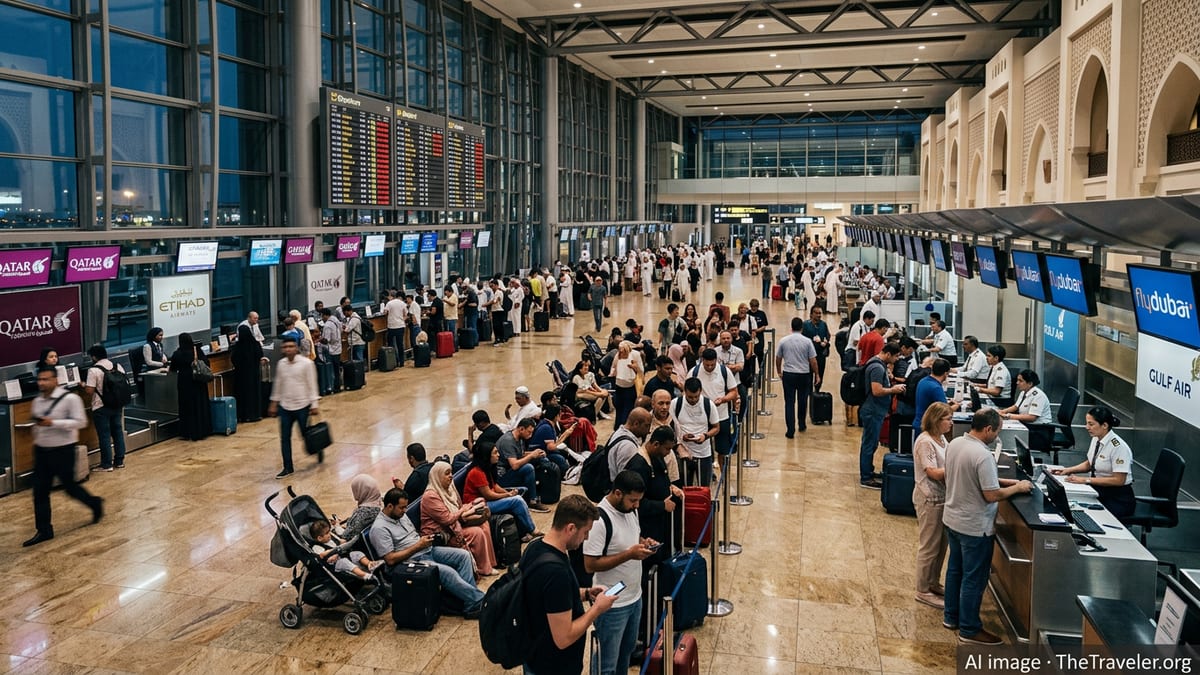
More than 272 flights have been suspended across the Middle East, with over 200 additional delays stacking up at airports from Bahrain to the UAE — leaving thousands of travellers stranded, scrambling for answers, and facing missed connections they may not recover for days.
The disruption is widespread and hitting some of the region’s busiest aviation hubs simultaneously. Airlines including Gulf Air, Qatar Airways, Malaysia Airlines, Egypt Air, and FlyDubai are among those caught up in what has quickly become one of the most significant short-term air travel breakdowns the Middle East has seen in recent memory.
If you have a flight booked through Manama, Doha, Dubai, Abu Dhabi, or Fujairah in the coming hours or days, this situation directly affects you.
What Is Happening Across Middle East Airports Right Now
The scale of the disruption is hard to overstate. At least 272 flights have been suspended, and more than 200 separate delays have been recorded across the region’s major airport network. That combination — cancellations and delays running in parallel — is what creates the cascading effect that makes situations like this so difficult to untangle quickly.
When flights are cancelled in large numbers, passengers get rebooked onto later services. Those later services then carry heavier loads, become delay-prone themselves, and the knock-on effect ripples across the network for hours or even days. For travellers with tight connections or time-sensitive travel, the window to recover shrinks fast.
The disruption is being driven by a combination of operational constraints and airspace complexities, according to reports. The region’s airspace is among the most heavily managed in the world, and any significant pressure on routing or capacity can trigger wide-scale disruption across multiple carriers almost simultaneously.
Airlines and Cities Caught in the Middle East Flight Disruption
The list of affected carriers is long and spans both regional and international airlines with major Middle East operations. Here is what is confirmed from available reporting:
| Airline | Status | Hub/Region Affected |
|---|---|---|
| Gulf Air | Flights suspended | Manama, Bahrain |
| Qatar Airways | Flights suspended | Doha, Qatar |
| Malaysia Airlines | Flights suspended | Regional routes |
| Egypt Air | Flights suspended | Regional routes |
| FlyDubai | Flights suspended/delayed | Dubai, UAE |
| Multiple additional carriers | Delays reported | Abu Dhabi, Fujairah, wider UAE |
The cities bearing the brunt of the disruption include Manama, Doha, Dubai, Abu Dhabi, and Fujairah — a cluster of hubs that together handle an enormous share of global transit traffic, particularly for passengers connecting between Europe, Asia, and Africa.
Who Gets Hit Hardest — and Why the Numbers Feel Bigger Than They Look
The raw numbers — 272 cancellations, 200-plus delays — don’t fully capture the human scale of what’s unfolding. Each cancelled flight typically carries anywhere from 100 to over 400 passengers depending on the aircraft type. Multiply that across hundreds of suspended services and you are looking at a situation affecting potentially hundreds of thousands of passenger journeys in total.
Travellers with connecting itineraries are the most vulnerable. Someone flying from London to Singapore via Dubai, for example, doesn’t just lose a flight — they lose their onward connection, their hotel check-in window, and sometimes their entire trip if the downstream bookings can’t be moved in time.
Business travellers, those attending time-sensitive events, and passengers with non-flexible ticket types face the steepest consequences. Budget and low-cost carrier passengers — including many FlyDubai customers — often hold tickets with more restrictive rebooking conditions, making recovery slower and sometimes more expensive out of pocket.
Transit passengers who are already in the air or in airport terminals when suspensions are announced face a particularly disorienting situation: they may land at a hub only to find their connecting flight no longer exists.
What Travellers Should Do Right Now
If you have travel booked through any of the affected airports or airlines in the near term, there are practical steps worth taking immediately:
- Check your airline’s app or website directly for real-time flight status — airport boards can lag behind actual decisions.
- Contact your airline proactively rather than waiting for them to contact you. Call queues will grow quickly as disruption scales.
- Document everything — screenshot your original booking, any delay notifications, and all rebooking communications. This matters for insurance and compensation claims later.
- Check your travel insurance policy for coverage on delays and cancellations. Many policies require you to report disruption within a set window.
- If you are already at the airport, locate your airline’s service desk rather than relying solely on the general information desk.
- Be cautious about booking replacement travel independently — doing so before your airline formally cancels your flight can complicate refund eligibility.
What Happens Next as the Region Works to Clear the Backlog
Situations of this scale typically take 24 to 72 hours to fully work through the system, depending on how quickly the underlying operational and airspace issues are resolved. Airlines will generally prioritise getting grounded aircraft back into service and clearing the longest-delayed passengers first.
For the airports themselves — particularly the major UAE hubs and Doha — the priority will be managing terminal congestion and ensuring passengers have access to food, water, and updated information. Large-scale disruptions at Gulf hubs have historically drawn scrutiny over how transit passengers, who may have no local currency or accommodation options, are supported during extended waits.
Officials have noted that the situation is being driven by operational constraints and airspace complexities, though the specific trigger for a disruption of this magnitude had not been fully detailed in early reporting. As more information becomes available, the picture of how long recovery will take should become clearer.
For now, the advice is simple: stay close to your phone, check your airline directly, and don’t assume your flight is operating until you have confirmation from the carrier itself.
Frequently Asked Questions
Which airlines have suspended flights in this Middle East disruption?
Gulf Air, Qatar Airways, Malaysia Airlines, Egypt Air, and FlyDubai are among the confirmed carriers with suspended flights, alongside additional airlines operating across the region.
How many flights have been cancelled or delayed?
At least 272 flights have been suspended, with over 200 additional delays reported across the affected network.
Which cities and airports are most affected?
Manama, Doha, Dubai, Abu Dhabi, and Fujairah are the major cities confirmed as impacted, covering airports across Bahrain, Qatar, and the UAE.
What is causing the Middle East flight suspensions?
Reports indicate the disruption is being driven by operational constraints and airspace complexities, though the specific underlying cause had not been fully confirmed in early reporting.
Am I entitled to compensation if my flight was cancelled?
Compensation eligibility depends on your ticket type, airline policy, and the jurisdiction under which your flight was booked. Passengers should contact their airline directly and review their travel insurance policy.
How long will the disruption last?
This has not yet been confirmed, but disruptions of this scale in the region typically take between 24 and 72 hours to fully resolve depending on when the underlying issues are addressed.




Leave a Reply