
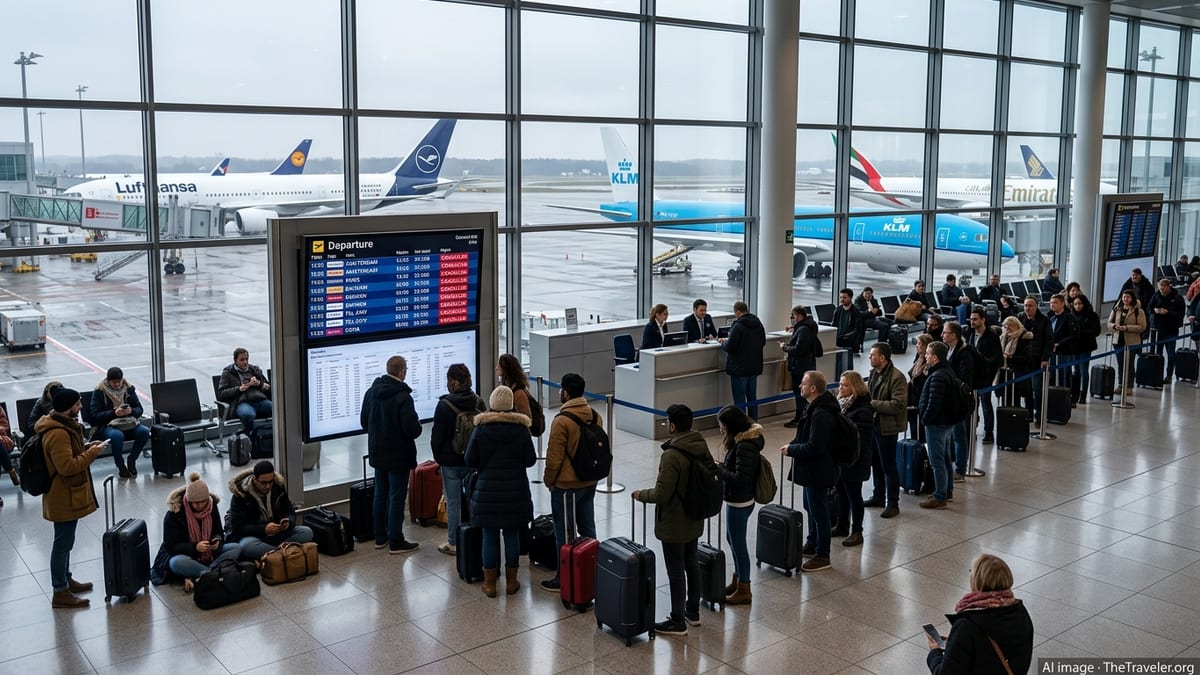
Twenty-six flights canceled in a single week across five major German airports — that’s the scale of disruption now hitting travelers trying to reach destinations from Bahrain to Brussels, Tel Aviv to Stockholm.
The cancellations have swept through Frankfurt, Munich, Berlin, Dusseldorf, and Hamburg airports, touching routes across Europe and beyond. Airlines including Lufthansa, KLM Royal Dutch Airlines, Icelandair, Gulf Air, and Air France are among those affected, leaving passengers scrambling to rebook or find alternative connections.
For anyone with travel plans moving through Germany right now, this is not a minor inconvenience. With both short-haul and medium-haul services impacted across multiple carriers and aircraft types, the disruption is broad enough to affect thousands of passengers across dozens of itineraries.
What’s Behind the Flight Cancellations in Germany
The wave of cancellations is not limited to one airline or one airport. The disruptions span Germany’s busiest aviation hubs simultaneously, which suggests a systemic pressure on operations rather than an isolated technical issue with a single carrier.
Both regional European routes and longer international connections are caught up in the cancellations. Destinations affected include Amsterdam, Keflavik in Iceland, Ljubljana in Slovenia, Paris Charles de Gaulle, Copenhagen, Stockholm, Brussels, and Tel Aviv — a mix that covers leisure, business, and connecting traffic across the continent and into the Middle East.
Multiple aircraft types are involved, adding another layer of complexity for airlines trying to substitute equipment and reroute passengers. When cancellations hit across different fleet types, the operational flexibility airlines normally rely on to manage disruptions is significantly reduced.
The Full Scope: Airports, Airlines, and Routes Affected
Here is a breakdown of what’s confirmed across the affected airports and routes:
- Airports affected: Frankfurt, Munich, Berlin, Dusseldorf, Hamburg
- Airlines involved: Lufthansa, KLM Royal Dutch Airlines, Icelandair, Gulf Air, Air France, and additional carriers
- Total cancellations confirmed: 26 departures
- Route types affected: Both short-haul and medium-haul services
| Destination | Route Type | Airlines Involved |
|---|---|---|
| Amsterdam | Short-haul | KLM Royal Dutch Airlines and others |
| Paris Charles de Gaulle | Short-haul | Air France and others |
| Brussels | Short-haul | Multiple carriers |
| Copenhagen | Short-haul | Multiple carriers |
| Stockholm | Short-haul | Multiple carriers |
| Keflavik | Medium-haul | Icelandair |
| Tel Aviv | Medium-haul | Multiple carriers |
| Bahrain | Medium-haul | Gulf Air |
| Ljubljana | Short-haul | Multiple carriers |
How This Disruption Hits Real Travelers
If you’re booked on any of these routes out of a German airport this week, the immediate priority is checking your flight status directly with your airline. With 26 cancellations spread across five airports, the rebooking queues at customer service desks and call centers are likely to be stretched.
Travelers connecting through German hubs to reach onward destinations face a compounded problem. A canceled short-haul leg from Berlin or Hamburg to Amsterdam or Paris doesn’t just mean a missed flight — it can unravel an entire multi-leg itinerary, particularly for passengers continuing to long-haul routes.
Business travelers on time-sensitive itineraries to Tel Aviv, Bahrain, or Keflavik face some of the sharpest consequences. These are not routes with dozens of daily alternatives, and rebooking onto the next available seat can sometimes mean a 24-hour or longer delay.
Passengers flying on tickets covered by European Union air passenger rights rules are entitled to care — meals, accommodation where overnight stays are required, and in some cases compensation — when cancellations are within the airline’s control. It’s worth reviewing your ticket conditions and the carrier’s obligations before accepting any rebooking offer.
What Passengers Should Do Right Now
The situation is active and evolving. With disruptions confirmed across multiple airlines and airports simultaneously, the advice for affected travelers is straightforward but time-sensitive.
First, check your flight status through your airline’s official app or website rather than relying on airport departure boards, which can lag behind real-time updates. Second, if your flight has been canceled, contact your airline directly for rebooking options before the available seats on alternative flights fill up.
If you haven’t yet departed for the airport, call ahead or check online before making the journey. Showing up to discover a cancellation after a long drive or train ride adds unnecessary stress to an already difficult situation.
Travel insurance holders should document everything — cancellation notices, rebooking correspondence, and any out-of-pocket expenses incurred — to support any claim they may need to file later.
Travelers booked on routes not yet canceled but departing from the affected airports should also monitor their flights closely. When disruptions reach this scale, delays and gate changes can ripple outward even to services that remain technically on schedule.
Frequently Asked Questions
How many flights have been canceled in Germany this week?
A total of 26 departures have been canceled across Frankfurt, Munich, Berlin, Dusseldorf, and Hamburg airports.
Which airlines are affected by the cancellations?
Airlines confirmed as affected include Lufthansa, KLM Royal Dutch Airlines, Icelandair, Gulf Air, and Air France, among others.
Which destinations are impacted by the cancellations?
Affected destinations include Bahrain, Amsterdam, Keflavik, Ljubljana, Paris Charles de Gaulle, Copenhagen, Stockholm, Brussels, and Tel Aviv.
Are both short-haul and long-haul flights canceled?
The cancellations cover both short-haul and medium-haul services, spanning multiple aircraft types across all five affected airports.
What should I do if my flight has been canceled?
Contact your airline directly as soon as possible to explore rebooking options, and check your eligibility for passenger rights protections if the cancellation is within the airline’s control.
Is the cause of the cancellations confirmed?
The specific cause of the disruptions has not been confirmed in available reporting at this time.


Leave a Reply