
Most Americans think the country’s best travel is already mapped. They picture Times Square, the Vegas Strip, or the Grand Canyon’s South Rim. But the real question isn’t where the crowds go — it’s where locals go when they want to feel somewhere worth remembering.
The 15 towns featured here have combined populations ranging from 600 to 18,000. None appear in a standard “top destinations” roundup. All have something most hyped cities don’t: a reason to return. [California alone hides dozens of underrated destinations most travelers drive straight past.]
The Question: Should Hidden Towns Stay Hidden?
Read more: 15 Hidden American Towns Most Road-Trippers Never Find
This isn’t just a travel question. It’s a debate about identity, economics, and what tourism actually does to a place. Here’s how both sides land.
Side A — These Towns Need You to Show Up
Silverton, Colorado sits in San Juan County, the least populated county in the state. Its population hovers near 600 year-round residents. The Durango & Silverton Narrow Gauge Railroad — a -era steam line — still runs 45 miles through the San Juan Mountains. A round-trip ticket costs around $109 per adult. Without that tourist revenue, the town’s handful of historic storefronts would shutter entirely.
Natchitoches, Louisiana — pronounced “Nak-uh-tish” — was founded in , making it the oldest permanent European settlement in the Louisiana Purchase territory. Its brick-paved Front Street sits along Cane River Lake in Natchitoches Parish. Median household income in the parish runs around $38,000, well below the national median. Tourism dollars here aren’t optional — they’re structural.
Lewisburg, West Virginia, tucked in Greenbrier County, population roughly 3,800, was named “Coolest Small Town in America” by Budget Travel more than a decade ago. It didn’t blow up. It stayed exactly itself. That’s the case for showing up: sometimes a town has enough character to absorb attention without being devoured by it.
Side B — Discovery Has a Body Count
Marfa, Texas is the cautionary tale. Presidio County had a sleepy ranching economy for a century. Then Donald Judd arrived. Then the art world. Now a motel room runs $250+ a night and longtime residents — many of them Hispanic families who’d lived there for generations — got priced out entirely. The “hidden gem” became a brand.
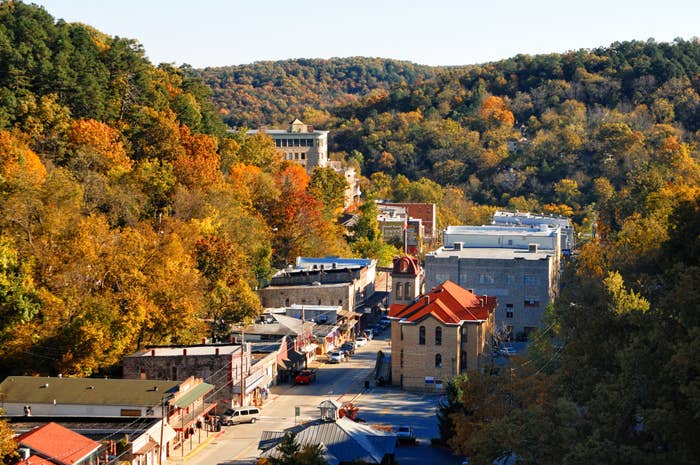
[Over-tourism can corrode the very authenticity that made a place worth visiting — a pattern documented across wildly different destinations globally.] Eureka Springs, Arkansas, in Carroll County, population around 2,073, has retained its Victorian character only because its hills and winding roads physically prevent mass bus tourism. The terrain is the preservation policy.
Publishing a list of “hidden towns” is itself an act of destruction. Every article like this is a slow-motion wrecking ball. The moment a local coffee shop appears in a travel piece, its rent follows. [Even word-of-mouth restaurant discovery changes a neighborhood’s economic fabric faster than most people expect.] We know this. We’re publishing anyway — with caveats.
The 15 Towns — What Makes Each One Worth Finding
| Town | State / County | Pop. | Why Locals Love It |
|---|---|---|---|
| Cohoes | Albany County, NY | ~16,000 | Cohoes Falls rivals Niagara — and has zero crowds |
| Mineral Point | Iowa County, WI | ~2,600 | Cornish mining heritage, world-class pottery studios |
| Pella | |||
| Pella | Marion County, IA | ~10,200 | Dutch windmills, tulip festivals since |
| Bisbee | Cochise County, AZ | ~5,200 | Copper-boom ghost town reborn as an artists’ colony |
| Eureka Springs | Carroll County, AR | ~2,100 | Victorian gingerbread architecture, zero flat streets |
| Port Townsend | Jefferson County, WA | ~10,000 | Best-preserved Victorian seaport on the Pacific Coast |
| Galena | Jo Daviess County, IL | ~3,200 | Ulysses Grant’s hometown, 85% of buildings are landmarked |
| Oberlin | Lorain County, OH | ~8,300 | First U.S. college to admit women; a living civil rights timeline |
| Lewisburg | Greenbrier County, WV | ~4,000 | Antebellum courthouse square, secret Cold War bunker nearby |
| Fernandina Beach | Nassau County, FL | ~13,000 | Eight flags have flown here; Florida’s oldest continuously operating bar |
Mineral Point, Wisconsin: Where Cornwall Moved to the Midwest
Read more: 25 Hidden US Towns With Hotels From $89 a Night
Iowa County, WI · Population: ~2,600 · Founded:
Drive southwest from Madison about 50 miles on U.S. Route 151 and the land starts to wrinkle into something unusual for Wisconsin — actual hills, limestone bluffs, a skyline that belongs in Devon, England. That is not accidental.
Cornish miners arrived in Mineral Point after the lead rush of the . They built stone cottages with their own hands — stacked limestone, low doorways, stubborn walls. Many still stand on Shake Rag Street, a name derived from women waving rags to call miners home to lunch. Pendarvis State Historic Site, operated by the Wisconsin Historical Society, preserves six of these cottages. Admission runs $12 for adults as of .
Today Mineral Point has more working artists per capita than almost any Wisconsin municipality. Pottery studios, glass blowers, and painters occupy old storefronts on High Street. The Walker House, opened in , still serves food. Order the Cornish pasty. Do not skip it.
Practical Details: Iowa County has no hotel tax surcharge beyond Wisconsin’s standard 5% room tax. A two-night stay at a Shake Rag Street cottage rental averages $280–$340 total. Nearest airport: Madison Dane County (MSN), 52 miles east.
Cohoes, New York: The Waterfall That Industry Forgot to Advertise
Albany County, NY · Population: ~16,000 · At the confluence of the Mohawk and Hudson Rivers
Cohoes Falls drops 65 feet and stretches 900 feet across. In peak spring flow, the roar is physical — you feel it in your sternum before you see it. Niagara Falls, by comparison, drops 167 feet. But Niagara draws four million visitors annually. Cohoes draws almost none.
The reason is partly municipal. The city diverts most Mohawk River water through a -era canal system that once powered some of America’s most productive cotton mills. Visit during spring snowmelt — roughly late March through April — and the diversion valves open, restoring the falls to something extraordinary.
The Cohoes Music Hall, built in , hosts live performances in a Second Empire building that has never been demolished or gutted. Tickets typically run $15–$35. The mastodon skeleton discovered under the city in is now displayed at the New York State Museum in Albany, just 8 miles south on I-787.
Getting There: Cohoes sits 8 miles north of Albany off I-787. The Amtrak Empire Service stops in Albany-Rensselaer; from there, a rideshare to Cohoes costs roughly $18. No admission charged at Cohoes Falls Overlook Park.
Bisbee, Arizona: The Town That Refused to Die Quietly
Cochise County, AZ · Population: ~5,200 · Elevation: 5,538 ft · Founded:
In , Phelps Dodge shut the Lavender Pit copper mine after pulling out 8 billion pounds of copper. Most company towns simply collapsed. Bisbee did something stranger: it attracted artists, then musicians, then retirees, then curious travelers who couldn’t explain why they stayed three extra days.
The town is physically bizarre in the best way. Staircase streets climb the Mule Mountains. Victorian buildings painted in candy colors cling to canyon walls. You cannot walk two blocks without gaining 40 feet of elevation. The Queen Mine Tour takes you 1,500
Frequently Asked Questions

You Might Also Like

JR East Pass Now Covers Tohoku and More Travelers Are Taking Notice
Only 1.5% of overnight stays by international visitors to Japan happen in the Tohoku region…
Mumbai Mega Block on 22 March Will Disrupt Far More Routes Than Most Realise
Millions of Mumbai commuters who rely on the Trans-Harbour line every week will face a…

El Al Is Adding Nine New Destinations While Others Are Just Returning
Israel’s national carrier is making one of its most significant moves in years. El Al…
Leave a Reply