
▶ Read transcript
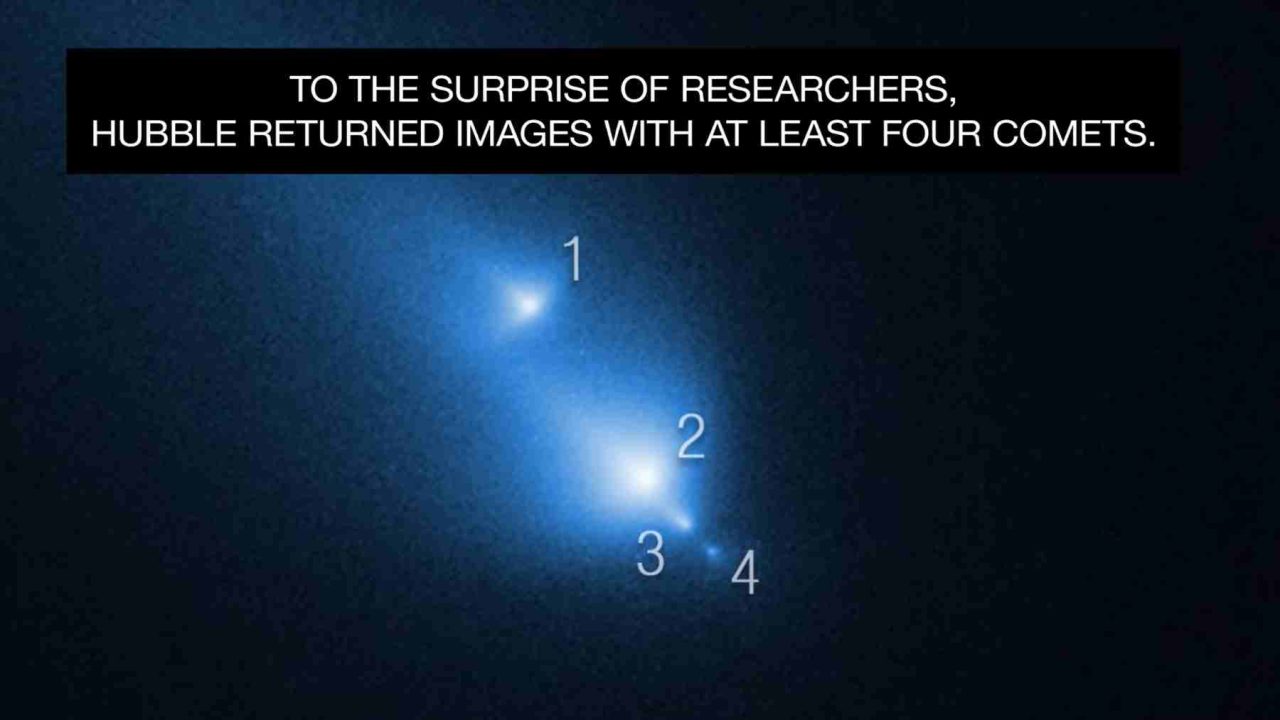
Here’s what you need to know about a remarkable discovery from the Hubble Space Telescope. In November 2025, Hubble captured Comet K1, a pristine visitor from the Oort Cloud estimated to be four and a half billion years old, breaking apart into at least four fragments after swinging inside Mercury’s orbit. The observation almost didn’t happen. Hubble was scheduled to look at a completely different comet, but a last-minute technical issue forced a target switch, catching this rare event by pure luck.
What really puzzled scientists was a 48-hour delay between the comet’s apparent breakup and its peak brightness surge. Existing models predicted an instant spike, but researchers at Auburn University now believe dust coatings on freshly exposed ice need time to form before reflecting enough sunlight. If confirmed, this could force revisions to decades of assumptions about how we interpret comet breakups.
The takeaway: keep an eye on this research, because it may reshape how astronomers read brightness data from comets going forward.
When was the last time you watched something 4.6 billion years old fall apart before your eyes? Not metaphorically. Not in a museum. But live, unfolding across millions of miles of empty space, captured by the most famous telescope ever launched.
That’s exactly what happened in November 2025. And the story of how scientists almost missed it, then couldn’t explain what they saw, is one of the strangest astronomy tales in recent memory.
How a Scheduling Accident Led to Comet K1’s Discovery
The Hubble Space Telescope wasn’t even supposed to be looking at Comet C/2025 K1 (ATLAS). The observing time had been reserved for a completely different comet. But new technical limitations forced a last-minute switch, redirecting Hubble’s gaze toward K1.
John Noonan and Dennis Bodewits at Auburn University called the observation “the slimmest of slim chances.” That phrase barely captures the improbability. A long-period comet from the Oort Cloud, K1 may not return to our solar system for thousands of years. Catching it at the exact moment of fragmentation required a convergence of timing, technology, and sheer luck.
K1 reached perihelion on October 8, 2025, swinging inside Mercury’s orbit at roughly 31 million miles from the Sun. That close encounter subjected its ancient icy body to extreme solar heating. About a month later, the comet began to crack.
Three Nights in November: What Hubble Actually Saw
Hubble’s key images were captured across three consecutive nights: November 8, 9, and 10, 2025. Each exposure lasted about 20 seconds. In that narrow window, the telescope recorded something extraordinary. The comet had split into at least four separate fragments, each surrounded by its own coma, the cloud of gas and dust that forms around an active cometary nucleus.
| Date | Observation | Key Detail |
|---|---|---|
| Oct 8, 2025 | Perihelion reached | ~31 million miles from the Sun, inside Mercury’s orbit |
| ~Nov 1, 2025 | Breakup likely begins | Ground-based telescopes detect initial activity changes |
| Nov 2–4, 2025 | Biggest brightness surge | 48-hour delay after apparent start of fragmentation |
| Nov 8, 2025 | Hubble imaging begins | Four fragments visible, each with its own coma |
| Nov 9–10, 2025 | Continued Hubble tracking | Fifth fragment appears; ~20-second exposures per image |
By the final night, a fifth fragment had appeared. Each piece was drifting away from the others, trailing its own envelope of gas and ancient dust. The images were stunning. But the real puzzle wasn’t visual. It was temporal.
The 48-Hour Brightness Gap That Broke the Models
Here’s where the story gets strange. Ground-based monitoring stations had been tracking K1’s brightness throughout early November. The breakup appeared to have started around November 1, 2025. Standard comet theory predicts that when a nucleus fractures, fresh ice surfaces are immediately exposed to sunlight. That exposure should trigger a rapid spike in brightness as volatile ices sublimate and scatter light.
But the biggest rise in activity didn’t come until between November 2 and November 4. A full 48 hours after the breakup seemed to begin.
For Noonan and Bodewits at Auburn, this delay was deeply confusing. Every existing model predicted a near-instantaneous brightness jump. Two days of silence didn’t fit any established framework.
“The slimmest of slim chances.”
— John Noonan and Dennis Bodewits, Auburn University
The delay forced the Auburn team to reconsider fundamental assumptions about cometary disintegration. What if the brightness of a fragmenting comet isn’t driven primarily by freshly exposed ice at all?
Dust, Not Ice, May Drive Cometary Brightness
The study emerging from this observation argues something counterintuitive. Most of a comet’s brightness comes from dust reflecting sunlight, not from clean ice surfaces alone. When K1 fractured, the newly exposed ice was pristine. Too pristine, perhaps.
The Auburn researchers propose that fresh cometary surfaces may need time to build a thin dust coating before producing a brighter burst. Think of it like this: raw ice is a poor reflector compared to ice covered in a fine layer of dark, sun-warmed dust particles. The dust absorbs solar energy, heats the ice beneath it, and accelerates sublimation. That process generates more gas, which lifts more dust, which reflects more sunlight.
The 48-hour gap, in this framework, represents the time it took for that dust mantle to form on the fresh fracture surfaces. It’s an elegant hypothesis. And it carries enormous implications for how we interpret historical comet observations.
You’re an astronomer with reserved Hubble observing time for a stable, well-studied comet. Breaking news arrives that a different comet, K1, is showing signs of imminent fragmentation. Switching targets means losing your original data entirely.
Why 4.6-Billion-Year-Old Ice Matters to Planetary Science
Comets like K1 are time capsules. Originating from the Oort Cloud at the frigid edges of our solar system, they preserve materials from the very formation of the Sun and planets. The ice inside K1 hadn’t seen sunlight in roughly 4.6 billion years. When the comet shattered, those interior surfaces were exposed for the first time since before Earth existed.
Studying the composition of that ancient ice can reveal what the early solar system’s chemical environment looked like. Water isotope ratios, organic molecule concentrations, and volatile gas mixtures locked inside cometary ice all provide clues about the conditions that eventually gave rise to life on Earth.
K1’s fragmentation was rare not just because Hubble happened to be watching. Comet breakups are inherently uncommon events. Long-period comets from the Oort Cloud visit the inner solar system so infrequently that catching one mid-disintegration, with a space telescope capable of resolving individual fragments, borders on the miraculous.
What This Means for Future Comet Tracking
The Auburn University findings carry practical consequences. If brightness curves don’t accurately reflect the moment of fragmentation, then early-warning systems for potentially hazardous comets could be miscalibrated. A 48-hour error margin might seem small on cosmic timescales. But for planetary defense calculations, timing matters enormously.
The Hubble Space Telescope, now over 36 years into its mission, continues to deliver discoveries that ground-based observatories cannot match. Its ability to resolve K1’s individual fragments, each with a distinct coma, provided the spatial detail needed to connect the brightness delay to the physical breakup process.
Hubble has previously helped pin down the age of the universe at 13.8 billion years, discovered moons of Pluto, and confirmed that nearly every major galaxy harbors a central black hole. Adding “rewrote the rules of cometary brightness” to that résumé feels fitting for a telescope that keeps defying its own expiration date.
A Lesson in Scientific Humility
The K1 story is ultimately about the gap between theory and observation. Scientists had robust, well-tested models for how comets brighten during fragmentation. Those models worked for every previous case. Then a single 48-hour anomaly forced a complete rethinking.
That’s how science is supposed to work. Not as a steady accumulation of confirming data, but as a series of surprises that demand new explanations. The Auburn team didn’t dismiss the delay as an instrument error or an outlier. They followed it to a hypothesis that could reshape cometary science for decades.
Somewhere beyond Neptune, in the cold silence of the Oort Cloud, countless other ancient comets drift in darkness. Some will eventually fall sunward. Most will never be seen. But K1 taught us something crucial: even when we do catch one, we might not understand what we’re seeing for another 48 hours.
And in those 48 hours, everything we thought we knew can change.



Leave a Reply