
A family drives along the southern edge of Riyadh on a Thursday afternoon. Through the dusty car window, the children point at something that seems impossible: a real, flowing river cutting a ribbon of green through the pale desert. What they are looking at is not a natural oasis. It is treated sewage, and it is growing larger every single year.
The Assumption That Arabia Is Defined by Permanent, Unfixable Water Scarcity
The mental image most people carry of Saudi Arabia and water is one of absolute scarcity. Enormous dunes. No natural rivers. A population sustained by some of the largest desalination plants on earth. The country sits on top of fossil aquifers draining faster than any rainfall can replenish them.
That image is not entirely false. Desalinated water accounted for 50% of total distributed water in Saudi Arabia in 2023. Groundwater reserves that took thousands of years to accumulate are being consumed in decades. For most observers, Saudi Arabia is the textbook case of a civilization betting everything on a shrinking finite resource.
Within that framing, wastewater is treated as a secondary problem. Something to manage, neutralize, and discard. The idea of transforming it into a permanent, living river running through the capital city sounds less like engineering and more like fiction.
| Metric | Conventional Wastewater Approach | Wadi Hanifah Model |
|---|---|---|
| Treatment method | Chemical-intensive filtration | Sunlight and oxygen, natural biological process |
| Final destination of water | Discharged or disposed of | Released into a permanent 57 km open channel |
| Ecological outcome | Minimal to none | Returning fish, birds, and native vegetation |
| Community use | None | Parks, walking paths, farms, weekend recreation |
| Daily water volume | Variable, often wasted | ~1,000,000 cubic meters (264 million gallons) |
Wadi Hanifah: A 120-Kilometer Valley Transformed From Open Sewer to Desert River
Wadi Hanifah is a natural valley stretching 120 kilometers (about 75 miles) through the heart of Riyadh. For most of its modern history, it served as a dry flood-control corridor, collecting rare rainfall runoff and baking dry for the remaining months of the year. By the late 20th century, it had become something far worse than dry.
Riyadh’s explosive population growth outpaced its water treatment infrastructure entirely. Raw and partially treated wastewater poured into the valley unchecked. The Manfouha sewage treatment plant had begun operating in the early 1980s, but the city was growing faster than any single facility could handle. The smell from the wadi was reportedly detectable kilometers away, and residents avoided the corridor completely.
Then Saudi engineers made a decision that inverted the usual logic of waste management. Instead of treating water and discarding it downstream, they designed a system to channel it back into the landscape as a permanent, productive, and publicly accessible resource.
The Non-Chemical Treatment System Running on Sunlight and Open Air
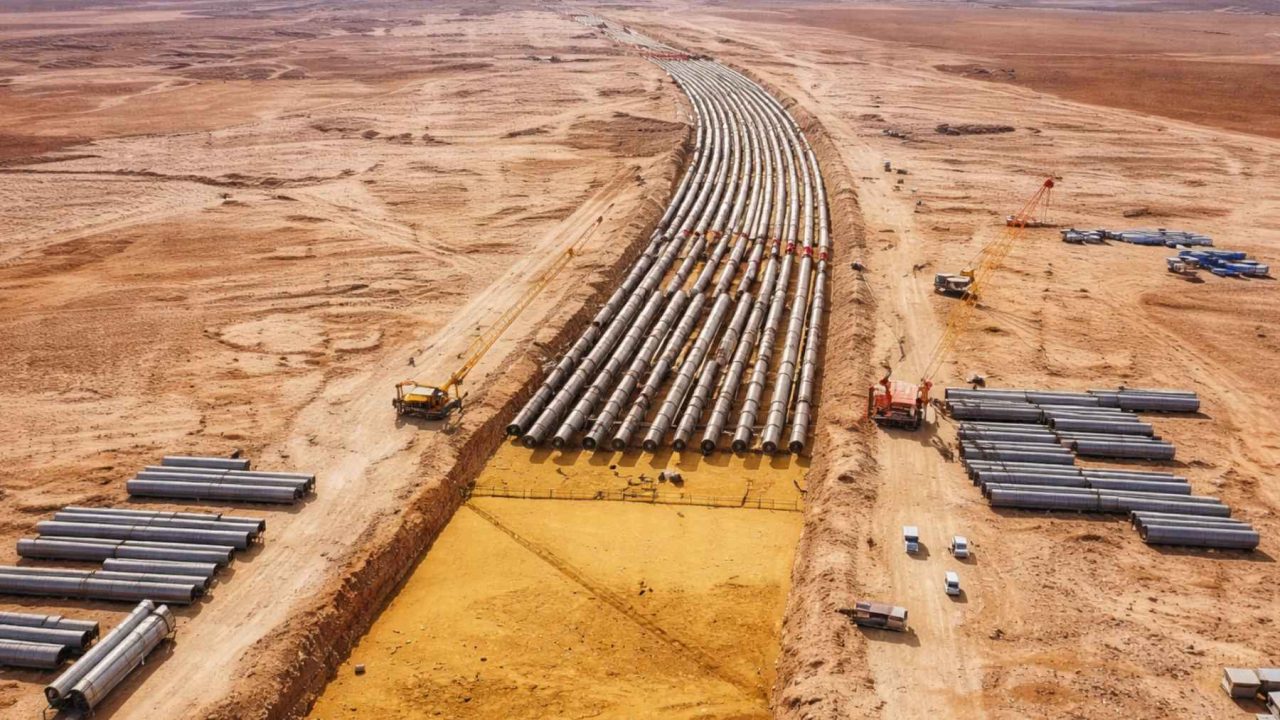
The rehabilitation program at Wadi Hanifah relies on a natural, non-chemical treatment approach. Treated wastewater enters a sequence of open pools and shallow channels. Sunlight drives photosynthesis and UV sterilization simultaneously. Oxygen supports aerobic bacteria that break down organic material at a rate that industrial chemical systems often struggle to match at this scale.
This is not a primitive solution. It is a precisely engineered biological cascade designed to take advantage of Riyadh’s extreme solar exposure. Where other climates might struggle with open-water biological treatment due to cold temperatures or limited sunlight hours, the Arabian Peninsula has both resources in essentially unlimited supply.
In 2023, the National Water Company awarded a major rehabilitation contract for the Manfouha treatment plants complex, bringing its operational capacity to 700,000 cubic meters per day. That investment does not read like an experiment being extended cautiously. It reads like a government committing to permanent infrastructure.
The average flow through the wadi now runs at roughly 410 cubic feet per second. For context, that is comparable to a modest but real river in the American West. It is not a landscaped feature. It has measurable hydraulic force, and it runs year-round without interruption.
Birds, Fish, and Farms: The Riparian Ecosystem Now Rebuilding Along the Banks
The ecological story unfolding at Wadi Hanifah is the part that consistently stops visitors cold. What began as a public health crisis visible from miles away has become a functioning riparian ecosystem in the center of the Arabian desert.
Native plants have been reintroduced along the channel banks. Fish species have returned to the water. Bird populations that had not nested in this part of the peninsula for decades are being documented again. Permaculture instructor Andrew Millison, who traveled to the wadi and documented the project firsthand, described it as a living proof that treated wastewater can seed entirely new ecosystems in the most arid environments on the planet.
“The wastewater of Riyadh is growing an ecosystem at the same time.”
— Andrew Millison, Permaculture Instructor, documenting Wadi Hanifah
The social transformation runs parallel to the ecological one. Riyadh residents who once avoided the valley entirely now use it for weekend picnics, cycling, and family walks. Farms along the corridor have integrated the treated water into active irrigation systems. The wadi has become one of the most-visited green spaces in a city not historically associated with green spaces at all.
This connects directly to Saudi Arabia’s Green Riyadh Program, which targets the planting of 7.5 million trees across the capital. The wadi’s treated water is a core resource for that effort, linking urban greening policy with water recycling infrastructure in a single, self-reinforcing operational loop.
What Falling Consumption and a Desert River Reveal About Global Water Science
Saudi Arabia does not currently lead global wastewater treatment rankings. Chile tops the list at approximately 105% of wastewater treated (accounting for industrial reuse volumes), followed by the Netherlands at 99.59%, Luxembourg at 99%, and Germany at 97.35%. Those nations benefit from centuries of rainfall, river networks, and environmental regulation.
What Saudi Arabia is demonstrating is an entirely different proof of concept. It is showing how to engineer a permanent hydrological system from nothing, in a near-zero-rainfall environment, using only the water a city produces as daily waste. No river input required. No monsoon to count on. Just a city’s outflow, carefully managed and released back into the land.
The implications reach far beyond Arabia’s borders. Phoenix, Cairo, Karachi, and Lima all face a version of the same pressure: growing urban populations pressing against shrinking reliable water sources. The Wadi Hanifah project offers one answer that does not require rainfall, glacier melt, or imported water to function at scale.
Riyadh essentially designed a closed hydrological cycle where none existed before. Water enters the city from desalination plants and ancient aquifers. People use it. The city treats it. A desert valley carries it downstream, feeding plants, animals, and farms for 57 kilometers along the way. At some point in that chain, the label “wastewater” stops being accurate.
The harder question, one that water scientists and urban planners are only beginning to ask out loud, is whether a river built entirely from treated sewage and kept permanently alive by a city’s daily output should be called something different entirely. Because what is flowing through Wadi Hanifah right now is not waste. It is, by any functional definition, a river.

Leave a Reply