
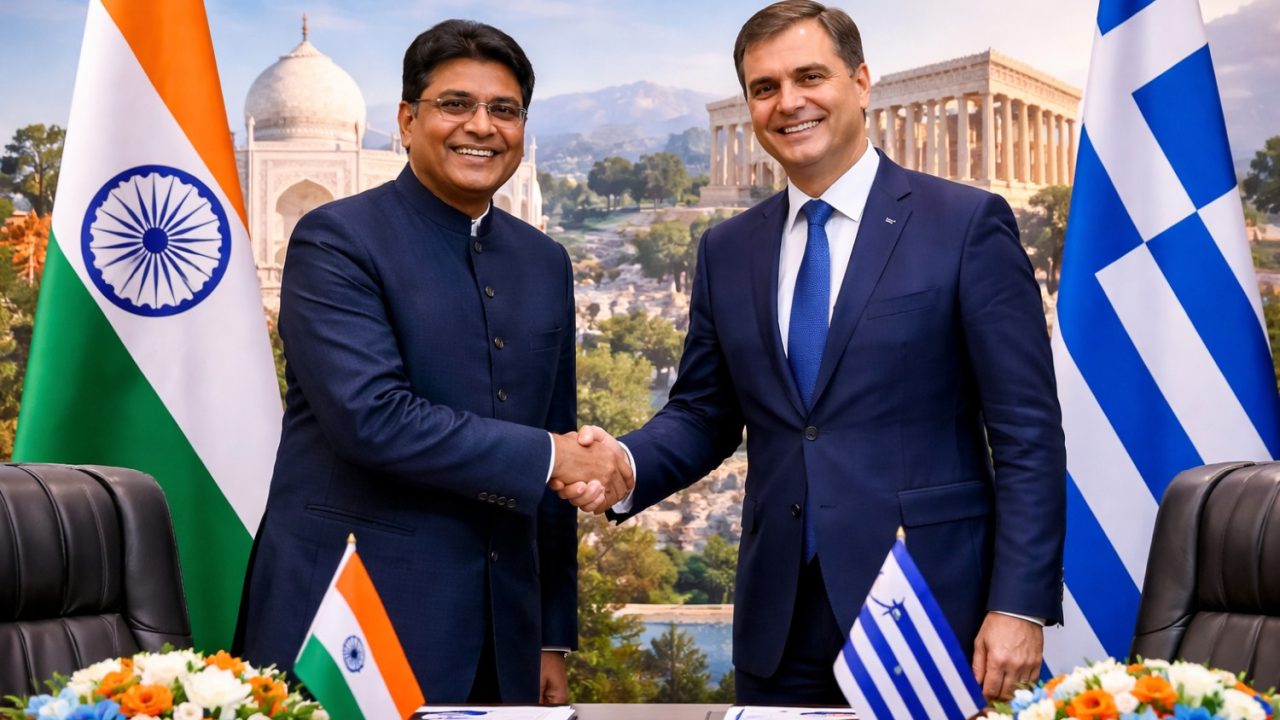
Two ancient civilizations, both rooted in philosophy, trade, and seafaring tradition, are moving closer together in 2026 — and the results could reshape travel and commerce flows across two continents.
On March 20, 2026, India’s Union Minister of Commerce and Industry, Piyush Goyal, held a virtual meeting with Greece’s Deputy Minister of Foreign Affairs, Harry Theoharis. The session covered trade, investment, tourism, and maritime connectivity — a broad agenda that signals both countries are serious about turning a historically warm relationship into something more economically concrete.
For travelers, exporters, and businesses operating in either country, this moment is worth watching closely.
What Happened in the March 20 Meeting
The virtual meeting between Goyal and Theoharis wasn’t a ceremonial exchange. The two ministers worked through a specific set of priority areas where India and Greece see genuine room for growth.
According to confirmed reporting, the key sectors discussed included:
- Trade — expanding the volume and variety of goods exchanged between the two nations
- Investment — identifying opportunities for cross-border capital flows and business partnerships
- Tourism — strengthening travel links and making it easier for citizens of each country to visit the other
- Maritime connectivity — a natural focus given Greece’s position as one of the world’s leading shipping nations and India’s long coastline and port infrastructure
- Other sectors of mutual interest — the meeting left room for the bilateral agenda to expand further
Minister Goyal is reported to have emphasized India’s keen interest in enhancing bilateral cooperation across all of these areas, reflecting a deliberate push by New Delhi to deepen ties with European partners beyond the traditional major economies.
Why India and Greece Make Sense Together
On paper, the pairing might seem unexpected. But look at the underlying strengths of both countries, and the logic becomes clear quickly.
Greece sits at the crossroads of Europe, the Middle East, and North Africa. Its ports — particularly Piraeus — are among the busiest in the Mediterranean and serve as a critical gateway for goods moving into Europe. India, meanwhile, is the world’s most populous nation, a fast-growing economy, and one of the largest sources of outbound tourists globally.
The shared emphasis on maritime connectivity in the March 20 discussions reflects exactly this complementarity. Indian exporters looking to reach European markets need reliable Mediterranean port access. Greek shipping operators, in turn, are well positioned to facilitate that movement.
On tourism, the fit is equally strong. Greece consistently ranks among the world’s most visited destinations, drawing travelers with its islands, ancient sites, and Mediterranean culture. Indian outbound tourism has been growing rapidly, with middle-class travelers increasingly looking beyond traditional destinations in Southeast Asia and the Gulf.
A Snapshot of What’s on the Table
| Sector | India’s Interest | Greece’s Strength |
|---|---|---|
| Trade | Expanding export markets for goods and services | Gateway to European consumer markets |
| Investment | Attracting European capital; outbound investment | Strategic location for regional business hubs |
| Tourism | Growing outbound traveler base seeking new destinations | World-class heritage, islands, and hospitality infrastructure |
| Maritime Connectivity | Port access and shipping routes for exports | One of the world’s largest merchant shipping fleets |
Officials on both sides have noted that the two nations share not just economic interests but cultural values — a point that has historically made diplomatic engagement between India and Greece relatively smooth compared to some other bilateral relationships.
What This Could Mean for Travelers and Businesses
If the momentum from the March 20 meeting translates into action, the practical effects could be felt in several ways.
For Indian travelers, a stronger bilateral relationship often brings easier visa processing, more direct or better-connected flight routes, and promotional tourism campaigns targeting Indian visitors. Greece has been actively courting non-European tourism markets in recent years, and India’s growing travel appetite makes it a natural focus.
For businesses, deeper trade ties typically mean fewer barriers for Indian exporters moving goods through Greek ports into Europe, and potentially new investment opportunities in sectors where both economies have complementary needs. Maritime companies operating between the two countries could also benefit from improved regulatory frameworks and bilateral agreements.
The emphasis on investment during the Goyal-Theoharis meeting suggests both governments are thinking beyond simple trade volumes — they want to build durable economic links that survive changes in government and global market conditions.
Where This Relationship Goes from Here
The March 20 virtual meeting is described as “another step” in a continuing process — which means it builds on prior engagement rather than starting from scratch. Both countries have historical ties that predate modern diplomacy, and the current leadership on both sides appears committed to giving that history economic substance.
The sectors identified — trade, investment, tourism, maritime connectivity — give a clear roadmap for what formal agreements or working groups might follow. Whether that produces a bilateral trade framework, a tourism promotion partnership, or specific maritime cooperation agreements remains to be seen.
What’s clear is that India is taking an active, leading role in driving this relationship forward. The decision to have a senior minister like Piyush Goyal engage directly with his Greek counterpart signals that this isn’t a low-priority diplomatic courtesy — it’s a relationship New Delhi is choosing to invest in.
For anyone with interests on either side of this partnership, the direction of travel is worth paying attention to.
Frequently Asked Questions
Who held the bilateral meeting between India and Greece on March 20, 2026?
India’s Union Minister of Commerce and Industry, Piyush Goyal, met virtually with Greece’s Deputy Minister of Foreign Affairs, Harry Theoharis.
What topics were discussed in the India-Greece meeting?
The ministers discussed trade, investment, tourism, maritime connectivity, and other sectors of mutual interest.
Why is maritime connectivity a focus for India and Greece?
Greece is one of the world’s leading shipping nations, and its Mediterranean ports serve as a key gateway into Europe — making it a natural partner for India’s export ambitions.
What could this mean for Indian tourists wanting to visit Greece?
Stronger bilateral ties often lead to easier visa processes and better travel connections, though specific agreements have not yet been confirmed from this meeting.
Is this the first diplomatic engagement between India and Greece at this level?
The meeting is described as “another step” in deepening cooperation, suggesting ongoing engagement rather than a first-time contact.
Have any formal trade or tourism agreements been signed as a result of this meeting?
No specific agreements have been confirmed from the March 20 meeting; the discussions were focused on identifying areas for future cooperation.




Leave a Reply