
▶ Read transcript
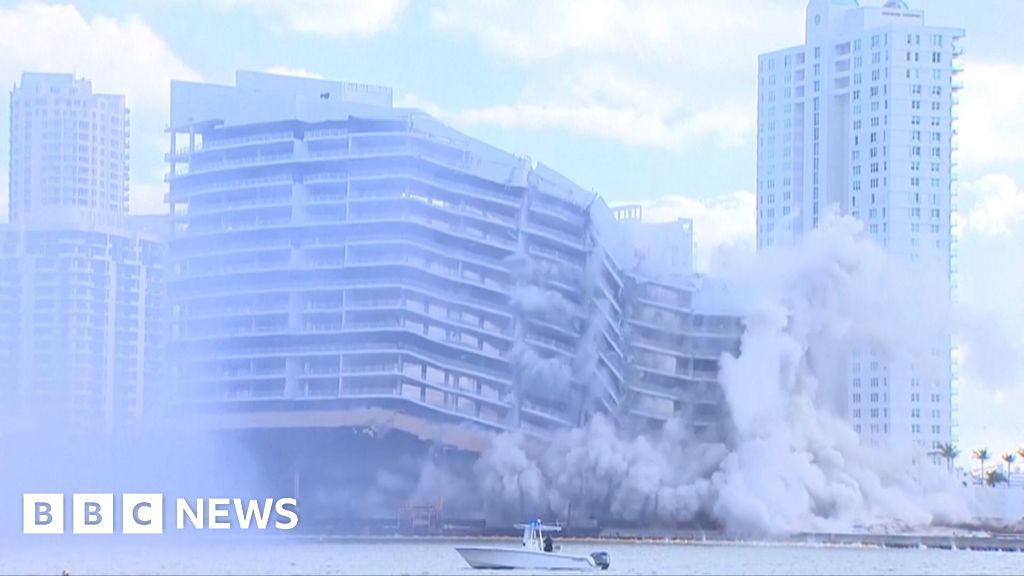
Here’s what you need to know about the dramatic transformation happening on Miami’s Brickell Key. On April 12, 2026, the iconic 23-story Mandarin Oriental Hotel was imploded in just 20 seconds, making it the largest demolition of its kind in Miami in over a decade. But here’s the part that surprises most people: the Mandarin Oriental brand isn’t leaving. Developer Swire Properties, which has shaped Brickell Key for decades, broke ground on a new project called One Island Drive immediately after the dust settled. It’s a one billion dollar, two-tower luxury development called The Residences at Mandarin Oriental, Miami, keeping the brand’s identity at the heart of the site. This isn’t erasure — it’s evolution. So if you’re a fan of the Mandarin Oriental’s waterfront presence in Miami, don’t write it off just yet. Keep an eye on One Island Drive, because what rises next could redefine Miami’s skyline for a generation.
On the morning of April 12, 2026, a crowd gathered on the edges of Brickell Key to watch something irreversible happen. In exactly 20 seconds, the 23-story Mandarin Oriental Hotel, a landmark that had defined Miami’s luxury waterfront scene for decades, crumbled into a cloud of dust and debris. The implosion was controlled, precise, and, for many onlookers, emotionally complicated.
It was the largest implosion Miami had seen in more than a decade. And it was just the beginning.
What replaces it is called One Island Drive, a $1 billion luxury development by Swire Properties that promises to transform Brickell Key into something the city has never quite seen before. But before anyone starts celebrating Miami’s bold architectural future, it’s worth examining what assumptions most people carry into this story, and which of those assumptions are quietly, completely wrong.
What Most People Assume About Hotel Demolitions and Luxury Redevelopment
The common narrative around a beloved hotel’s demolition tends to follow a predictable arc. A storied property closes. Developers swoop in, erase history, and erect something glassy and soulless in its place. Longtime guests mourn. Locals protest. The city loses another piece of its character in exchange for condos marketed to overseas investors who will never actually live in them.
It’s a familiar and often accurate story. Miami, in particular, has lived through enough cycles of teardown-and-tower to make skepticism the default setting for anyone paying attention to real estate here.
So when news broke that the Mandarin Oriental on Brickell Key was being demolished via implosion, the instinct for many was to frame it as another erasure. Another luxury brand cashing out. Another piece of Miami’s hospitality soul sacrificed for square footage.
The 20-Second Collapse That Took Years to Plan
Controlled implosions look instantaneous. They are anything but. The demolition of the Mandarin Oriental on April 12 required months of preparation by specialized demolition engineers. Charges had to be placed at precise structural points throughout the 23-story building. Timing sequences were calculated to direct the collapse inward, protecting the surrounding waterfront environment and neighboring structures on Brickell Key’s narrow island footprint.
The result was a building that had stood for decades disappearing in less time than it takes to read this paragraph.
CBS News Miami confirmed this was the largest implosion in Miami in more than a decade. That detail matters beyond spectacle. It signals the scale of what Swire Properties is undertaking, and how seriously the developer is treating the site’s transformation.
Brickell Key is a small, man-made island connected to Miami’s financial district by a single bridge. Space is finite. Demolishing a 23-story structure via implosion, rather than a slower mechanical teardown, reflects both the engineering constraints of the island and the urgency of the development timeline.
| Feature | Former Mandarin Oriental Hotel | One Island Drive (Planned) |
|---|---|---|
| Structure Type | Single hotel tower, 23 stories | Two-tower residential and hotel complex |
| Primary Use | Hotel and hospitality | Luxury residences with Mandarin Oriental branding |
| Developer | Swire Properties (original) | Swire Properties (continuing) |
| Estimated Investment | N/A (legacy asset) | $1 billion |
| Demolition Method | Controlled implosion, April 12, 2026 | Groundbreaking immediately post-demolition |
Why the Erasure Narrative Gets This Story Wrong
Here is the assumption that deserves the most scrutiny: that the Mandarin Oriental brand is being pushed out of Brickell Key by profit-hungry developers. According to Swire Properties, the opposite is true.
The demolition was immediately followed by the groundbreaking of The Residences at Mandarin Oriental, Miami. This is a two-tower development that keeps the Mandarin Oriental name, aesthetic, and hospitality DNA embedded in the new project. The brand is not a casualty of this redevelopment. It is the centerpiece of it.
Swire Properties has deep roots in Brickell Key. The company has been the primary developer on the island for decades, shaping its residential and commercial identity over multiple phases of construction. One Island Drive is not a hostile takeover of a beloved site. It is the same developer making a generational bet on the same piece of land.
“The demolition made way for the groundbreaking of The Residences at Mandarin Oriental, Miami, a two-tower development.”
— NBC Miami, reporting on Swire Properties’ announcement
The distinction between a brand being erased and a brand being evolved is significant. Travelers who loved the Mandarin Oriental’s waterfront positioning, its Brickell Key address, and its association with understated luxury will find those qualities preserved, and amplified, in what comes next.
What One Island Drive Actually Represents for Miami’s Skyline
A $1 billion development on a man-made island in Miami is not just a real estate transaction. It is a statement about where the city’s center of gravity is heading.
Brickell has spent the last decade transforming from Miami’s financial district into one of the most densely developed urban neighborhoods in the American Southeast. New towers, transit infrastructure, restaurant corridors, and cultural venues have reshaped what it means to live and work in this part of the city.
Brickell Key sits just offshore from all of that energy, connected but separate. Its island geography has always given it a quiet exclusivity that the mainland cannot replicate. One Island Drive is designed to capitalize on exactly that quality.
The two-tower format signals ambition. A single replacement tower would have been the conservative play. Two towers suggest Swire Properties is betting that demand for this address, this brand, and this waterfront experience will sustain a significantly larger footprint than what existed before.
For Miami’s skyline, the visual impact will be substantial. Brickell Key’s profile has been relatively stable for years. Two new towers of luxury scale will be visible from the causeway, from the bay, and from the mainland Brickell corridor. The island’s silhouette is about to change permanently.
What This Means for Travelers, Future Guests, and Miami Watchers
If you were a regular guest at the Mandarin Oriental Miami, the immediate reality is straightforward: the hotel is gone, and it will not reopen in its original form. The implosion on April 12 was final.
But the longer arc of this story offers something more interesting than loss. The Residences at Mandarin Oriental, Miami will likely include hotel and hospitality components alongside private residences, as is standard for Mandarin Oriental’s branded residence model globally. That means the experience of staying at a Mandarin Oriental on Brickell Key may eventually return, in a newer, larger, and more architecturally ambitious form.
For travelers drawn to Miami’s luxury hospitality scene more broadly, the implosion and redevelopment of the Mandarin Oriental site is a signal worth tracking. It reflects a broader pattern in which aging first-generation luxury hotels in prime urban locations are being replaced not by generic towers, but by branded residence hybrids that blend private ownership with hotel-level services.
This model has appeared in New York, London, Dubai, and Singapore. Miami’s adoption of it on Brickell Key suggests the city is maturing into a market where that kind of development is not just viable, but expected.
The Mandarin Oriental Miami stood on Brickell Key long enough to become part of the city’s identity. Its implosion was not a quiet goodbye. It was a 20-second spectacle witnessed by crowds, filmed from every angle, and broadcast across the country. Miami does not do things quietly, and it did not let this building go quietly either.
What rises in its place will take years to complete. But the question worth sitting with is not whether One Island Drive will be impressive. At $1 billion, on one of Miami’s most coveted addresses, with one of the world’s most recognized luxury brands attached, impressive is the floor, not the ceiling.
The real question is whether a city that implodes its past in 20 seconds can build a future that earns the same kind of loyalty the old building took decades to accumulate.
Frequently Asked Questions

You Might Also Like

Chicago Now Has the Highest Hotel Tax in America — and Not Everyone Is Celebrating
Book a hotel room in Chicago today, and nearly 20 cents of every dollar you…

Solo Travelers Are Quietly Choosing Group Travel For Good Reason
Something unexpected is happening in the travel world: the solo adventurer — long celebrated as…
Flight Cancellations Are Hitting NYC LA and Chicago Harder Than Anyone Planned For
More than 188 flights were cancelled and nearly 4,000 delays were recorded in a single…
Leave a Reply