
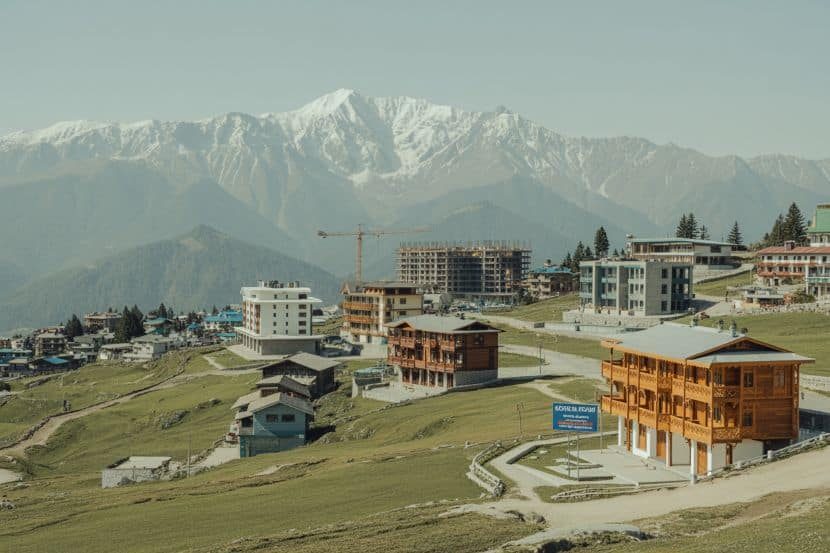
In a single fiscal year, authorities in Jammu and Kashmir approved 415 building permissions in notified tourist areas — the highest figure in three years, and more than what was sanctioned in either of the two preceding years individually. That number tells a story about one of India’s most dramatic tourism transformations underway right now.
The mountain destinations of Gulmarg, Pahalgam, Sonamarg, Bhaderwah, and Patnitop are all at the centre of this shift. Between 2023 and 2026, Tourism Development Authorities across the Union Territory sanctioned a total of 807 constructions, covering new hotels, guesthouses, and a wide range of tourism-supporting real estate. For global travellers and investors paying attention to India’s hill station economy, this is the moment to understand what is actually changing — and what it means on the ground.
This is not just a story about construction numbers. It is about a region entering a new phase of high-volume infrastructure growth under noticeably tighter regulatory scrutiny, with implications for everyone from a first-time visitor booking a ski trip to Gulmarg to a hospitality investor watching the region’s development pipeline.
(function(){var wrp=document.getElementById(“paap_stat_69df0b90851e45.89212428”);if(!wrp)return;var ids=[“paap_stat_69df0b90851e45.89212428_c0″,”paap_stat_69df0b90851e45.89212428_c1”];var dur=1800;function ease(t){return 1-Math.pow(1-t,3);}function anim(){ids.forEach(function(id){var el=document.getElementById(id);if(!el)return;var tgt=parseFloat(el.getAttribute(“data-target”))||0;var pfx=el.getAttribute(“data-prefix”)||””;var sfx=el.getAttribute(“data-suffix”)||””;var dec=parseInt(el.getAttribute(“data-decimals”))||0;var st=null;function step(ts){if(!st)st=ts;var p=Math.min((ts-st)/dur,1);var v=ease(p)*tgt;el.textContent=pfx+v.toFixed(dec)+sfx;if(p<1)requestAnimationFrame(step);}requestAnimationFrame(step);});}if("IntersectionObserver" in window){var obs=new IntersectionObserver(function(e){e.forEach(function(en){if(en.isIntersecting){anim();obs.disconnect();}});},{threshold:0.2});obs.observe(wrp);}else{anim();}})();
Why India’s Mountain Tourism Rules Are Changing Now
Jammu and Kashmir’s tourism sector has been on an upward trajectory for several years, with the Union Territory government actively positioning its mountain destinations as world-class alternatives to established Himalayan and Alpine resorts. The surge in visitor numbers has created enormous pressure on infrastructure — roads, accommodation, waste management, water supply — particularly in compact, ecologically sensitive areas like Gulmarg and Pahalgam.
The response from Tourism Development Authorities has been a more structured permitting regime, one that attempts to channel development rather than restrict it outright. The record-high approvals in 2025–26 suggest that demand from developers and hospitality operators is stronger than ever, while the oversight framework has been tightened to ensure that growth does not outpace the carrying capacity of these fragile mountain environments.
For travellers, this matters because the quality and character of these destinations is directly shaped by how — and how fast — they are built up. For investors, it signals both opportunity and a more demanding compliance environment than existed even a few years ago.
The Numbers Behind the Building Boom
The data from Tourism Development Authorities gives a clear picture of the pace of development across J&K’s notified tourist areas over the past three years.
| Period | Building Permissions Approved |
|---|---|
| 2023–24 | Less than 415 (part of 807 total) |
| 2024–25 | Less than 415 (part of 807 total) |
| 2025–26 (fiscal year) | 415 — highest in three years |
| 2023–2026 (combined total) | 807 constructions sanctioned |
The destinations covered under this framework include some of the most recognisable names in Indian mountain tourism: Gulmarg, known internationally for skiing and alpine scenery; Pahalgam, a base for trekking and the Amarnath pilgrimage; Sonamarg, the gateway to Ladakh; and the lesser-known but increasingly visited Bhaderwah and Patnitop in the Jammu division.

(function(){function loadChartJs(cb){if(window.Chart){cb();return;}var s=document.createElement(“script”);s.src=”https://cdn.jsdelivr.net/npm/chart.js@4.4.0/dist/chart.umd.min.js”;s.onload=cb;document.head.appendChild(s);}function initChart(){var cv=document.getElementById(“paap_chart_69df0b90852ed7.60021664”);if(!cv)return;var dv=[“<415","<415","415"];new Chart(cv,{type:"bar",data:{labels:["2023u201324","2024u201325","2025u201326"],datasets:[{data:[200,192,415],backgroundColor:["#3b82f6","#10b981","#f59e0b"],borderRadius:6,borderSkipped:false}]},options:{indexAxis:"y",responsive:true,maintainAspectRatio:false,animation:{duration:1200,easing:"easeOutQuart"},plugins:{legend:{display:false},tooltip:{callbacks:{label:function(ctx){return dv[ctx.dataIndex]||ctx.formattedValue;}}}},scales:{x:{grid:{color:"#e5e7eb"},ticks:{color:"#6b7280"}},y:{grid:{display:false},ticks:{color:"#1a1a1a",font:{weight:600}}}}}});}var cv=document.getElementById("paap_chart_69df0b90852ed7.60021664");if(!cv)return;if("IntersectionObserver" in window){var obs=new IntersectionObserver(function(e){e.forEach(function(en){if(en.isIntersecting){loadChartJs(initChart);obs.disconnect();}});},{threshold:0.1});obs.observe(cv);}else{loadChartJs(initChart);}})();
What This Means for Travellers Visiting These Destinations
If you are planning a trip to any of these mountain destinations in the near or medium term, the construction wave has real practical consequences. More accommodation supply means more choices and, in competitive segments, potentially better value. New hotels and guesthouses entering the market in destinations like Gulmarg and Sonamarg are likely to raise the overall standard of facilities available to visitors.
At the same time, active construction in compact mountain towns can affect the experience of visiting them. Travellers who value the quieter, less-developed character of places like Bhaderwah and Patnitop may find the landscape changing more quickly than expected over the next two to three years.
The tighter regulatory scrutiny that now accompanies development approvals is broadly good news for environmental sustainability. Authorities have placed these resorts under closer oversight precisely because unchecked development in ecologically sensitive mountain zones carries long-term risks — to water sources, forest cover, and the scenic quality that makes these places worth visiting in the first place.
For investors, the compliance environment is more demanding, but the pipeline of approved projects confirms that the regulatory framework is functional and that permits are being granted at scale. The 807 sanctioned constructions across three years represent a substantial and growing hospitality inventory entering the market.
What Happens Next for These Mountain Destinations
The trajectory points toward continued acceleration. With 415 permissions granted in a single fiscal year — surpassing the totals of each of the two years before it — the development pipeline for J&K’s notified tourist areas is fuller now than at any recent point.
Authorities have signalled that oversight will remain tight even as approvals increase. The combination of high-volume permitting and closer regulatory scrutiny is the defining feature of this new phase: growth is being encouraged, but within a framework designed to prevent the kind of unregulated expansion that has damaged other Indian hill stations.
For destinations like Gulmarg and Sonamarg, the next two to three years will likely see a significant expansion of the formal accommodation sector. For Bhaderwah and Patnitop, which have historically attracted fewer international visitors, the current development cycle could mark the beginning of a more prominent place on the global adventure and mountain tourism map.
Global travellers and hospitality investors watching India’s mountain tourism market would do well to track the permitting data from J&K’s Tourism Development Authorities — it is one of the clearest leading indicators of where the region’s tourism landscape is heading.
Frequently Asked Questions
How many building permissions were approved in J&K tourist areas in 2025–26?
Authorities approved 415 building permissions in notified tourist areas during fiscal year 2025–26, the highest figure in three years.
Which mountain destinations in Jammu and Kashmir are covered by these new tourism rules?
The destinations under active development oversight include Gulmarg, Pahalgam, Sonamarg, Bhaderwah, and Patnitop.
How many total constructions were sanctioned in J&K between 2023 and 2026?
Tourism Development Authorities sanctioned a total of 807 constructions across the Union Territory’s notified tourist areas during that three-year period.
Are the new rules making it harder or easier to develop tourism properties in J&K?
The data suggests development is being actively encouraged — record approvals indicate permits are being granted at scale — but under tighter regulatory scrutiny than in previous years.
What types of developments are being approved in these tourist areas?
Approved constructions include new hotels, guesthouses, and tourism-supporting real estate across J&K’s mountain destinations.
Is Gulmarg still the main focus of tourism development in the region?
Gulmarg is among the destinations under the spotlight, alongside Pahalgam, Sonamarg, Bhaderwah, and Patnitop — suggesting development interest is spreading across multiple mountain resorts rather than concentrating in one location.

Leave a Reply