
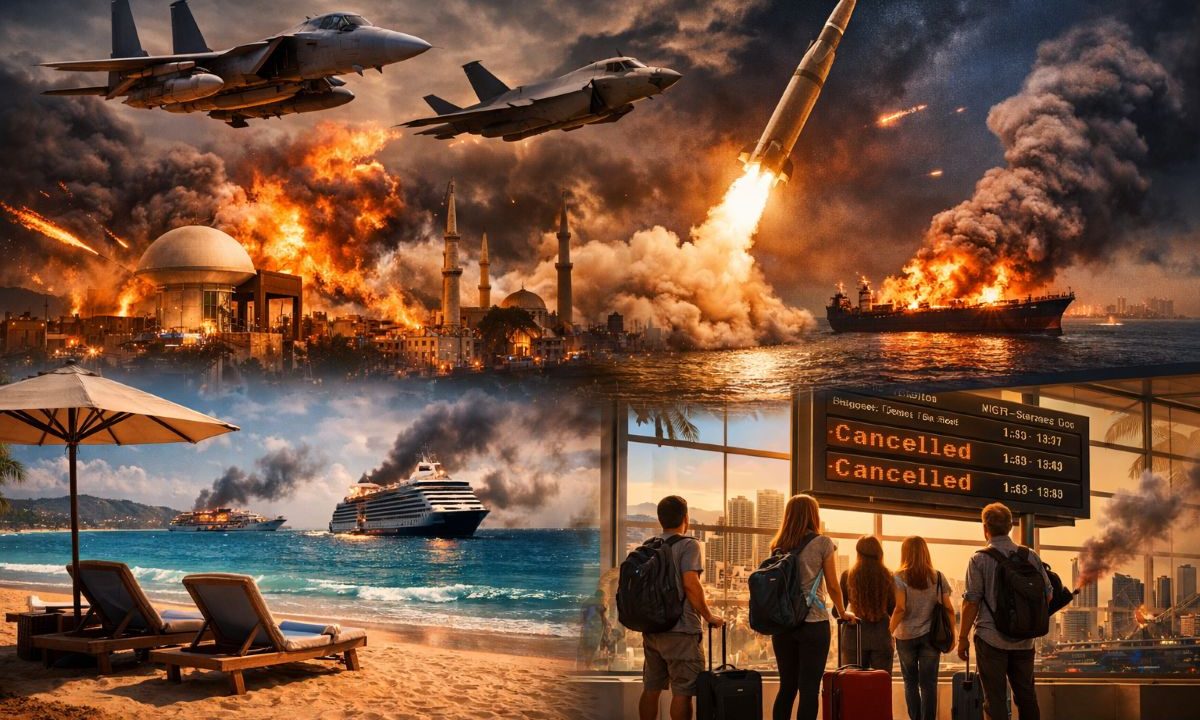
A joint US–Israeli air campaign launched on 28 February 2026 killed Iran’s Supreme Leader Ayatollah Ali Khamenei, struck nuclear facilities and missile sites, and set off a chain of retaliatory actions across the Gulf — and the shockwaves are now reaching beaches, airports, cruise terminals, and resort towns far beyond the Middle East.
The operation, codenamed “Operation Epic Fury,” has done something that few military conflicts in recent memory have managed so quickly: it has transformed a regional military confrontation into a direct, measurable threat to global travel and tourism. Flight paths are being redrawn. Cruise itineraries are being cancelled or rerouted. And travelers are reassessing whether the resort they booked months ago is still a safe destination.
If you have travel plans anywhere connected to the Middle East, the Gulf, or regions where Iranian-aligned networks operate, this is a story that directly affects you.
What Operation Epic Fury Actually Triggered
The strikes on 28 February 2026 were not a limited warning shot. According to reporting on the operation, US and Israeli forces targeted leadership compounds, nuclear facilities, and missile sites simultaneously. The scope was sweeping — and the Iranian response has been framed accordingly.
Following Khamenei’s death, his son Ayatollah Mojtaba Khamenei was elevated to the position of Supreme Leader. In his Nowruz message, the new Supreme Leader claimed Iran had delivered a “bewildering blow” to its enemies — language that signals this conflict is being positioned as a long campaign rather than a brief exchange.
That framing matters enormously for the travel industry. A war with a defined endpoint is manageable. A war that a new government is publicly committed to extending — and framing as a civilizational struggle — creates the kind of sustained uncertainty that keeps travelers home and forces airlines, cruise lines, and tour operators to make difficult long-term decisions.
How the Iran–Israel–US Conflict Is Rewriting the Travel Map
The most immediate impact has been on aviation. Airspace over Iran and parts of the Gulf has become a live operational zone, forcing carriers to reroute long-haul flights — adding time, fuel costs, and complexity to routes that connect Europe, Asia, and Australia. Passengers on affected routes are already experiencing longer flight times and, in some cases, cancellations.
Cruise lines operating in the Gulf and Eastern Mediterranean face a parallel problem. Itineraries that include ports in the region are being reconsidered or quietly pulled from sale. The cruise industry, which relies on predictable port access and passenger confidence, is particularly vulnerable to the kind of open-ended instability this conflict has introduced.
Beyond the immediate conflict zone, the concern is broader. Iranian retaliation has extended across the Gulf and beyond, according to the source reporting — meaning tourist hotspots in neighboring regions are now being assessed as potential indirect targets or flash points.
The Specific Risks Travelers Need to Know About
| Travel Category | Nature of Risk | Current Status |
|---|---|---|
| Flights over Gulf/Iran airspace | Active conflict zone, missile activity | Rerouting underway by multiple carriers |
| Gulf cruise itineraries | Port access uncertainty, security concerns | Itineraries being revised or withdrawn |
| Middle East resort destinations | Proximity to retaliation zones | Under active reassessment |
| Global tourist sites | Perceived soft-target risk in escalation scenarios | Elevated general vigilance advised |
| Long-haul routes (Europe–Asia) | Airspace closures adding flight time and cost | Ongoing disruption |
The source reporting specifically notes that the war is “reshaping flight paths, cruise itineraries, and perceptions of safety at beaches, resorts, and even city parks worldwide.” That last part is significant. The concern is no longer confined to travelers heading directly into the conflict zone — it extends to how the conflict changes the global security environment for tourists everywhere.
- Flight disruptions: Airspace closures and rerouting are adding cost and uncertainty to long-haul travel across Asia, Europe, and Australia routes.
- Cruise cancellations: Gulf and Eastern Mediterranean itineraries face the highest immediate disruption risk.
- Resort and beach destinations: Areas within Iran’s retaliatory reach are being reassessed by travelers and operators alike.
- Soft-target awareness: Security analysts and travel advisors are raising the general threat level for crowded tourist locations globally.
Who Bears the Heaviest Burden Right Now
The travelers most directly affected are those with existing bookings in the Gulf region, anyone transiting through Middle Eastern hubs, and passengers on long-haul routes that previously crossed Iranian airspace. For them, the disruption is immediate and practical — longer journeys, rerouted connections, and the real possibility of cancellation.
The tourism industry in Gulf states is facing a more structural challenge. Countries that have invested heavily in positioning themselves as global travel destinations — building massive resort infrastructure and international event pipelines — now find that investment shadowed by a conflict on their doorstep that they did not start and cannot control.
For the broader global travel market, the damage is more psychological than physical, but no less real. Traveler confidence is a fragile thing. When a new Supreme Leader publicly vows a long campaign of retaliation, and when that retaliation is already spreading beyond the immediate conflict zone, the instinct of millions of potential travelers is to wait and see — and the industry feels every one of those hesitations in booking numbers.
What Travelers and the Industry Are Watching Next
The elevation of Ayatollah Mojtaba Khamenei as Supreme Leader is itself a major variable. A new leader inheriting a mobilized security apparatus and a public commitment to ongoing retaliation represents an unpredictable factor — one that travel risk analysts will be tracking closely in the weeks and months ahead.
The key questions shaping the near-term outlook include whether Iranian retaliation remains concentrated in the Gulf or expands to other regions, whether airspace closures become permanent fixtures requiring permanent rerouting, and whether the new Supreme Leader’s stated framing of a “long campaign” translates into actions that further destabilize travel infrastructure.
For travelers with upcoming plans, the practical advice from the current environment is straightforward: monitor government travel advisories, check directly with airlines and cruise operators about rerouting or cancellation policies, and purchase comprehensive travel insurance that covers conflict-related disruptions — if you haven’t already.
Frequently Asked Questions
What is Operation Epic Fury?
Operation Epic Fury is the codename for a joint US–Israeli air campaign launched on 28 February 2026, which targeted Iranian leadership compounds, nuclear facilities, and missile sites and resulted in the death of Supreme Leader Ayatollah Ali Khamenei.
Who is Iran’s new Supreme Leader following the conflict?
Ayatollah Mojtaba Khamenei, the son of the late Supreme Leader, has been elevated to the position of Iran’s new Supreme Leader following his father’s death.
How is this conflict affecting flights?
Airspace over Iran and parts of the Gulf has become an active operational zone, forcing airlines to reroute long-haul flights and causing longer journey times and increased costs for passengers on affected routes.
Are cruise itineraries in the Gulf being cancelled?
According to source reporting, cruise itineraries in the Gulf and Eastern Mediterranean are being revised or reconsidered due to port access uncertainty and the broader security environment.
Is the travel risk limited to the Middle East?
No — source reporting indicates the conflict is reshaping perceptions of safety at tourist destinations globally, including beaches, resorts, and city parks, as Iranian retaliation has extended beyond the immediate conflict zone.
What should travelers do if they have upcoming bookings in the region?
Travelers should monitor official government travel advisories, contact their airline or cruise operator directly about rerouting or cancellation policies, and confirm whether their travel insurance covers conflict-related disruptions.




Leave a Reply