
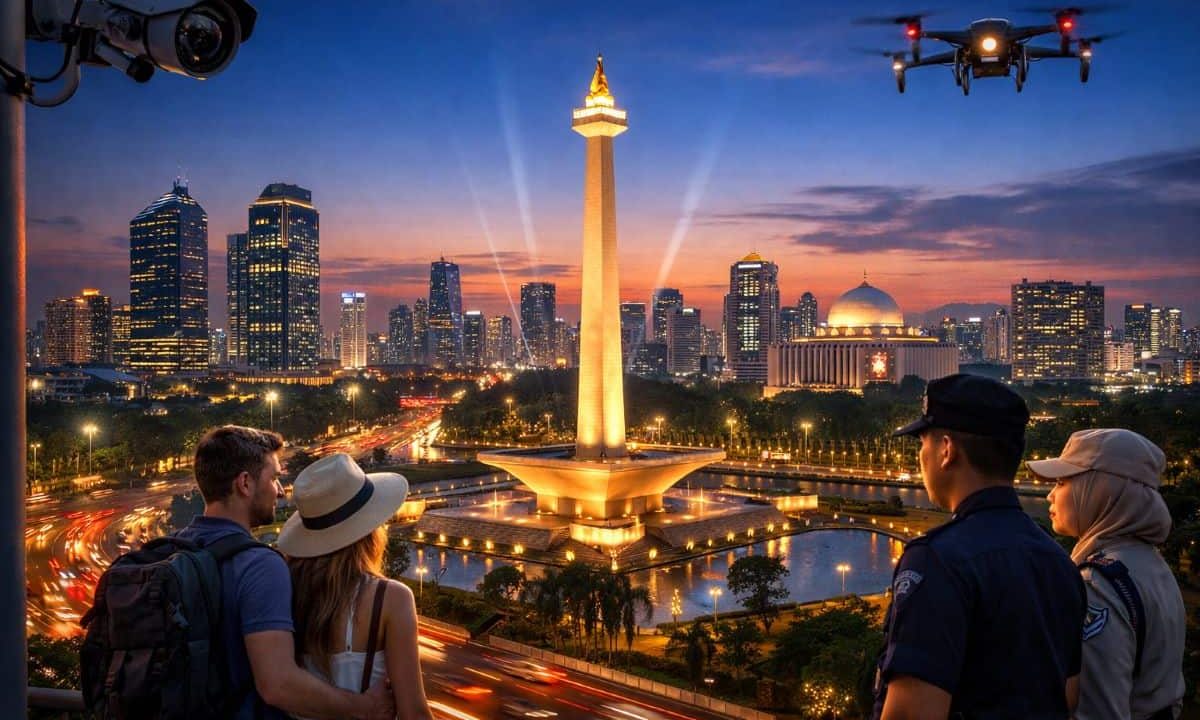
Jakarta has just earned a ranking that would have surprised many travelers even a few years ago: second safest city in Southeast Asia, according to the Global Residence Index released in January 2026. With a safety score of 0.72, Indonesia’s sprawling capital sits just behind Singapore — long considered the region’s gold standard for urban order — which holds a score of 0.90. For a megacity that once carried a reputation for congestion and unpredictability, that placement carries real weight.
The result isn’t just a feel-good statistic for local officials. It signals something larger: a measurable shift in how international travelers can think about visiting Jakarta. Safety perception is one of the most powerful invisible forces in tourism, and when a credible index moves a city this dramatically up the rankings, booking behavior tends to follow.
For millions of travelers weighing Southeast Asia as their next destination, this changes the conversation about where Jakarta fits on the map — not as a transit stop or an afterthought, but as a genuine destination worth choosing.
(function(){var wrp=document.getElementById(“paap_stat_69dec4ddda83e7.50671171”);if(!wrp)return;var ids=[“paap_stat_69dec4ddda83e7.50671171_c0″,”paap_stat_69dec4ddda83e7.50671171_c1”];var dur=1800;function ease(t){return 1-Math.pow(1-t,3);}function anim(){ids.forEach(function(id){var el=document.getElementById(id);if(!el)return;var tgt=parseFloat(el.getAttribute(“data-target”))||0;var pfx=el.getAttribute(“data-prefix”)||””;var sfx=el.getAttribute(“data-suffix”)||””;var dec=parseInt(el.getAttribute(“data-decimals”))||0;var st=null;function step(ts){if(!st)st=ts;var p=Math.min((ts-st)/dur,1);var v=ease(p)*tgt;el.textContent=pfx+v.toFixed(dec)+sfx;if(p<1)requestAnimationFrame(step);}requestAnimationFrame(step);});}if("IntersectionObserver" in window){var obs=new IntersectionObserver(function(e){e.forEach(function(en){if(en.isIntersecting){anim();obs.disconnect();}});},{threshold:0.2});obs.observe(wrp);}else{anim();}})();
What the Global Residence Index Actually Measures
The Global Residence Index compiles safety data across cities worldwide, producing a composite score that reflects how secure a city is for residents and visitors alike. A score of 0.72 out of a possible 1.0 puts Jakarta firmly in the upper tier — not just for Southeast Asia, but by any international standard.
Singapore’s 0.90 is exceptional by global measures, so the gap between the two cities is real. But the more striking fact is how far Jakarta sits ahead of the rest of the regional field. Cities like Bangkok, Kuala Lumpur, Manila, and Ho Chi Minh City — all major tourism hubs — are not in the top two. That gap matters when travelers are deciding where to go and how confident they feel once they arrive.
The index was released on January 16, 2026, giving tourism planners, travel agencies, and individual visitors a fresh data point to factor into their decisions heading into the year’s main travel seasons.
Jakarta’s Safety Rankings at a Glance
| City | Country | Safety Score (Global Residence Index, Jan 2026) | Regional Rank |
|---|---|---|---|
| Singapore | Singapore | 0.90 | 1st |
| Jakarta | Indonesia | 0.72 | 2nd |
(function(){function loadChartJs(cb){if(window.Chart){cb();return;}var s=document.createElement(“script”);s.src=”https://cdn.jsdelivr.net/npm/chart.js@4.4.0/dist/chart.umd.min.js”;s.onload=cb;document.head.appendChild(s);}function initChart(){var cv=document.getElementById(“paap_chart_69dec4ddda8fc1.51462114”);if(!cv)return;var dv=[“0.90″,”0.72″];new Chart(cv,{type:”bar”,data:{labels:[“Singapore”,”Jakarta”],datasets:[{data:[0.9,0.72],backgroundColor:[“#3b82f6″,”#10b981″],borderRadius:6,borderSkipped:false}]},options:{indexAxis:”y”,responsive:true,maintainAspectRatio:false,animation:{duration:1200,easing:”easeOutQuart”},plugins:{legend:{display:false},tooltip:{callbacks:{label:function(ctx){return dv[ctx.dataIndex]||ctx.formattedValue;}}}},scales:{x:{grid:{color:”#e5e7eb”},ticks:{color:”#6b7280″}},y:{grid:{display:false},ticks:{color:”#1a1a1a”,font:{weight:600}}}}}});}var cv=document.getElementById(“paap_chart_69dec4ddda8fc1.51462114”);if(!cv)return;if(“IntersectionObserver” in window){var obs=new IntersectionObserver(function(e){e.forEach(function(en){if(en.isIntersecting){loadChartJs(initChart);obs.disconnect();}});},{threshold:0.1});obs.observe(cv);}else{loadChartJs(initChart);}})();
Why This Matters More Than a Single Index Score
Rankings like this one don’t exist in a vacuum. Travel confidence is built — or destroyed — by accumulated signals, and a high-profile safety index is one of the strongest signals the industry watches. When a city climbs in credibility on safety, tour operators adjust their packages, airlines rethink their routes, and travel insurers recalibrate their risk assessments.
For Indonesia specifically, the timing is significant. The country has been actively working to broaden its international tourism appeal beyond the obvious draw of Bali. Jakarta, as the capital and economic center, has always had the infrastructure and cultural richness to compete — but safety perception was a persistent obstacle. This ranking directly addresses that obstacle with hard data.
Observers note that megacities are often unfairly painted with a single brush — assumed to be chaotic simply because of their size. Jakarta’s placement challenges that assumption directly. A city of more than ten million people achieving a safety score of 0.72 suggests that scale alone doesn’t determine urban safety outcomes.
What This Means for Travelers Considering Jakarta
If you’ve been curious about Jakarta but hesitant, this is the kind of data point that should meaningfully shift your thinking. The city offers a density of cultural experiences — historic neighborhoods, world-class dining, vibrant arts scenes — that few Southeast Asian capitals can match. The safety ranking now adds a layer of confidence that was harder to quantify before.
For travelers already planning a Southeast Asia itinerary, Jakarta deserves consideration as more than a layover city. Its infrastructure supports international visitors, and a safety score that places it above the vast majority of regional competitors is a concrete reason to extend a trip or plan a dedicated visit.
Business travelers, who have long been Jakarta’s most consistent international visitors, now have clearer data to share with risk-averse employers and travel managers who need documented justification for destination approvals.
- Often perceived as chaotic and difficult to navigate safely due to its massive size and population density.
- Frequently overlooked by leisure travelers in favor of Bali or other Indonesian destinations with clearer safety reputations.
- Lacked a strong, data-backed safety credential to present to cautious international visitors or corporate travel managers.
- Confirmed as the second safest city in Southeast Asia with a verified safety score of 0.72 out of 1.0.
- Positioned as a compelling destination where tourism, culture, and urban order genuinely converge for international visitors.
- Equipped with a credible global index ranking that gives travel planners and individual visitors a concrete confidence benchmark.
What Comes Next for Jakarta’s Tourism Trajectory
The Global Residence Index score released in January 2026 sets a benchmark that Jakarta’s tourism authorities will almost certainly build their marketing around for the rest of the year. Safety rankings tend to have compounding effects — they attract media attention, generate social proof, and gradually shift the instinctive associations travelers make with a city’s name.

The broader question is whether Jakarta can convert this credibility boost into sustained visitor growth. The infrastructure is in place. The cultural attractions are real. Now the city has a third pillar — documented safety standing — that it lacked in previous tourism cycles.
Whether this translates into measurable increases in international arrivals will become clearer as 2026 progresses. But the foundation has been set, and the data is on Jakarta’s side in a way it has never been before.
Frequently Asked Questions
What safety score did Jakarta receive in the Global Residence Index?
Jakarta received a safety score of 0.72, placing it second in Southeast Asia according to the index released on January 16, 2026.
Which city ranked first in Southeast Asia for safety?
Singapore ranked first with a safety score of 0.90, the highest in the region.
When was the Global Residence Index ranking released?
The ranking was released on January 16, 2026.
Does this ranking cover the whole of Indonesia or just Jakarta?
Based on the available data, the ranking specifically applies to Jakarta as a city, not to Indonesia as a whole.
How does Jakarta’s score compare to other Southeast Asian cities?
Jakarta’s score of 0.72 places it second in the region, directly behind Singapore — though specific scores for other regional cities were not included in the confirmed data.
Should this ranking change how travelers plan trips to Jakarta?
The ranking provides a credible, data-backed reason to reconsider Jakarta as a primary destination rather than a transit point, particularly for travelers who previously had safety concerns.


Leave a Reply